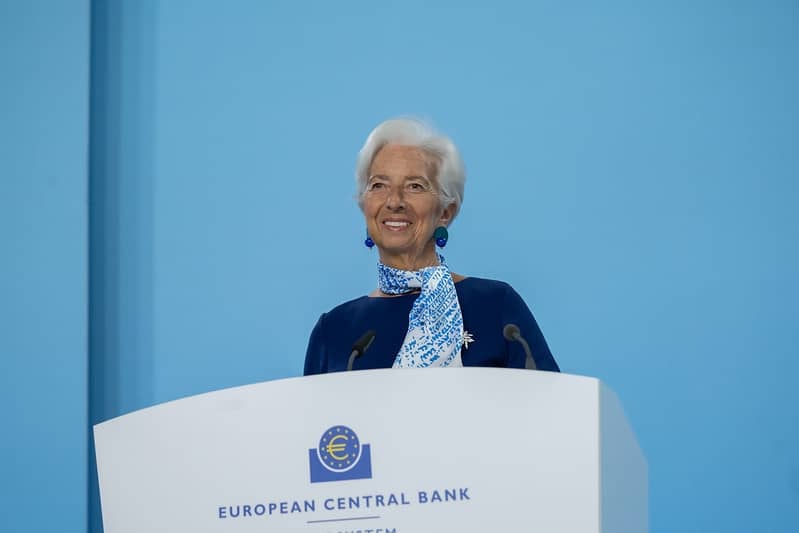
President Christine Lagarde presents the latest monetary policy decisions and answer questions from journalists, Frankfurt, 24 July 2025. Source: ECB.
The Euro could soften in the short term.
The European Central Bank (ECB) held interest rates steady at its July policy meeting, snapping an unbroken run of seven consecutive 25 basis point cuts.
The halt in the cutting cycle has been anticipated for some time and has been one factor that has underpinned the Euro's steady advance against the Dollar and Pound over recent weeks.
Currency markets are highly responsive to interest rate market developments, and the Euro is being helped by signs that point to the ECB ending its cutting cycle ahead of the Federal Reserve and Bank of England.
However, that the Euro has not jumped on Thursday's decision should come as no surprise:
"The euro has barely reacted to today’s ECB policy announcement as the pause in interest rate cuts was heavily signposted in advance, and there was little else new to digest in the accompanying statement. Markets tend to only move when the unexpected happens, but this was as locked in as it gets," says Richard Potts, Economist at Bondford.

We'll WhatsApp You An Exchange Rate Quote
The best exchange rates with one-on-one support and FX market intelligence.
With the ECB being of little assistance to Euro 'bulls', the Euro risks being left listless and vulnerable to a correction in an environment where a heavily sold Dollar and Pound would look to reclaim recent losses.
The Pound is holding GBP/EUR above 1.15 and looks set to consolidate, with an eye to potentially bouncing, while EUR/USD's latest upmove is starting to look toppy near 1.18.
"EUR/USD remains overbought and our tactical preference remains bearish," says Francesco Pesole, FX Strategist at ING Bank.
Analysts at Berenberg Bank meanwhile holds a bearish short- and medium-term outlook for EUR/USD, targeting 1.1580 in the short term and 1.1500 in the medium term, despite maintaining a longer-term objective target of 1.2000.
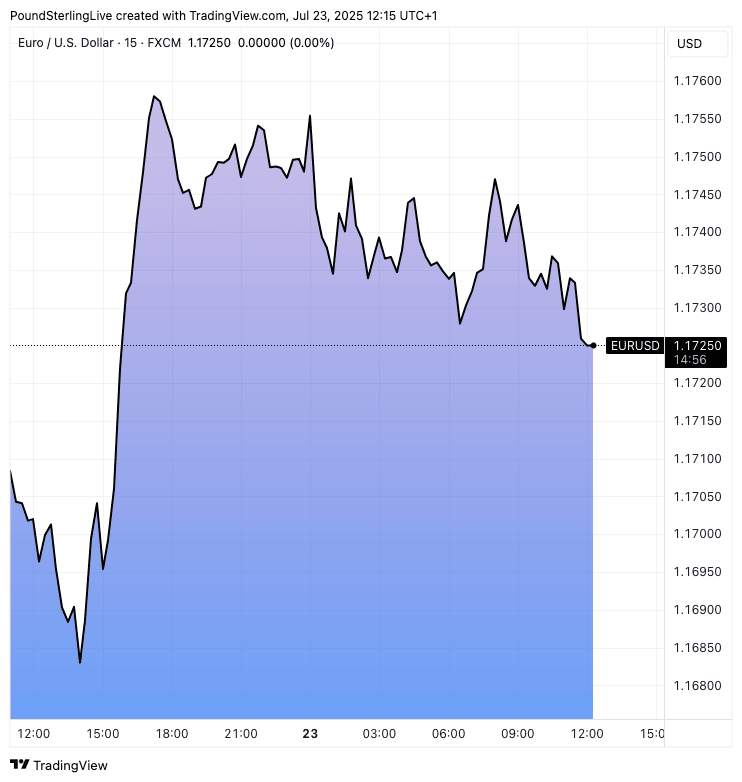
Above: EUR/USD has pared recent gains.
The Euro has risen 13.50% in 2025, which has raised eyebrows on the ECB's Governing Council and encouraged speculation that 1.20 would represent a line in the sand for the central bank, prompting it to adjust policy with a view to stifling the advance.
The concern is that the rapidly strengthening euro makes Eurozone exports pricier on international markets, potentially slowing a grinding recovery that is underway in the bloc's battered manufacturing sector.
The talk would likely influence market behaviour in the run up to 1.20 and we would not be surprised to see increased profit taking and speculative activity that weighs on the currency start to dent rallies.
"Whilst not an explicit goal of the ECB, a subsequent weakening of the euro amid a fresh programme of rate cuts might be somewhat desirable giving recent grumblings from policymakers and industry across the bloc. The euro hasn’t been this strong in nearly four years, and exporters had gotten used to the benefits a weaker currency confers onto their order books," says Potts.
Despite increased talk of a potential pullback in the Euro increasing, the strength and robust nature of the Euro's rally cannot be ignored and betting against a trend can prove costly.
While we think the odds of a short-term turnaround in the Euro are building, we must also respect that key technical indicators remain constructive, suggesting that, for now, pullbacks are likely to be short and shallow.