The GBP to EUR conversion is once again deep in the red again confirming that the relief rally seen on Monday was not the start of a more sustained recovery.

Those with an eye on the pound v euro pair should be wary that the UK currency remains overwhelmingly bearish.
Sterling remains in position of notable weakness having broken through a number of long-standing support levels over previous weeks; levels that in the past would have attracted enough buying interest to halt any further declines.
2016 is different it seems and there is actually little positive to say with regards to the GBP/EUR in fact.
We speculated that the 1.35 support zone would prove durable and allow sterling to recover; this proved wrong and traders hardly hesitated before selling the UK currency below here.
The support zone between 1.3350 and 1.34 was then surely expected to hold the British pound - this level has not been broken on a weekly chart at any stage in 2015:
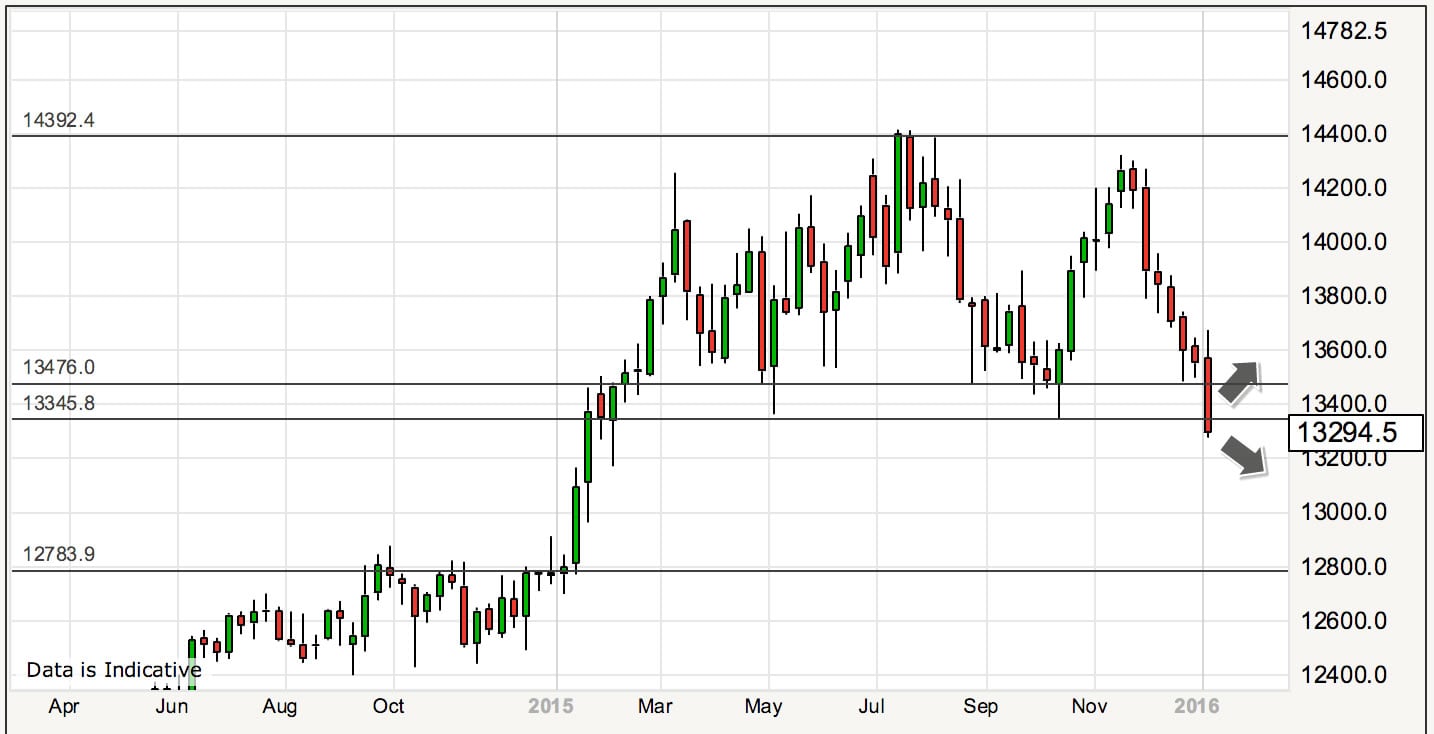
What the chart above represents is a big problem for those watching the market and waiting for a better pound to euro exchange rate.
Sterling has been in decline for 6 weeks in a row - momentum clearly favours the euro and we see no technical signal to suggest that sterling is forming a bottom.
From a technical perspective we need to see the GBP to EUR conversion close this week at a higher level than it opened at. This will suggest the formation of a potential floor is taking place.
Only then would we even start to consider the run lower has come to an end.
Latest Pound/Euro Exchange Rates
  | Live: 1.1888▲ + 0.19%12 Month Best:1.1913 |
*Your Bank's Retail Rate
| 1.1484 - 1.1531 |
**Independent Specialist | 1.1722 - 1.1769 Find out why this is a better rate |
* Bank rates according to latest IMTI data.
** RationalFX dealing desk quotation.
The charts also tell us that there is little in the way of support lying between 1.3350 and 1.27, as such we would have to favour 1.27 as the first medium-term target which, at the present rate of decline, could be reached by the end of March.
The declines will represent a major headache for the majority of institutional researchers we follow.
Our polling data confirms that the average forecast for GBP/EUR is at 1.4424 for March 2016. We could well see analysts shift their tone towards sterling over coming weeks.
The FTSE 100 Matters for Sterling-Euro
We believe one of the key drivers of the latest decline in the exchange rate is the risk-off environment concerning global financial markets.
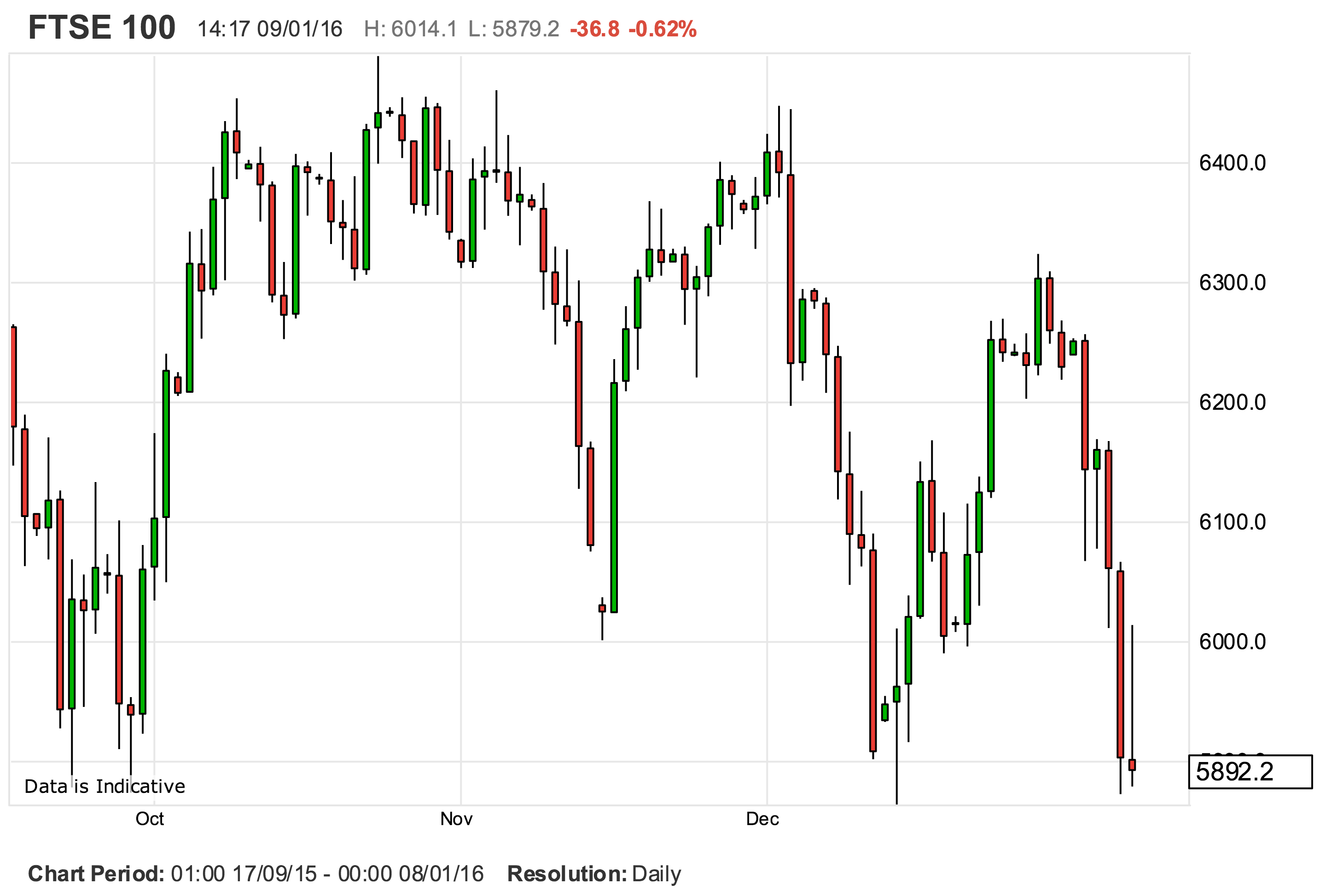
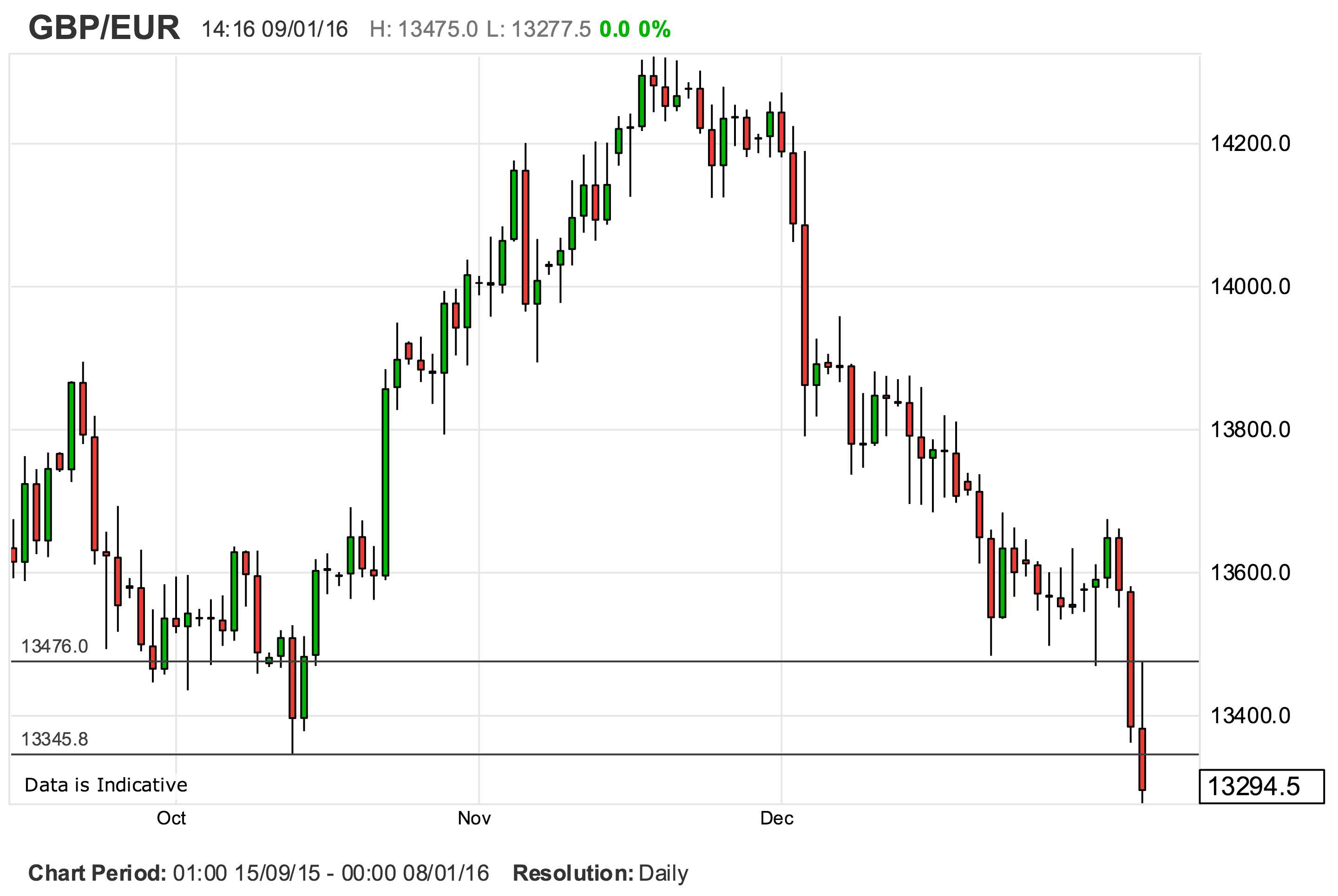
The GBP/EUR turned lower at the start of December - exactly when the FTSE 100 turned lower. The FTSE 100 is at its lowest levels since mid-December. The level also corresponds with previous September lows. Can the UK’s leading index make a comeback.
As far as we are concerned this will be ultimate decider of upcoming direction in sterling euro.
Look at the following charts, the first being the FTSE 100 and the second being the pound/euro rate:
What matters the most for the FTSE 100 and global markets at the present time? China and commodity prices are certainly a major driver of the index at present.
The downturn in global financial markets follow a fresh bout of concern over China’s transition into a more mature, services-orientated economy.
Much of the recent panic also has its roots in the inability of Chinese authorities to deal with the transition.
“The latest upsets cannot be explained by weak fundamentals (such as this week's PMI indices). An economic slowdown in China had been expected for quite some time, and the reasons are well known. Instead, market turbulences can be traced back to growing doubts that the Chinese leadership can continue to successfully manage the economy and the markets,” says Bernd Weidensteiner, economist with Commerzbank.
There are however signs that sentiment is changing, and the FTSE 100 sell-off (and therefore the sterling-euro selloff) may be coming to an end.
Update: FTSE 100 and GBPEUR Decouple
The FTSE 100 surged up by close on 2% in a notable relief rally on Tuesday the 12th - our observations would suggest that the British pound should be higher.
However, it is not, which could suggest the linkage has been broken. It also suggests that a popular theme on global markets at the present time is 'sell sterling at all costs.'
We relationship between the UK stock market and the GBPEUR was never a clear-cut one and we therefore will allow ourselves some slack on this.
We will judge this model's accuracy at the end of the week - who knows perhaps the GBP/EUR lags the FTSE 100?
Bank of England Could Trigger Further GBP Weakness
One driver that could seriously test the British currency this week is the Bank of England who hold a their monthly policy meeting on Thursday and will release the associated minutes shortly after.
"While the Bank is widely expected to leave policy settings unchanged and the minutes should again note uncertainty amid muted underlying inflation pressure, markets will search the minutes for any reaction to recent commodity price declines, financial market volatility and sterling weakness," say Barclays in a note to clients.
According to Barclays, market attention will focus on the degree to which these recent developments alter the MPC’s outlook and whether it may be enough for Ian McCafferty, the only MPC member voting for a 25bp hike, to change his vote to no change – as he did in January 2015 following the December 2014 oil price decline.
"While it is likely too early for this to occur, and we expect another 8:1 vote, the risk remains and would likely provide further impetus for GBP weakness in the context of UK-specific 2016 downside risks including aggressive fiscal tightening and the impending EU referendum," say Barclays.