Image: Dave Collier, sourced: Flickr, licensing: CC 2.0.
Britain's unemployment rate fell to 4.9% in February said the ONS on Tuesday, which was well below consensus expectations for it to remain at 5.2%.
That figure also undershot the Bank of England's internal forecast for unemployment to be at 5.1%.
Despite the headline unemployment rate falling, more timely HMRC data on full-time employment was at -11k in March, while February's figure was revised from +20k to -6k.
So how do we square signs of falling unemployment AND signs of rising unemployment?
One answer could be that fewer people are actively looking for jobs: labour force participation was down 71k in the three months to February 2026. If fewer people are looking for work, your unemployment rate falls, all else equal.
"As ever with this knotty dataset, nuances and balancing factors seem to creep in," says a reaction note from Lloyds Bank.
"Underneath the hood, and beyond the headline unemployment rate, signs of weakness continue," says Sanjay Raja, UK economist at Deutsche Bank.
Raja cites the fall in HMRC payrolls, but also points to a 136k increase in redundancies in the three months to February.
Elsewhere, the number of job vacancies fell 10k to 711k, the lowest level since April 2021.
The claimant count - those signing on for out-of-work benefits - rose from 4.3% to 4.4% in March.
"Moreover, survey data also point to renewed weakness in the labour market with firms cutting back on hiring plans in the wake of the unfolding energy shock," says Raja.
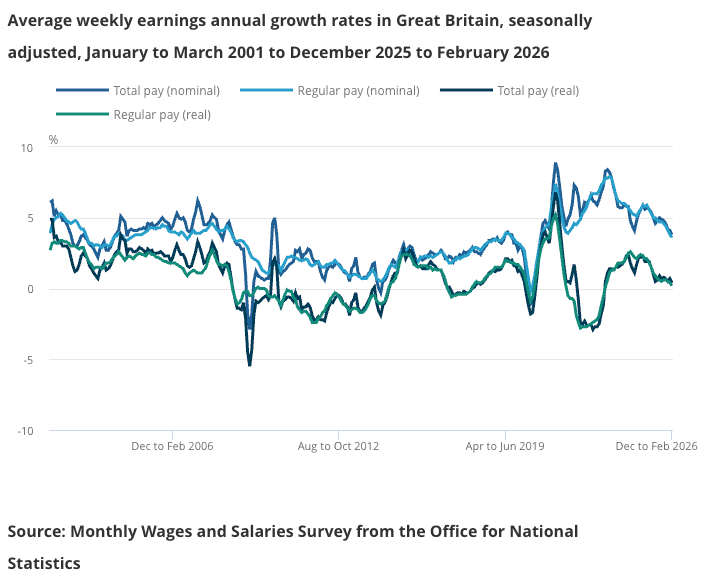
Wages also beat expectations, coming in at 3.8% versus the consensus estimate for 3.6%, even though this represents another cooling from 3.9%.
Average earnings excluding bonuses read at 3.6%, which was stronger than the 3.5% expected, albeit lower than 3.8% in the previous month.
"The BoE will take some comfort from pay growth looking less inflationary than it expected but be a little more concerned that the unemployment rate indicates tighter conditions than anticipated. But in reality, with most of the data in this report being pre-energy shock, its relevance for forthcoming policy decisions has somewhat faded," says Lloyds.
"Big picture, we do not think today’s data will alter the BoE’s image of the labour market. Despite a much better unemployment reading, underlying weakness persists. There is still slack in the labour market. And the unfolding energy shock will also revive fears of higher unemployment in the near-term – as signalled by the HMRC payroll data. The UK labour market is not out of the woods yet," says Deutsche Bank's Raja.