
Image © Adobe Images
A leading UK high street name warns about UK inflation holding above 3.0% well into next year.
UK inflation is rising into the "ugly zone", warn economists at UK high street lender, Santander.
In an economic research briefing just 24 hours ahead of the UK's monthly inflation release, Victoria Clarke, UK Chief Economist at Santander, says "our forecast envisages CPI moving firmly into the ugly zone of double the BoE’s 2.0% target in September."
The inflation print is expected to confirm the UK's inflation rates are well above those of comparable economies, presenting unique challenges to the Bank of England, which must keep interest rates high enough to lower inflation while ensuring those elevated rates do not harm the economy.
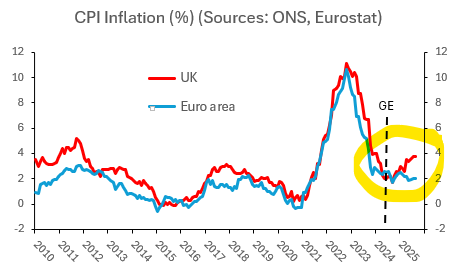
Above: The UK's inflation trends have diverged from comparable economies. Image courtesy of Julian Jessop.
Santander says the main driver for the outcome will be a 27bp upward contribution from transport, topped up by a 4bp boost to the 12-month CPI rate from furniture and household goods, with no material offsetting influences elsewhere.
It is that lack of offsetting contributions that is perhaps the more alarming element of the research, as it suggests a broad-based and stubborn inflation profile, one that will be hard to knock.
"The absence of clear disinflationary forces across the rest of the basket is concerning. So too is the risk that double-target inflation, whatever the cause, risks pushing inflation and wage expectations higher again," says Clarke.
Santander's forecast sees inflation holding above 3% all the way to next summer.
Theoretically, this will limit the Bank of England's ability to lower interest rates, however, fears of rising unemployment might yet see the next cut delivered as soon as December.
Economists say the government's decision to raise national insurance taxes on employers in April has been a key driver of elevated inflation, as businesses pass the cost onto consumers via higher prices.
The government also mandated above-inflation minimum wage increases, while raising pension payments at above-inflation rates.
Indeed, social security spending is proving to be one of the UK's major growth engines. This is inherently inflationary as it drives demand but does not address supply-side constraints.