Image © Adobe Stock
Inflation will fall notably next year, allowing a forward-looking Bank to cut rates again.
Markets headed into this week thinking the Bank of England could still sneak in another interest rate cut before the year is out, even if the August 07 policy meeting caused reason to be more cautious.
However, this week's above-consensus inflation print appears to have convinced the market that November is now off, with the odds of such a cut now less than 50/50.
However, some economists have looked at the data in detail and calibrated it against the Bank of England's guidance, and reckon a cut is still likely in November.
Morgan Stanley says the Bank of England will look through the July spike in prices, noting that strong air fares helped the surprise above-consensus outcome of 3.8% year-on-year in headline CPI.
Indeed, the outcome is still in line with the Bank's August forecasts. Even strong food price inflation - 4.9% y/y - was in line with expectations. Services CPI, which the Bank pays close attention to rose to 5.0% from 4.7% y/y.
"To us, the marginal news today is that the June inflexion in underlying services inflation was halted. For the BoE, we think, there is not much in here to change existing priors. We look for the next cut in November," says Bruna Skarica, an economist at Morgan Stanley.
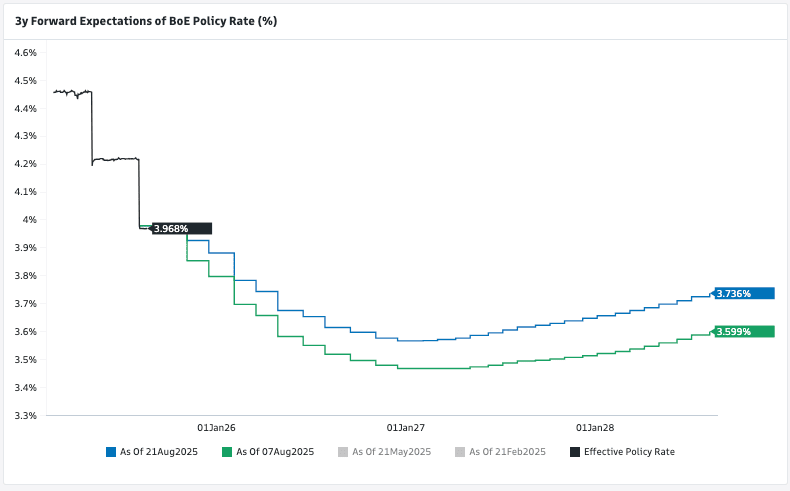
Above: Market-implied expectations show investors see less cuts ahead.
Oxford Economics is also not willing to shift its stance on the UK outlook based on Wednesday's inflation figures, saying the above-consensus reading was the result of seasonal factors that should soon fade.
Oxford Economics forecasts inflation to average 3.5% this year and 2.8% in 2026. "There was little in the way of genuine news that shifted the monetary policy debate in either a more hawkish or dovish direction," says Andrew Goodwin, Chief UK Economist at Oxford Economics.
"We continue to think that several more Bank Rate cuts are likely over the next 18 months. However, there's now considerable uncertainty around the timing of those moves, and a scenario in which the MPC slowly feels its way to a neutral level over a long time horizon is becoming more compelling," adds Goodwin.
Economists at UniCredit are particularly 'dovish' on the outlook for UK interest rates, still expecting two rates cuts over the rest of this year and 75bp of cuts next year, more than financial markets expect.
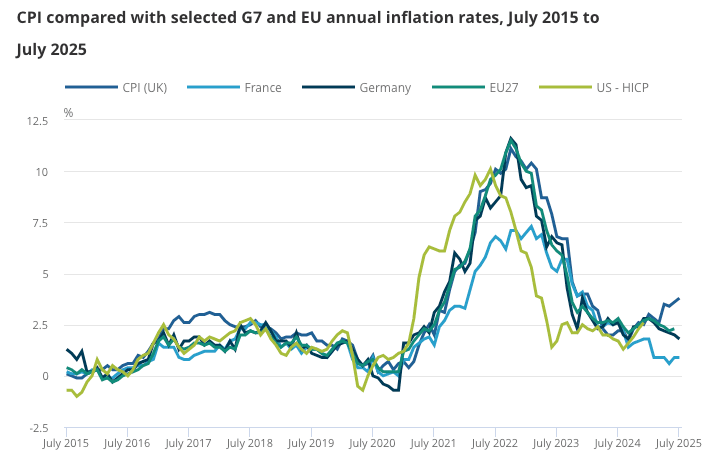
Above: UK inflation is trending higher, whereas it's closing in on target in other countries.
Daniel Vernazza, Chief International Economist at UniCredit in London, acknowledges that the 2025 cuts might be skipped, but this is merely a delay and not a reduction in the total to come.
From a financial markets standpoint, this is an important call, as it implies cuts will be backloaded, hinting at notable GBP downside to come.
"We see the bank rate ending next year at 2.75%, which we see as broadly neutral. At the time of writing, financial markets are pricing only a 70% probability of 25bp cut in the remainder of this year, and only 40bp of cuts by the end of next year, to 3.6%," says Vernazza.
HSBC economists expect the Bank to cut rates to 3.0% by Q3 2026, implying four more cuts spread over that period.
According to HSBC's FX Strategist, Nick Andrews, this should weaken GBP versus the EUR. "Given the impact of government policies on growth and inflation over the last year, we also think the Autumn Budget poses a risk to GBP over the coming months."
However, not all economists are convinced and are inclined to err on the side of the market in expecting limited scope for further rate cuts, based on the observation that the economy isn't exactly crying out for support.
"We still expect the MPC to remain on hold for the rest of 2025, which is slightly tighter policy than the current market pricing of 0.5 cuts by December," says Robert Wood, Chief UK Economist at Pantheon Macroeconomics.
"Major data in the UK have increasingly outperformed over the course of the year," he explains.