The Pound has enjoyed gains against the Canadian Dollar over recent days, but we do not believe they will last.
The Pound has outperform the Canadian dollar over the week gone by, despite the latter’s list of apparent fundamental advantages.
The GBP/CAD conversion is quoted at 1.6827 at the time of writing, off the weeks low at 1.6607.
Yet, when we look at the weekly charts we will note that this week's GBP/CAD advance is a mere shadow of the previous week's drop:
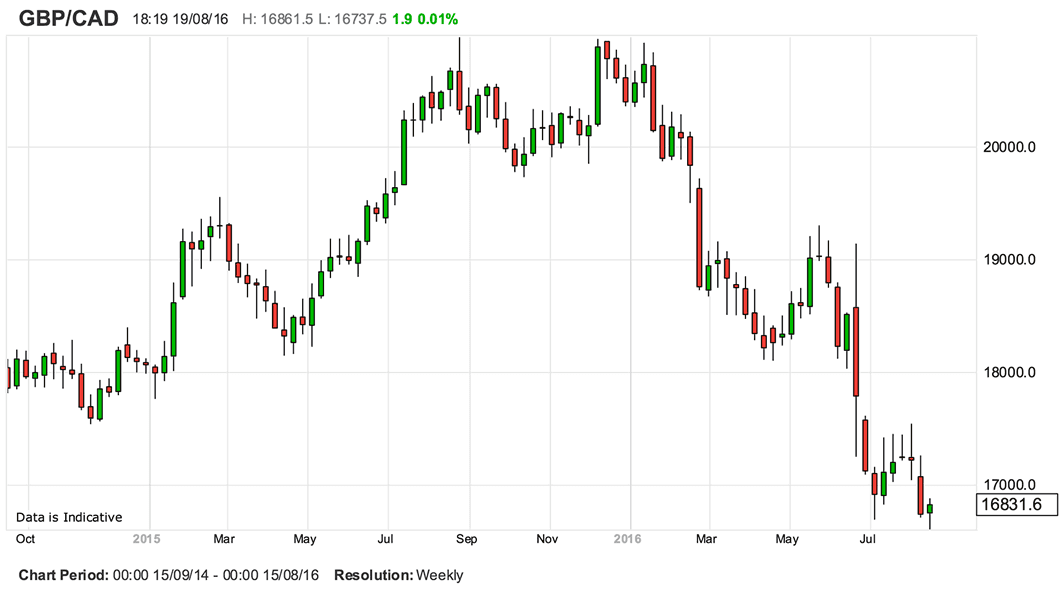
Therefore, on momentum alone, we would suggest CAD retains the advantage amidst no sign of a base forming.
From a technical perspective, studies of the daily chart suggests there is the possibility the pair may be completing an Elliot Wave lower.
An Elliot Wave formation consists of five component waves, and we note wave five must complete. This completion would give us a target of 1.65 to aim for:
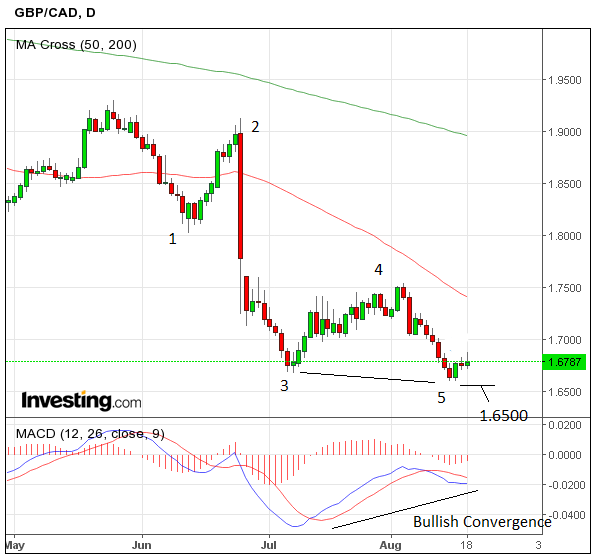
The MACD and price are converging bullishly at the most recent trough low on August 16 indicating the potential for a bounce (which has already partly occurred).
Despite this the down-trend remains intact, so a move below the August 16 lows at 1.6600 would probably lead to a move down 1.6500 close to where historic support is situated.
Latest Pound / Canadian Dollar Exchange Rates
  | Live: 1.8738▲ + 0.04%12 Month Best:1.9044 |
*Your Bank's Retail Rate
| 1.8101 - 1.8176 |
**Independent Specialist | 1.8476 - 1.8551 Find out why this is a better rate |
* Bank rates according to latest IMTI data.
** RationalFX dealing desk quotation.
Fundamentals Suggest a Stronger CAD Going Forward
With oil prices on the up, we would expect the Canadian Dollar to find support over coming days and weeks.
A surge in crude oil prices comes as traders bet on OPEC announcing a supply freeze at their next meeting.
Brent Crude poked above $50 a barrel again and WTI rose to the 48’s after the commodity had pulled back to the lower 40’s in previous weeks.
Other data showed Canada still enjoying a surplus in foreign portfolio flows but that surplus narrowing more than forecast, after inflows from foreign investors seeking Canadian bonds - which had increased due to the negative yield climate in most of the normal sources of supply - fell back to 9bn in June from 13bn in May.
Outflows, or purchases by Canadian investors of foreign assets, meanwhile, remained around the same level of 4bn, resulting in a reduction in the balance from 9bn to 5bn (9-4).
The recent large, circa 10bn, monthly surplus in foreign portfolio flows was considered a factor supporting the loonie, since at those levels, it would more than eclipse the trade and current account deficits, resulting in net positive demand for CAD.
The fall to the 5bn result in June, if replicated across a quarter would also still cancel out the current account deficit of circa 15bn, too, but with no or little net surplus.
The pound side of the pair was strengthened following the release much better-than-expected retail sales data for July, which showed shoppers increasing their retail activity regardless of the recent vote to leave the EU.
The data was one of the few hard data points for July, the month after Brexit, and was thought to reflect a immediate slow-down, however, in the end the opposite was true with retail sales actually rising in July.
The higher figures were not necessarily a surprise to many analysts as similar data from the British Retail Consortium (BRC) out earlier in the month had shown a surprising surge in purchases in July as well, as a result of the hot weather encouraging barbeque, food, drink and fashion buying, and a lack of “material” impact on household finances of Brexit so soon after the referendum.
It’s possible, however, the data for the months ahead may show a retraction in retail sales as the strong pound and possible economic slowdown from Brexit impact reduce real household income.