We bring the latest forecasts for the Canadian dollar against the euro, US dollar and British pound after what has been a time of high volatility for global FX.

GBP to CAD Outlook
The pound to Canadian dollar has fallen sharply following Brexit and is forecast to maintain a negative tone.
Over recent days we saw a laboured recovery back up to a major support and resistance line at 1.7540 (the 2014 lows).
It will probably rotate at this level and resume moving lower, in line with the dominant medium and short-term down-trend.
Indeed, a speech delivered by Bank of England Governor, and ex-Bank of Canada Governor for that matter, on Thursday afternoon in London undermined the British pound with the promise of monetary stimulus being introduced by as early as August.
The pair has fallen to the current 1.7190.
A break below the 1.7140 lows would signal more downside, to an initial target at 1.7000.
The 1.75s are an important level and any breaks below would indicate a much more bearish overall chart picture.
Scotiabank’s FX Strategist Shaun Osborne is very bearish the pair:
“Technically, we think the loss of support at 1.81 (long-term retracement support) paved the way for the drop to 1.75 that has already been seen and suggests strongly that downside risks to the 1.65/1.66 area remain.
"Short, medium and long-term trend momentum studies remain bearishly aligned and suggest ongoing downside risks for the GBP. We are bearish and expect extended GBP weakness in the weeks ahead."
Latest Pound / Canadian Dollar Exchange Rates
  | Live: 1.8743▲ + 0.07%12 Month Best:1.9044 |
*Your Bank's Retail Rate
| 1.8106 - 1.8181 |
**Independent Specialist | 1.8481 - 1.8556 Find out why this is a better rate |
* Bank rates according to latest IMTI data.
** RationalFX dealing desk quotation.
USD to CAD Outlook
The US to Canadian dollar pair rose mid-week following an upward revision in US growth figures and better-than expected Personal Spending.
However, USD/CAD failed to hold above the stubbornly defended 1.31 level, leaving analysts still too cautious to call a bullish reversal in the pair yet.
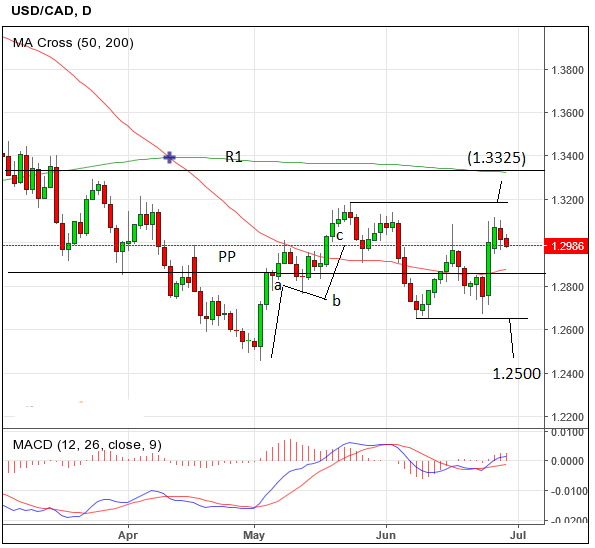
From a technical point of view USD/CAD is in a medium term broad sell-off within which it has paused, corrected and is now moving sideways.
As far as we are concerned, until the high of the ‘ABC’ correction (see chart below) at 1.3188 has been broken the pair is still structurally prone to more downside.
A break below 1.2654, in fact, would help confirm the dominant down-trend was likely resuming, with an expected extension down to 1.2500 initially, before probably reaching the 1.2460 lows as a bare minimum.
Assuming, however, that the high of the ABC correction at 1.3188 is surpassed, I would expect the up-trend to extend to 1.3325 where the 200-day MA is situated.
Scotiabank's FX Strategist, Shaun Osborne is leaning bullishly, arguing the pair has a bias to the upside and dips to 1.29 will be used as buying opportunities:
“The break above daily trend resistance has stalled but retains positive potential for the USD. We remain bullish and look for the USD to remain well-supported on weakness to the mid/upper 1.29 area for now.
He is not the only one, Blackwell Market’s Mathew Ashley is also bullish:
“The technicals are now suggesting that the recent bullishness of the pair could be extended even in the absence of another major Brexit-related upset.” He comments of USD/CAD.
For Ashley, the 100-day Exponential Moving Average (EMA) which had been providing ‘dynamic resistance’ to further gains (ie obstructing them), is looking like it will probably give way, allowing the pair to “soar” higher.
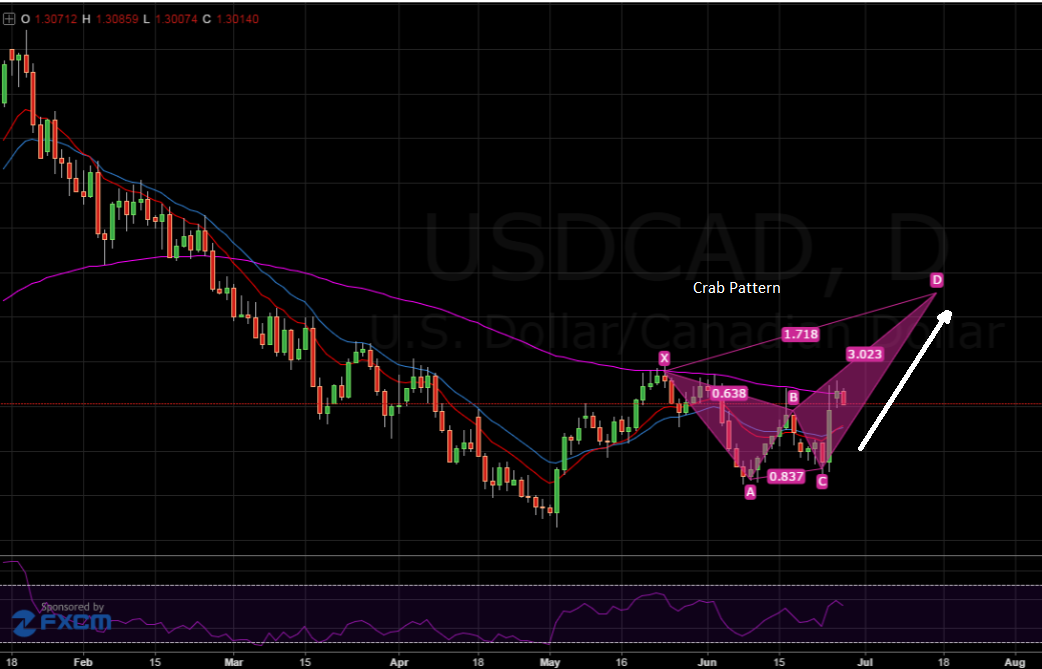
He also highlights an 'exotic' “crab pattern” (see chart below) as further indicating an extension higher:
“Additionally, the recent rally could be the beginning of the final leg in a Bearish Crab pattern which might also see the pair surge higher. As shown on the daily chart, the pattern has been forming for a number of weeks but the fallout from Brexit has gotten the final leg off to a flying start.”
CIBC’s Jeremy Stretch, is more bearish, arguing that the pair’s failure to break and close above the 100-day MA and the 1.31 level on three consecutive attempts does not bode well for bulls:
“Yet again we have seen USD/CAD fail to close above the 100-day MAV at 1.3069. Indeed in the light of three failures around the 1.31 area in the past three sessions it appears investors remain reluctant to chase the topside without fresh information to carry it there.”
EUR/CAD Forecast - Sliding Lower, but is a Comeback on the Horizon?
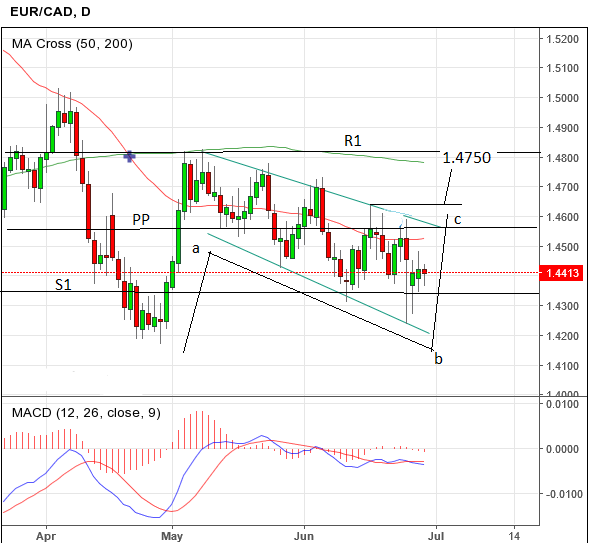
The euro to Canadian dollar pair is currently falling within a broadly sideways range.
After moving strongly higher at the start of May it has undergone a steady step decline to its current level in the 1.44s.
This decline looks overdone, however, and I would expect the next move in the pair to be another bullish leg higher – mirroring to some extent the May rally, and completing a common 3-wave market pattern.
A break above the 1.4639 16 June highs would probably lead to a continuation higher to the next target at 1.4750.
Scotia’s Osborne is more bearish, arguing the pair is in a more protracted decline which looks like continuing:
“But gains are mild and do little to alter the longer -term, bear trend dynamic that is slowly gaining momentum.“
Bullish moves are likely to be capped:
“This will keep counter -trend corrections capped around the 1.4550 (short-term trend resistance)/1.4600 (longer-term trend resistance) zone, we expect.”
Osborne thinks the outlook currently favours more consolidation and only a sustained move above 1.46 would lend charts a more bullish bias.
Canadian Economic Data Positive
As far as economic indicators go Canadian fundamentals are broadly improving, with GDP rising by 2.4% yoy in Q1, and unemployment unexpectedly falling from 7.1% to 6.9% in May.
Inflation remains a sticking point, however, after it retracted to 1.5% in May.
US data is also strong following the recent upwards revision to final result for first quarter GDP, of 1.1%, which although lacklustre is better-than initially estimated.
The US dollar, however, has gained a fresh bid from safe-haven flows in the wake of Brexit. Nevertheless it is unclear whether these will last.
Oil consolidating within a range
The Canadian dollar, especially versus the US dollar is highly correlated to oil, achieving a 78% average positive correlation with the commodity over the last 10 years.
WTI Crude Oil is consolidating within a range between clear lows at 45.83 and highs at 51.67.
It is expected to break higher in line with the short and mid-term lows.
Wednesday June 29’s lower-than-expected inventory data continues to suggest the oil market may be reaching a more stable demand/supply equilibrium point.
This is probably bullish for oil, and therefore for the Canadian Dollar too, however, it is not strongly bullish until price breaks above 51.67 and out of the range, in the meantime its neutral with a mildly bullish bias.
As far as near-term drivers go, the next major release on the Canadian data front is April GDP on Thursday June 30.