The 94% correlation between oil prices and the Canadian Dollar continues to weigh on the currency while technical levels against the US dollar and British pound are also playing their part.

The Canadian Dollar is in retreat as falling oil prices meet with strong technical levels on the charts.
We have seen both the USD to CAD and GBP to CAD exchange rates rally off recent support lines.
Meanwhile, the renewed fall in oil prices continues keeping the negative sentiment intact with a 10 year-long study showing a near-perfect correlation between oil prices and the Canadian Dollar.
"The elevated correlation between oil and USD CAD largely reasserted itself yesterday," notes Jeremy Stretch at CIBC.
Interestingly, Stretch notes, "while we continue to fixate on oil correlations we should not ignore the fact that 2-year spreads continue to move back in favour of the CAD and have moved by around 30bps in just three weeks. This suggest USD CAD should be trading nearer 1.3750."
The daily chart for the USD/CAD rate clearly shows how the pair rebounded off of the ascending trend-line after completing a rough a-b-c correction from recent highs.
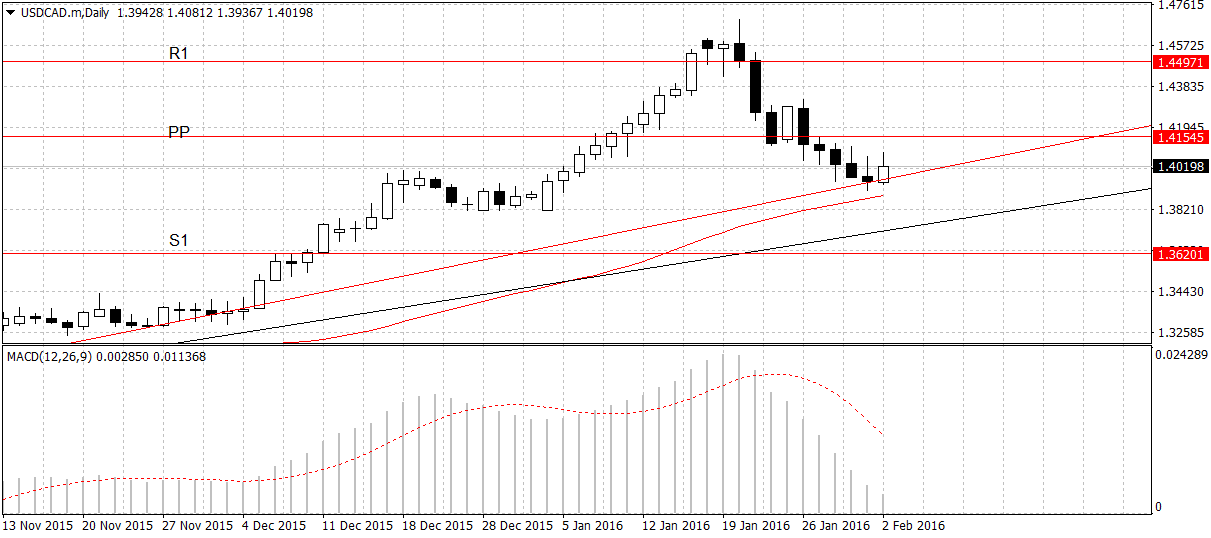
Note how the MACD has not yet fallen beneath the zero-line, indicating that the pair is still technically in an overall up-trend.
Note too the 50-day moving average (MA) situated just below the trend-line, adding support to the 1.38-40 region.
For confirmation of more downside I would ideally wish to see a break below the 50-day MA, and a clearance of 1.3800, which would generate a target at the S1 Monthly Pivot at 1.3620.
Forecast for the Pound to Candian Dollar
For sterling traders GBP/CAD is of more interest, and I have included a the chart below.
Here the patterns are different from USD/CAD: instead of a correction in a steep up-trend, a box consolidation pattern has been forming since early 2015.
Latest Pound / Canadian Dollar Exchange Rates
  | Live: 1.8766▼ + 0.19%12 Month Best:1.9044 |
*Your Bank's Retail Rate
| 1.8128 - 1.8203 |
**Independent Specialist | 1.8503 - 1.8578 Find out why this is a better rate |
* Bank rates according to latest IMTI data.
** RationalFX dealing desk quotation.
The box could break in either direction since whilst the dominant longer-term up-trend favours an upside break the Chaikin Money Flow oscillator has been declining during the formation of the range and this indicates underlying weakness and the possibility of a downside break.
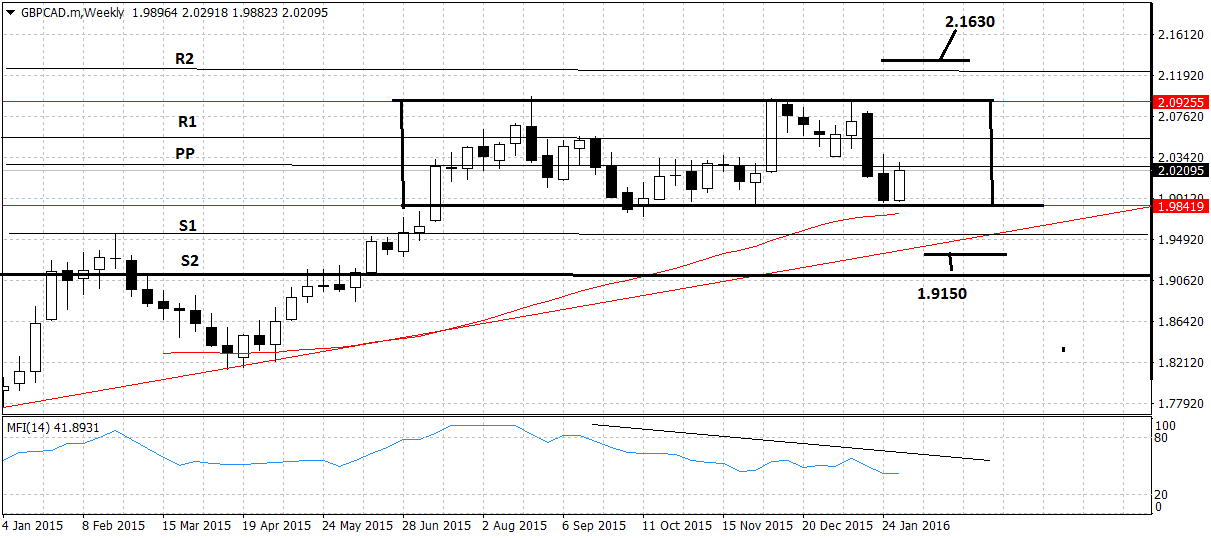
To confirm a breakout higher, I would first want to see a move clearly above the R2 monthly pivot, confirmed by a break above 2.1350, with a target at 2.1630, which is the 61.8% Fibonacci extension of the height of the box, and the minimum target.
To confirm a downside break, on the other hand I would ideally wish to see a move below all the layers of support – the bottom line of the box, the trend-line, the 50-day MA and the S1 monthly pivot - and then with a break below 1.9300 confirm an extension to S2 at 1.9179, which also happens to be the 61.8% downside extension of the height of the box.
Latest Pound / Canadian Dollar Exchange Rates
| | Live: 1.8766▼ + 0.19%12 Month Best:1.9044 |
*Your Bank's Retail Rate
| 1.8128 - 1.8203 |
**Independent Specialist | 1.8503 - 1.8578 Find out why this is a better rate |
* Bank rates according to latest IMTI data.
** RationalFX dealing desk quotation.
The Rise and Fall of Oil
Oil and CAD had started rising on reports Russian and Saudi Arabia were discussing cutting supply to stop the decline in oil prices, however, when these broke down on Friday the rise for oil stalled and the Canadian dollar slowed its rise – although unlike oil it ended the day higher.
The data on Monday morning from China showing a slow-down in manufacturing further weighed on oil, although the Canadian dollar was unaffected.
On Tuesday both the commodity and the loonie were impacted by news that the Kremlin was preparing to sell off several state-owned oil companies, in order to make up the short-fall left by dwindling oil revenues.
This suggested it was not going down the route of a supply cut with the Saudis’, which had provided the initial impetus for the recovery.
U.S Crude fell to just over 30 dollars from recent highs of 35.20.
USD/CAD rose to 1.4081 from lows of 1.3907.
Has the Correlation Between CAD and Oil weakened?
The fact that the Canadian dollar has not slavishly tracked oil lower over the last three days has not been ignored by assiduous analysts.
Olympia Trust FX, for example, noted on Monday (February 1st) that:
“The Canadian dollar is up slightly from the close last week on some negative news out of the US. Oil has slid after its marginal rallythroughout last week back to the $32 range.”
Jeremy Stretch suggested the difference in the outlook for interest rates between the U.S - where the Fed have tightened - and Canada - where the BOC has cut rates - might now be more significant in forecasting USD/CAD than the price of oil, after he said in a note, also on the 1st that:
“While oil correlations and USD/CAD remain elevated expect increasing interest in rate spreads, even though the BoC proved reluctant to sanction easier policy last month.”
Nevertheless, he concedes on the following day that it is too early to announce a divorce between Oil and CAD:
“There has been much recent discussion of a reversal in the elevated correlation between the oil price and USD CAD.
“At this juncture we would be cautious in extrapolating short term variance, this comes as the one-week correlation between oil and USD/CAD ended last month at around 0.94, well above the one year average at 0.63.
“Even should the relationship head back towards longer term averages amidst expectations of another build in US inventories this week (the most recent EIA data for the week ending January 22 revealed inventories at the highest level since August 1982), suggests USD CAD dips are merely corrective and not structural.”
The real reason behind the supposed dislocation between CAD and Oil may well be that the correlation still exists but that it has become diluted by another influence.
Perhaps recent dovishness from the Fed, including Fischer’s recent comments, have led to a narrowing of rate spreads, which has supported CAD versus U.S.
Stretch is probably right about spreads being a factor in USD/CAD, and it may be it is dampening the negative effect of oil.
If the Fed stalls its hike path it may well limit the divergence with Bank of Canada and limit downside for the loonie, which may even have already priced in significant divergence.
This could slow the loonies devaluation versus the dollar even if oil continues falling.