
The GBP/AUD exchange rate rallied to within a few pips of our initial upside target before fading - where do we see this pair going next?
GBP/AUD trades at 1.6851 at the time of writing having opened the week at 1.6843, confirming the upside momentum enjoyed through November is fading.
However, at this juncture we still believe the outlook favours Sterling.
The GBP/AUD shot higher at the start of the trading week, running all the way up to 1.6992, just a few points short of our 1.7000 target set out in our weekend forecast.
Support situated close to the current exchange rate at 1.6819 and 1.6750 from the R1 monthly pivot an old support level respectively are likely to act as formidable barriers to more weakness and the pair is expected to resume its uptrend in time.
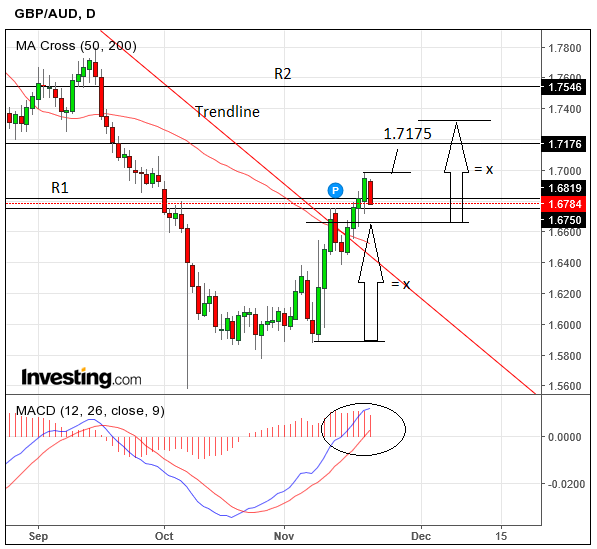
The break above the major trendline (red) eight days ago was a strong bullish signal.
Technical theory suggests that the exchange rate will probably travel an equal distance after the upside break as it did prior to the break (x).
These are shown on the chart as arrows with x’s next to them denoting their height.
They show the pair has not yet reached the target calculated from the height of the move prior to the break extrapolated higher (x) yet, implying there is still further upside to go.
The MACD indicator has broken above the zero-line showing the trend has switched from bearish to bullish, further supporting the view there is likely to be more upside.
We expect the pair to eventually reach at least to support and resistance at 1.7175, with confirmation coming from a break above the 1.6992 highs.
Latest Pound / Australian Dollar Exchange Rates
  | Live: 1.88▲ + 0.07%12 Month Best:2.0851 |
*Your Bank's Retail Rate
| 1.8161 - 1.8236 |
**Independent Specialist | 1.8537 - 1.8612 Find out why this is a better rate |
* Bank rates according to latest IMTI data.
** RationalFX dealing desk quotation.
Falling Carry Flows Hit Aussie in November
The Aussie has weakened broadly following the election of Donald Trump which triggered a revolution in the outlook for global inflation, which in turn augured ill for carry trade flows.
The carry trade is a strategy whereby investors borrow a currency which has a cheap borrowing rate and invest it in a currency with a high interest rate, thus profiting from the difference.
They might, for example, borrow in Euro’s which currently have a 0.00% interest rate and invest in the Aussie which has a 1.50% rate.
They would then gain a profit of 1.50% on the investment as it has cost them 0.00% to borrow money which they are earning 1.5% from.
If the Aussie strengthened versus the Euro in the process then that would also be a bonus.
However, improving interest rate expectations in the UK, due to the Bank of England (BOE), stating it is not intending to increase stimulus have reduced investor appetite for carry.
This has reduced carry flows to the Aussie, and although the outlook for Australian interest rates remains positive, the UK is catching up.
Australian Dollar Fights Back
Tuesday, November 22 was a tough day for those hoping for a stronger Pound against the Australian Dollar.
A look at the G10 currency performance board shows that the Aussie was the best performer of the day while Sterling was the worst:
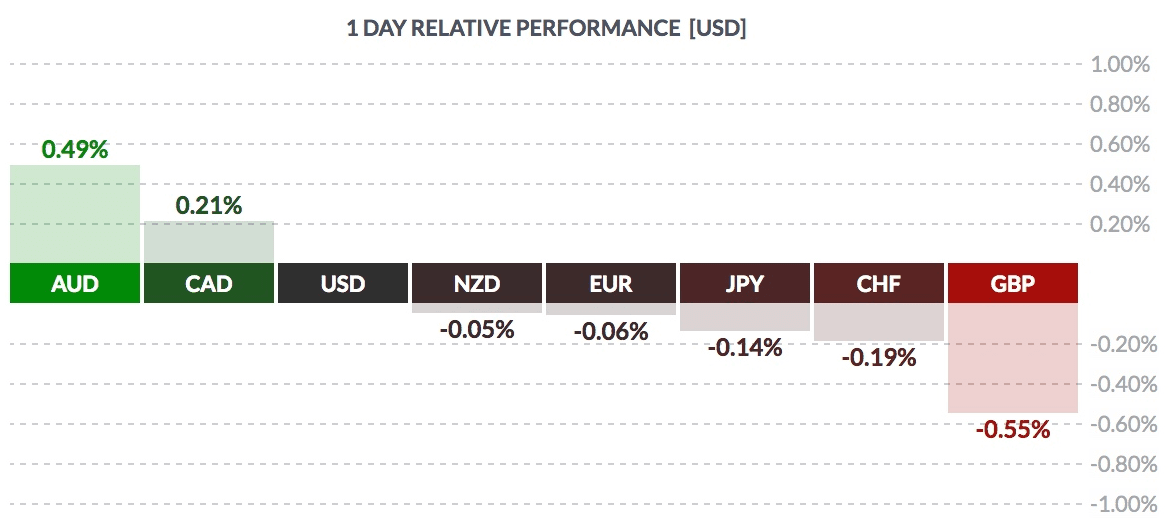
A strong risk-on move in global stocks and commodities played right into the hands of the Aussie which tends to thrives in conditions in which investors are at their most confident.
Also helping were positive comments from the Reserve Bank of Australia’s (RBA) Deputy Governor Kent.
Kent’s comments showed cautious optimism about the future of the economy, although he also highlighted notable headwinds such as remaining slack in the labour market, the lack of full-time employment and subdued mining investment.
Kent said he sees reasonable prospects for improvement in the mining states as global commodity prices start to find upside traction.
In turn, mining states such as Western Australia are showing signs of improvement while prospects for economic growth across the country as a whole have improved.
A gradual return of inflation to more normal levels is to be expected say the RBA.
Kent also mentioned that he did not want to see wage growth slow any further, noting that the 1.9% increase in wages was due mainly to Western Australia and the decline in demand conditions for the region.
The decline in full time employment continues to be of concern even in light of a falling unemployment rate but markets saw his message as being suggestive no further interest rate cuts are likely at the RBA in the foreseeable future.