
The Australian Dollar (AUD) has taken a knock from some negative employment data, but Westpac forecast the currency to maintain its advantage over Pound Sterling for some time.
Australian unemployment rose by 9.8K people in September, a poor outcome if we consider that markets were forecasting the unemployment rate to actually fall by 15K.
The Australian Dollar naturally fell as this would suggest the scope for the Reserve Bank of Australia to cut interest rates again has actually risen.
Governor Lowe noted only this week that “the case for moving more quickly [to cut rates] would be strengthened in a world where the labour market was deteriorating”.
And lower interest rates tend to prompt currency weakness.
“Our assessment is that the labour market is still slowly improving, which is consistent with our view that rates are on hold for an extended period,” says Felicity Emmett at ANZ Research in response to the data.
Emmett notes the fall in the headline employment figure reflects the sharp fall in full-time employment (-53k) which was partly offset by strength in part-time jobs (+43k).
“We think the volatility in the part-time/full-time split may reflect the impact of temporary census workers. Most census workers were already employed, so the extra hours worked for the census could have temporarily pushed people into the full-time category only to reverse now that these jobs have finished,” says Emmett.
Therefore, for now at least, this does not look like a major game-changer for the Aussie.
The Pound to Australian Dollar exchange rate remains trapped within the 1.59 - 1.60 zone that it has carved for itself this week.
International payments are being quoted in the 1.5440-1.5750 region.
Latest Pound / Australian Dollar Exchange Rates
  | Live: 1.8755▼ 0%12 Month Best:2.0851 |
*Your Bank's Retail Rate
| 1.8117 - 1.8192 |
**Independent Specialist | 1.8493 - 1.8568 Find out why this is a better rate |
* Bank rates according to latest IMTI data.
** RationalFX dealing desk quotation.
Westpac Forecast GBP/AUD to Remain Heavy
Regarding the outlook we hear the Pound should remain weak against the Australian Dollar for the foreseeable future thanks to the difference between the GBP/AUD exchange rate and 2-year interest rate swap differentials between Australia and the UK.
The call comes despite the Pound now looking undervalued against its Australian counterpart on the basis it has diverged from interest rates differentials.
Interest rate swaps are a useful indicator of future inflation and interest rate expectations since they price the difference between fixed and floating interest rates.
Higher expected rates tend to be supportive of a currency as they attract more foreign capital seeking higher returns.
As can be seen, the move in swaps is typically a good guide for the exchange rate. The UK over Aussie 2-year swap differential is showing a wider divergence with the GBP/AUD exchange rate than at any time in the past five years:
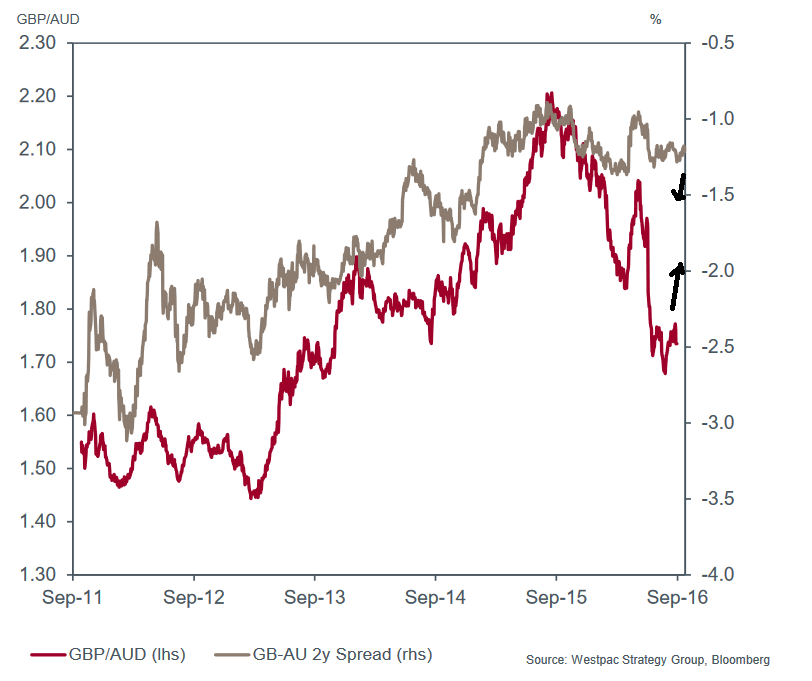
Whilst the difference, or ‘spread’, in swap rates, has moved roughly from -1.25% up to -1.0 and then back down to -1.25%, in a sort of range, the exchange rate has tumbled from 2.20 to 1.60.
The disproportionate decline in the exchange rate is out of sync with the spread meaning there will probably be a fall in the spread and a rise in the exchange rate to meet it and - close the gap so to say.
Song, however, dismisses the forecasting value of swap spreads.
”The relationship between GBP/AUD and 2-year swap spreads has not been reliable for much of the past 5 years. The divergence has been particularly pronounced in the wake of the Brexit vote in June,” he remarks.
Given the extraordinary divergence between the two, however, we think there is a possibility they could start working their back to each other.
Westpac are negative about UK growth, seeing risks tilted to the downside.
The wide current account deficit will also keep downwards pressure on sterling.
They see no relief from the deficit as although there is expected to be a large upturn in profits for British manufacturers who export many of their goods due to the weak pound making their goods more attractively priced, the fact most UK manufacturers rely on components from outside the UK which will rise in value eating up their margins, means there will be little net gain for the current account.
This, in turn, is expected to weigh on sterling.
“There remain few signs that the UK is achieving more balanced growth, with the UK current account deficit at -5.9% of GDP in Q2 2016.
“This is likely to persist as inelastic demand for imports and the uncertainty over service-sector imports are likely to keep the deficit in place despite the positive currency impact for exports,” says Song.
On a technical note, however, there is some hope for the Pound in the short-term.
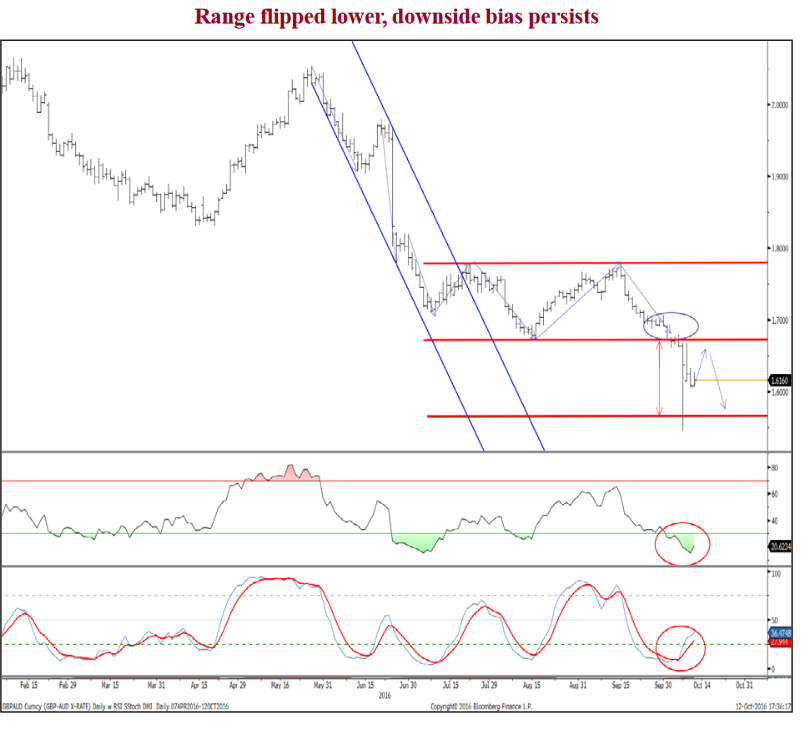
Song’s technical analysis of GBP/AUD highlights a countertrend recovery in momentum (circled in bottom panes of chart below) which is at odds with the dominant bullish trend, and suggests the possibility of either a full-blown bounce or at least a range bound movement on the horizon.
“Although a longer term GBP downtrend appears to be in place, the structure of momentum is now supportive.
“This implies that, rather than continue to rapidly decline, GBP/AUD is now likely to establish a new, lower range into the end of this month,” says song.
Brexit to Weigh on the Pound
Song believes the technical observations that advocate for a soft GBP/AUD are backed by the fundamental backdrop of Brexit.
A combination of weak technicals and the undermining influence of Brexit is likely to keep GBP/AUD trading in the region of 1.60, argues Westpac’s FX Strategist Martina Song.
Not all analysts believe Brexit ‘headlines’ can propel GBP lower.
Some now also argue that the Pound’s lack of direction following the crash is as a consequence of all the Brexit bad news now having all been priced in.
Indeed, there is also the possibility of a recovery in the pound if the current legal challenge to the prime minister’s authority to trigger Brexit, succeeds and she has to put it to a parliamentary vote first.
However, Westpac’s Song does not see this as a probable source of support for the pound.
“Legal action against the Brexit process may sway sentiment to some extent but the likelihood of actually altering policy is slim at present,” said song.
The final day of the court case is Tuesday, October 18, although no-one knows exactly when the outcome will be made known, however, if Brexit is delayed or requires the authority of a largely pro-EU parliament to trigger, it will result in more upside for sterling.
Sharp Profit-Taking on AUD/USD
The AUD/USD exchange rate has meanwhile fallen a notable 0.77% to hit 0.7663.
The employment data saw AUDUSD reverse trend after hitting 0.7734 mid-term resistance.
Profit-taking and tactical shorts sent the pair back to 0.7655, a touch higher than 0.7647 (major 38.2% retracement on Oct 13th to Oct 20th rise).
"Holding support at this level, we could expect a re-test of 0.7730/0.7750, while breaking below should encourage a deeper correction to 0.7620 (50% level) and 0.7608 (200-hour moving average)," says Ipek Ozkardeskaya at London Capital Group.