The South African Rand could be about to benefit from the delaying of interest rate rises at both the Bank of England and US Federal Reserve in response to the evolving global economic outlook.

Global slowdown fears and the falling price of oil are the two most important factors weighing on the South African Rand, which has recently seen some hefty declines.
The currency weakened further, tracking oil prices lower, after economic sanctions were lifted against Iran last weekend, which is expected to add an extra 500K barrels of oil to global markets a day. Global supply is already exceeding demand to the tune of 2 million barrels a day.
“The 2016 meltdown in global markets continues," says John Cairns at RMB, "the sell-off started with fears over China but now it is focussed on oil."
Brent plunged almost 10% to trade under US$28/bbl, on the correct assumption that sanctions on Iran would be lifted over the weekend, but has since recovered slightly.
Latest Pound / SA Rand Exchange Rates
  | Live: 21.8688▲ + 0.05%12 Month Best:23.3448 |
*Your Bank's Retail Rate
| 21.1253 - 21.2128 |
**Independent Specialist | 21.5627 - 21.6501 Find out why this is a better rate |
* Bank rates according to latest IMTI data.
** RationalFX dealing desk quotation.
Not All Bad
Things could be about to get better for the rand though, ironically for the exact same reasons that have seen the rand being sold in the first place.
How then does a slow-down in the global economy, and the fall in the price of oil, benefit the ZAR?
Figures from Europe last week showed that the real economy is doing worse than leading indicators initially suggested.
“U.S data has also been poor: Friday’s numbers showed industrial production contracted for a third straight month while retail sales unexpectedly dropped," notes Cairns in a note to clients, "US 4Q15 GDP growth now looks set to come in at 0.6%, down from 2.0% in 3Q15. Ironically, for all the fears, Chinese figures have actually held up the best.”
According to Cairns, all the above are feeding into expectations regarding the trajectory for U.S Federal Reserve interest rate hikes in 2016.
Expectations for agressive hikes have been hit as a result of a slow-down in the U.S economy and the deflationary impact of low oil prices.
“The implication of the oil price fall for U.S inflation plus the weak economic data has seen Fed hikes priced out,” says the RMB analyst.
According to Cairns there is now only a low probability the Fed will hike in March, and previous consensus estimates from Fed members themselves, which pointed to four rate hikes in 2016 have been pared back considerably:
“The market now places a 28% probability on a March move, 50% probability of a hike by June, and between only one and two hikes for the full year.”
The impact of lessened expectations, however, may reduce downside pressure on the rand – particularly from the dollar.
Higher interest rates in the US imply that global investors, who had previously borrowed in USD and invested in high-yield South African assets, will be liquidating exposure to SA in favour of the US. This creates demand for the USD while driving down the ZAR at the same time.
If the Fed retracts, however, this may also lessen the pressure on the Bank of England to follow in its footsteps and raise their rates, leading to a let-up of downside against GBP too.
SARB Rate Rise?
According to RMB’s Fixed Income analyst Deon Kohlmeyer, markets are pricing in a 50 basis point rise from The South African Reserve Bank (SARB), who have their rate meeting on the 28th.
“Fifty basis points has been priced into the FRA market, which may be a touch aggressive given the poor forecasts for growth as well as the fact that there has been no mention of increasing the 25bp increments from the SARB either.”
Data out on Wednesday 20th could be key in shaping expectations for the degree of tightening employed by the bank:
“This week's December CPI data as well as the retail sales numbers may still point to a moderate 25bp hike next week instead of the dreaded fifty points that markets are pricing in.
Chartist's View
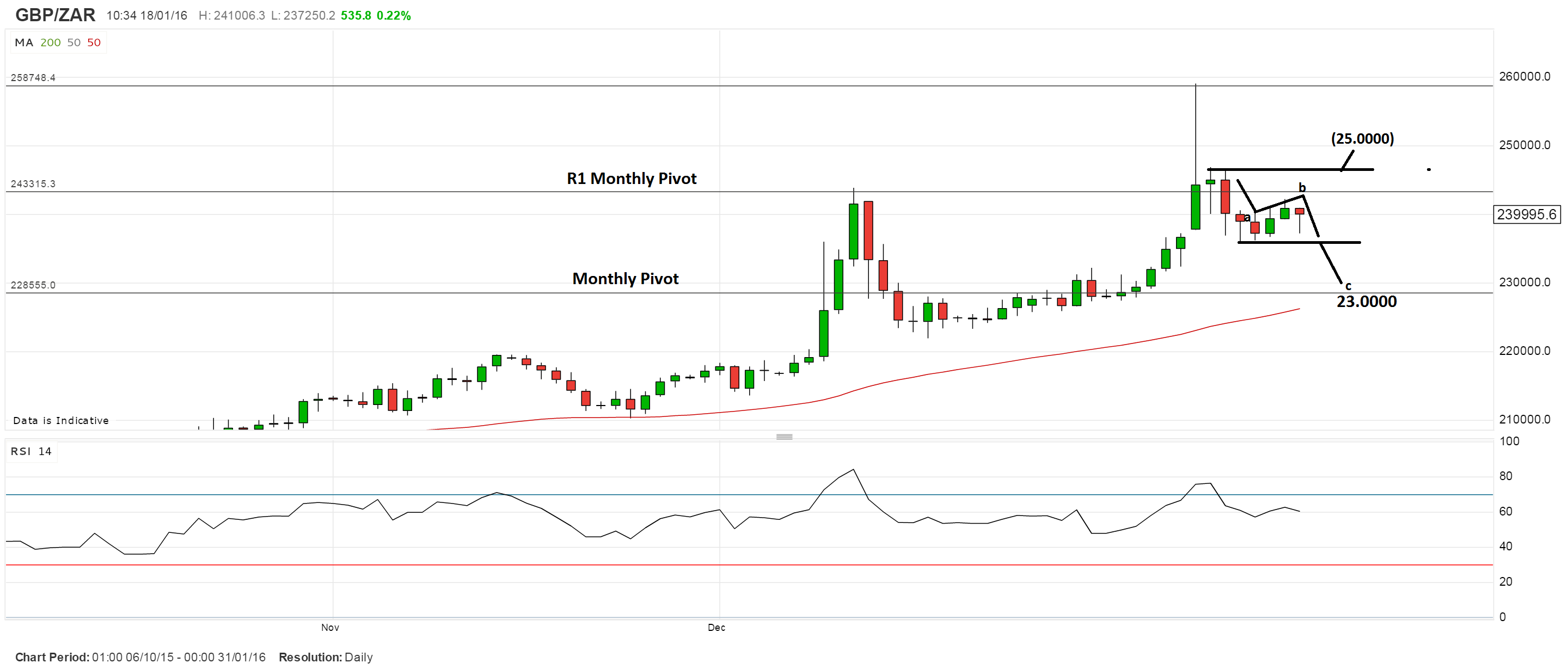
If we look at the chart of GBP/ZAR we see that there is a down-side bias which supports steadily diverging central bank policy outlooks, as reducing BOE rate hike expectations contrast with potentially aggressive moves from SARB.
The uptrend has blown off in a spike higher, on the 10th, and has now fallen back down.
The correction looks unfinished as it unwinds, what I have labelled a ‘b’ wave and ‘c’ still to unfold.
Wave ‘c’ will probably move lower towards the Monthly Pivot at 22.8555.
A break below the current wave B lows at 23.5758 would probably confirm such a move, with a target at 23.0000.
I think it unlikely there will be a move higher at the moment, but given the strong longer-term up-trend the possibility cannot be discounted completely.
A move back above the 24.6916 highs would open the way up to an initial target at round-number resistance at 25.0000.