
Image © Adobe Stock
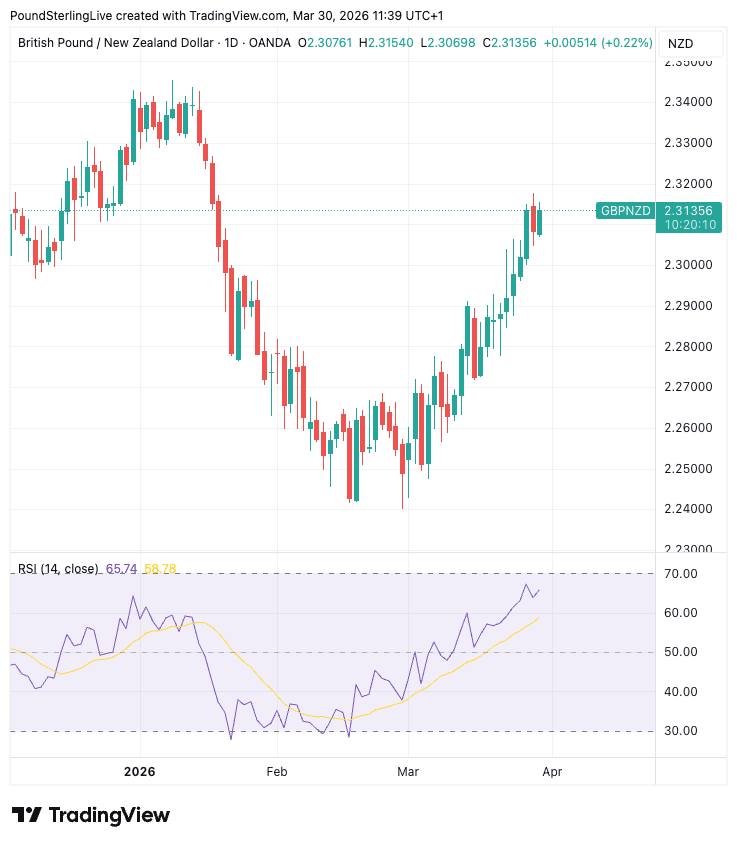
GBP/NZD trades at 2.3144 on Monday, extending a strong recovery from the late-February low of 2.24.
That marks a gain of over 3.30% in just over a month, with momentum turning decisively positive as the pair breaks above key moving averages and the Relative Strength Index rises to 66.
The technical setup suggests further upside is possible in the near term, and we see scope for a test of 2.33 in the coming days. (If you're aiming for higher exchange rates, consider setting an automated order with a specialist provider to ensure you don't miss out.)
The New Zealand dollar has weakened notably through March as the Middle East conflict weighs disproportionately on energy-importing economies. It is particularly exposed to the crisis, importing almost all refined petroleum products indirectly via Asia, leaving it vulnerable to both higher prices and potential supply disruption.
“Energy exposures are significant, as New Zealand imports almost all of its refined petroleum products indirectly from the Gulf via Singapore and Korea,” says a weekly research note from Barclays.
The deterioration in the external backdrop comes at an awkward time for the domestic economy, where expectations for a 2026 recovery are now being challenged.
“The first NZ economic data post-war has started to roll in and suggests a deterioration in economic activity as a result of elevated fuel prices and heightened uncertainty,” says ASB economist Kim Mundy.
March consumer confidence deteriorated across the board, while inflation expectations jumped.
This divergence between weakening growth and rising prices is expected to persist, creating a difficult backdrop for both businesses and the Reserve Bank of New Zealand.
Earlier in the year, the New Zealand dollar was supported by expectations that the RBNZ would raise rates ahead of peers.
However, that advantage has narrowed as rate expectations have risen globally, including in the UK, reducing the Kiwi’s relative appeal.
Barclays now argues that markets may be overestimating the scope for further tightening, pointing to weak growth dynamics and a negative output gap.
If those expectations are pared back, the New Zealand dollar could remain under pressure in the weeks ahead.
For GBP/NZD, this creates a constructive near-term backdrop, but not without risk.
While the trend favours further gains, positioning and momentum are starting to look stretched and, of course, we're in a headline-driven volatility environment. This means that execution becomes more important than direction alone.
For larger or more complex transfers, where setup, timing and execution all need to align, a more hands-on approach from the outset can help ensure the process runs smoothly.