
Image © Adobe Images
The Turkish lira faces renewed depreciation risks amidst a surge in capital outflows and a widening current account deficit in April, analysts at Commerzbank warned on Monday, citing "disastrous" balance of payments data.
According to new data, non-resident investors withdrew a record $10.9BN from Turkish portfolio assets in April, nearly triple the $3.6BN outflow seen in March.
The banking sector saw particularly sharp divestment, with outflows hitting $8.7BN, more than double the previous month.
"This unprecedented capital flight was driven by non-resident divestment from government debt securities for the most part, and was clearly linked to the political uncertainty," Commerzbank currency analysts said, referencing the arrest of Istanbul Mayor Ekrem İmamoğlu in late March, which rattled investor confidence.
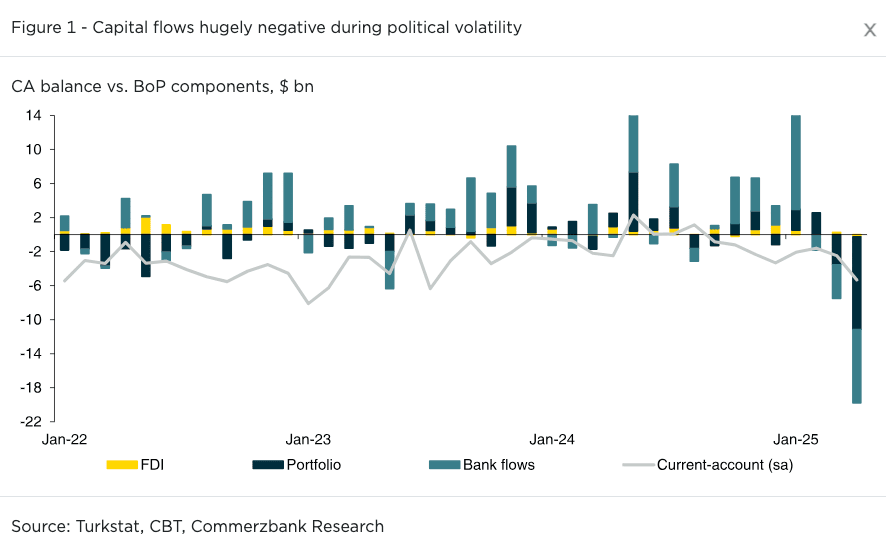
Image courtesy of Commerzbank.
The Central Bank of Turkey (CBRT) also saw a steep drop in foreign exchange reserves, losing $25BN in April alone.
Although reserves have modestly recovered since, analysts view the sharp April decline as indicative of the authorities’ struggle to stabilise the currency amid heightened political and economic turbulence.
The outlook for the lira is further clouded by a widening current account deficit, which surged to $5.3 billion in April on a seasonally adjusted basis, up from $2.5BN in March and $1.6BN in February.
Rising oil prices and a softening regional tourism outlook are likely to compound the external financing gap, with the price of oil surging in the wake of the Iran-Israel conflict.
"The latest figures argue for further downside risk on the lira exchange rate in coming months," Commerzbank concluded, warning that the confluence of capital flight, weak external balances, and political uncertainty leaves the currency vulnerable to further depreciation.
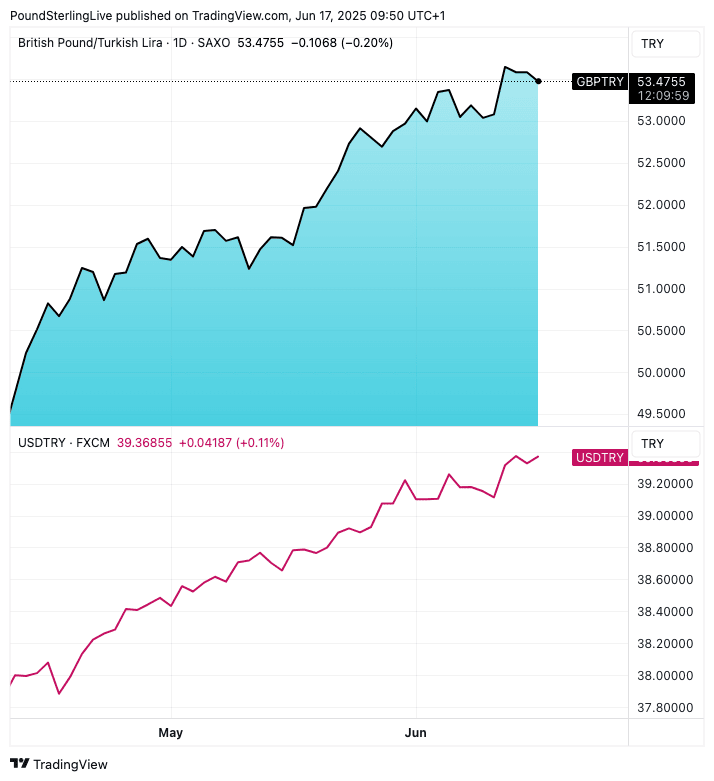
Above: GBP/TRY (top) and USD/TRY.
The lira has already lost significant ground this year and remains one of the worst-performing emerging market currencies, despite interest rate hikes and efforts by the central bank to restore policy credibility.
Investors now appear increasingly wary of Turkey’s near-term stability, with capital exodus amplifying pressure on the currency and the broader economy.