Pound Sterling has shot higher against the world's ten largest currencies as UK retail sales data suggests analysts were far too pessimistic over the impact of the Brexit vote. Can the move translate into further gains?
- Better-than-forecast retail sales data allows GBP to push best mult-week exchange rates
- SEB and Nordea Markets argue Sterling is undervalued
- At time of publication, Pound to Euro exchange rate was at 1.1620, a five day best
- The Euro to Pound sterling rate was at 0.8608
- Pound to Dollar exchange rate was at 1.3144, a two week best
The trade-weighted GBP has depreciated notably since the Brexit vote with the move lower accelerating following the larger-than-expected Bank of England easing package announced on August 4th.
It is currently about 10% below its pre-Brexit level.
Yet, financial markets have settled down surprisingly well following Brexit: in equity markets we have seen new all-time highs, commodities too are continuing to rebound.
And now, with the aid of Bank of England stimulus and the weak Pound, the outlook for exporters and the financial system are also looking good.
Is it safe to question whether Sterling has seen the worst?
One institutional analyst believes the downside pressures are indeed fading.
Nordea Bank’s FX analyst Aurelija Augulyte notes that while the Bank of England is responsible for near-term pain, it will also likely be the source of a GBP recover:
“The BoE easing, UK data worsening... not much optimism around the GBP. However, the short positions are stretched, and the ongoing - and upcoming - easing will help the UK economy, and thus ultimately the GBP.”
Augulyte, argues that the 10% fall in Sterling’s effective nominal rate has led to a, “substantial easing in financial conditions,” which will ultimately create a feed-back loop that should help Sterling arrest its fall.
Apart from the precipitous drop in the currency she sees little impact on other assets, except interest rates which have effectively been halved.
The fall of interest rates to record lows, however, has provided the twin benefits of very cheap borrowing rates and easy financial conditions, which according to Augulyte are likely to prevent the UK from falling into a recession:
“Apart from the GBP weakening, financial markets have been very resilient to the Brexit vote, with no funding stress seen. Equity and industrial commodity prices recovered and even reached new highs. Long and short rates have more than halved since the vote. The Bank of England has cut rates on top of that, introducing QE to the tune of 10% of GDP. This leaves the UK with massive financial easing which should help prevent any major recession going forward.”
Latest Pound/Euro Exchange Rates
  | Live: 1.1767▲ + 0.26%12 Month Best:1.1828 |
*Your Bank's Retail Rate
| 1.1367 - 1.1414 |
**Independent Specialist | 1.1602 - 1.1649 Find out why this is a better rate |
* Bank rates according to latest IMTI data.
** RationalFX dealing desk quotation.
The Nordea analyst also points out that Brexit did not have as negative an impact on the Eurozone as feared:
“Brexit has not affected the perception of the EUR and has not unleashed the collapse of the Euro area, which was a common fear before the vote.”
The Euro has also been helped higher because of its role as a funding currency, for the purchase of higher yielding emerging market and commodity country debt.
She even compares EUR/GBP to gold and offers a compelling chart illustrating their close correlation:
Nordea’s Augulyte sees little chance of another substantial cut in interest rates.
She cites the negative impact below-zero rates would have on savers and pension funds, and Carney’s statement that he was not a “fan” of negative interest rates as reasons limiting downside.
At the most she expects a further cut of -0.15% by the BOE, bringing the base lending rate down to 0.10%, however beyond that no more.
She sees this as a limiting factor for Sterling downside, since lower rates tend to weaken a currency.
The Bank is expected to turn increasingly away from monetary policy and allow the government to do the remainder of the heavy lifting by altering fiscal policy.
Indeed, we are likely to see an increase in spending and cutting of taxes, if recent comments made by Theresa May and Philip Hammond are anything to go by.
More concrete clues on what changes are coming are likely to be unveiled at the Autumn Statement, which is the mid-term budget review.
“The chancellor will present a revision of the fiscal plan in November, potentially reducing, if not removing, the planned fiscal drag for the next year. However, by then we will receive a number of hard data indicators, so the worse the data, the more pressure there will be to use fiscal policy – and that should be UK growth supportive, thereby helping the GBP maybe by anticipation alone,” says Augulyte.
Boost to Exports
Nordea’s analyst points to the positive effect on exports that the weak Pound has already had, and she sees this effect supporting growth if GBP continues to remain weak:
“We are already seeing some effect of a weaker GBP. For instance, real export growth has picked up to the highest rate since 2013. Assuming that the recent relationship between exports and currency development holds and GBP weakness is sustained, other things unchanged, exports can rise more than 5% y/y (real terms). With the export share in the UK economy around 25%, that translates into more than 1% point addition to UK GDP. “
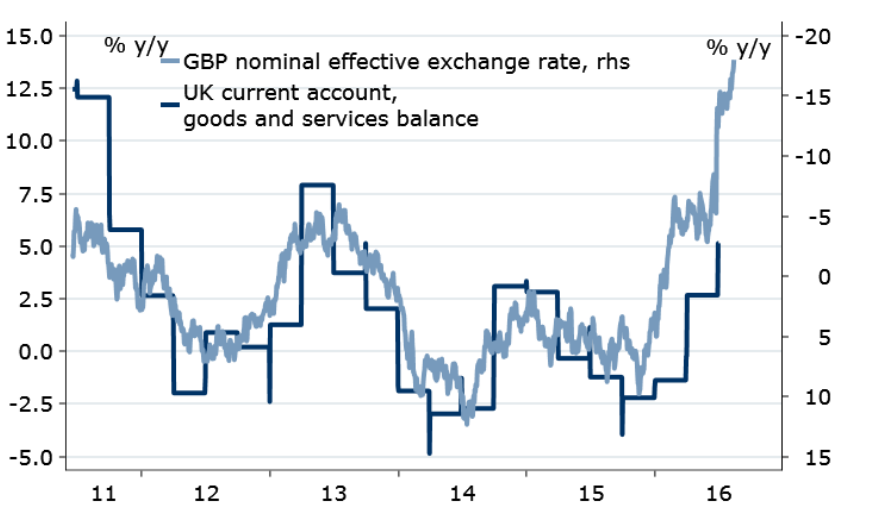
Augulyte concludes that with speculative short positions so overcrowded and so much negative expectation it would take another negative shock to push sterling down any further, which is unlikely.
Nordea forecasts are for GBP/USD to end the year at 1.32, EUR/GBP at 0.84, which in Pound to Euro terms equates to 1.1904.
SEB: Sterling Undervalued
Also suggesting the sell-off in Sterling may be too aggressive are the team at SEB, the Scandanavian lender.
"So far the actual impact on the economy of the vote is very uncertain but estimates indicate a potential recession in H2 this year. Consequently, the GBP has reacted by falling almost 18% in trade weighted terms since last year," says a recent strategy note to clients from SEB.
Most measures of GBP-valuation conducted by SEB suggest "severe under-valuation," in the currency.
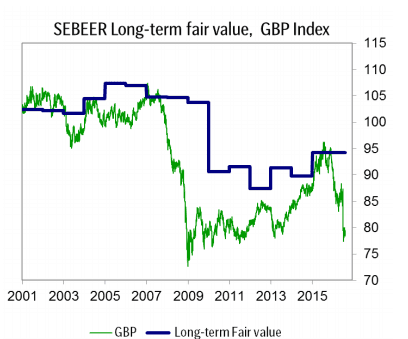
"With an adverse impact on the economy already discounted and the valuation deviating by almost 2 std dev, we belive most sterling depreciation is over. However, the GBP will remain weak as long as uncertainty regarding the economy remains," say SEB.
Charts Show there Could be a Limit to GBP Weakness
It is not just from a fundamental perspective that the Pound is expected to recover, the charts too are signalling the possibility.
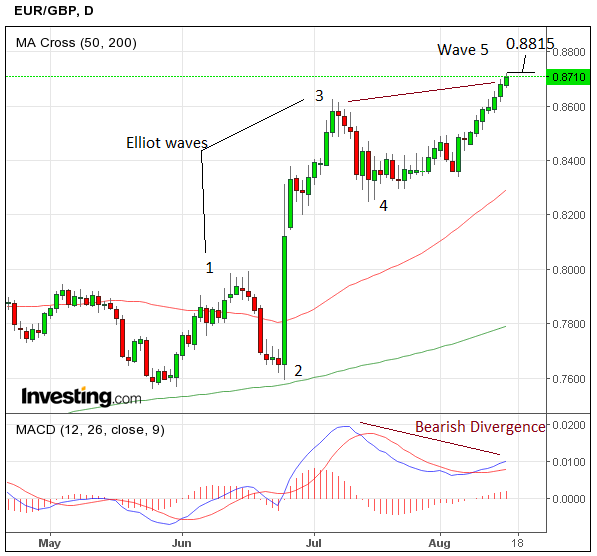
Take EUR/GBP, for example, the pair has risen up to above 0.87 , since it started rallying in late May, however, this short-term up-trend is showing potential for a reversal and weakness now.
The move up from the May lows looks like an Elliot Wave, which is a type of market pattern within a cycle - in this case an up-cycle.
Elliot waves are usually composed of five smaller waves and this Elliot Wave is currently probably unfolding its final fifth wave, which suggests the end of the sequence may be at hand.
Once the fifth wave completes it will start to fall in a correction which will take the exchange rate down to about the halfway point of the preceding up-wave, which in this case would be at around 0.8180.
The other sign the pair could be topping is a 13 count on the Demark Countdown indicator, which is seen as a fairly reliable sign of exhaustion by professional traders who use the indicator.
Finally, there is a steep bearish divergence between the MACD momentum indicator and price: whilst the price made a new high above its July peak in 0.68s, the momentum indicator fell short of its July peak – thus not confirming the rally with momentum.
This sort of steep divergence often precedes a sell-off.
Despite all these signs, however, we must emphasise that the exchange rate itself continues to rise and is not showing any signs in price action that it is about to reverse and start falling, and this would be a key requirement for taking a more bearish view.
Indeed, since the up-trend remains intact we continue to hold a bullish bias, with an upside target at 0.8815 resistance and confirmation from a move above 0.8715; however this is not a conviction call, rather a cautiously bullish call.
The Short Trade on GBP is Overcrowded
Meanwhile, every man and his dog appear intent on betting against Sterling.
Often it is this over-crowding that can spark hefty reversals as a more balancing positioning is demanded by sustainable market dynamics.
Normally this state of affairs is actually a signal that the currency may be close to bottoming, as it means there are a lack of anymore sellers and a sign those already in the trade will start cashing out soon.
Strong Retail Sales Data Defies Brexit Gloom
The UK currency rose sharply on Thursday the 18th of August as latest retail sales figures show the UK consumer did not even bat an eyelid at the EU referendum result.
Growth of 1.4% in July beat analyst expectations for a reading of 0.2% to be delivered while annual growth comes in at 5.8%.
The retail sales figures make it a three out of three beat for the UK economy with inflation and employment data by the ONS showing analysts to have been too pessimistic on the UK economy's post-Brexit vote prospects.
Indeed, the wallets were agape as shoppers hit the high streets and online stores in a spree not seen since 2014:
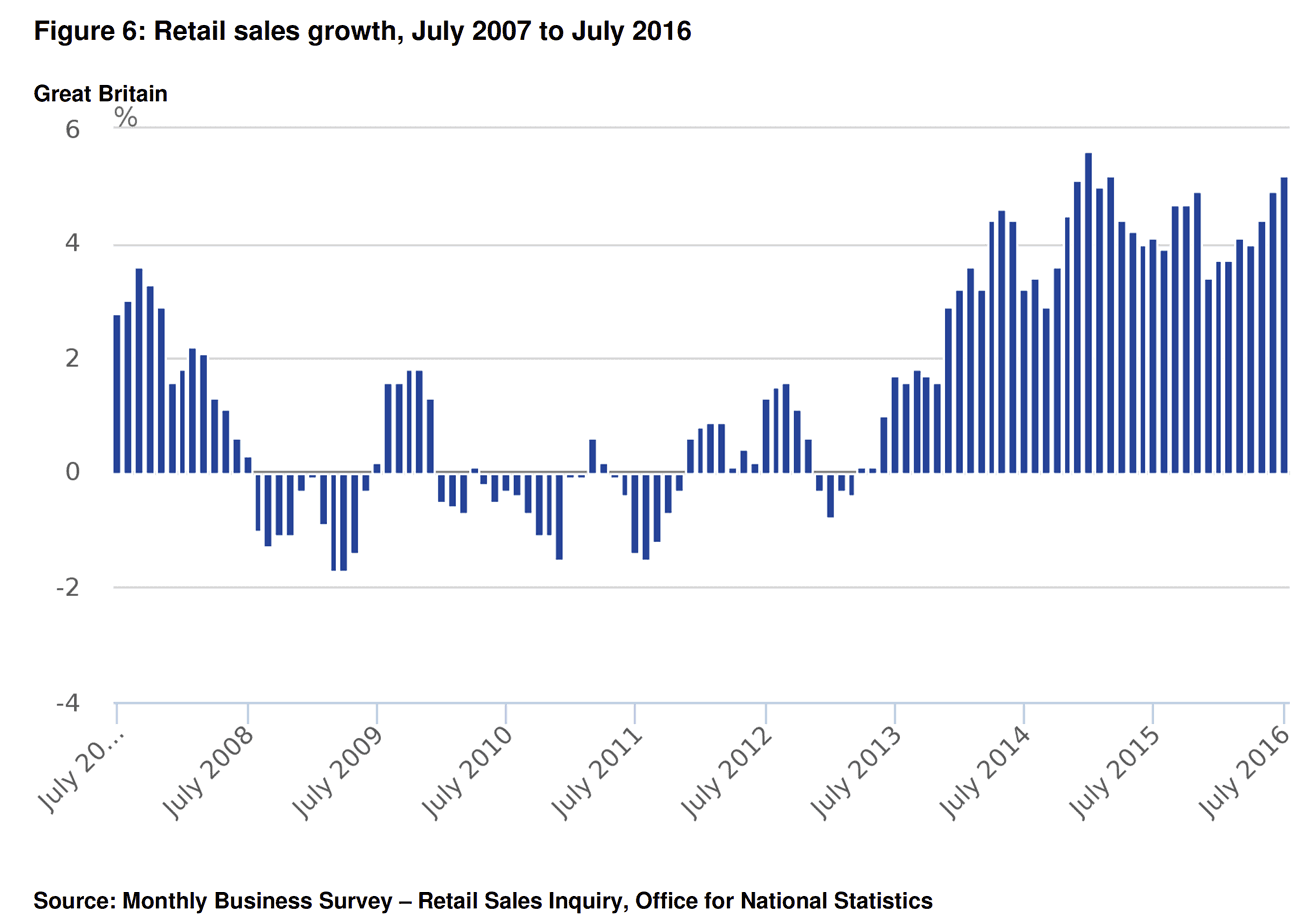
"Warm weather and a deluge of tourists drawn by the cheaper pound no doubt played their part, but this is clearly a very positive sign for the UK economy. Kingfisher’s update earlier this morning hinted that retail sales would hold up but no one predicted such a firm number,” says Neil Wilson at ETX Capital.
Markets entered this week aggressively positioned against GBP which tells us that there are many trading positions that could be cleared out by the present move, this suggests the relief rally could run notably higher.
"The pound’s rise forced many to unwind some of their short positions which are bets on further weakness. Still, the pound’s poor underlying bias will leave it susceptible to being sold on rallies, suggesting limited room to the upside," Joe Manimbo, an analyst with Western Union tells us.
While we would note many other analysts are expecting Sterling to be sold on strength, we would also point out there are other big-name analysts out there willing to call the bottom of the GBP decline.