Image © Adobe Images
Beware chasing this recovery say analysts at the Wall Street bank.
Gains by the British pound should be considered a short-term phenomenon as technical positioning unwinds, and not the start of a fundamentally durable rally.
That's according to analysts at Goldman Sachs, who have commented on the pound's recent outperformance on the crosses, particularly against the euro.
"The standout flow this week has been buying of sterling on crosses," says Goldman Sachs, having observed around 2BN in demand from a mix of hedge funds and real money, "mostly EURGBP but also other non USD pairs."
The euro-pound exchange rate fell below the significant support line of 0.8620 briefly on Wednesday, with the pound-to-euro rising through 1.16 - hitting a ten-month high.
Those gains are nevertheless considered by Goldman Sachs to be a "covering of shorts".
The Triggers for the Recent Recovery
What does Goldman Sachs think is behind the move higher in sterling? It explains "clearly the trigger for this has been" -
1) seemingly smooth handover to Burnham PM
2) his commitment again to fiscal rules (coming up in a speech next week)
3) his turn to a conventional economic team, perhaps led by Streeting as Chancellor.
Goldman concedes it has "seen a few fresh long GBP recommendations based around this narrative."
However, "we would disagree with thesis that GBP is a good fundamental long, whilst admitting that perhaps some of the tougher fiscal questions will only be addressed in November budget."
But Strength Isn't Durable
The key reasons why analysts at the Wall Street bank don't expect an enduring GBP rally are:
1) Measures of GBP risk premium is low, now only 30bps versus a max of around 3% over past year. That means there's ample room for the premium to rebuild.
2) This fading UK-risk premium comes even though "it is still hard to make the sums add up" in terms of the country's finances.
On the latter, analysts note the government's finances are precarious with fiscal headroom of approximately £15bn now, down by around 10bn from Spring.
This is against clear upward spending pressures: if real departmental spending is adjusted to more realistic 2% (rather than planned 1%) in 2027-2030 that will be a c. £20BN cost at outer year.
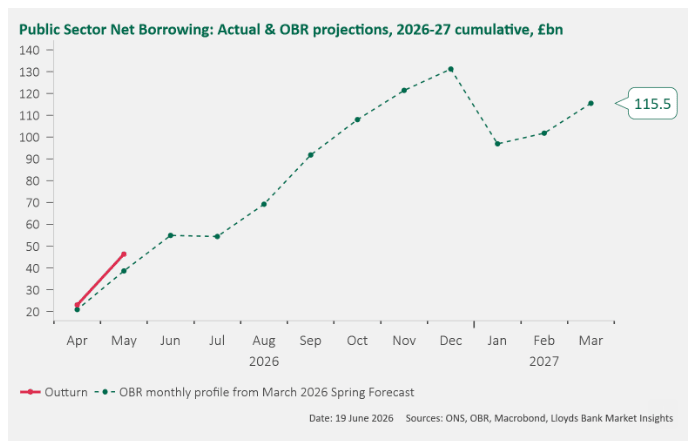
Last week's public sector finances data showed the government has already borrowed more than expected in the current fiscal year.
"And taxes available to offset this are either narrow or uncertain in how much they will raise given impacts on behaviour (CGT). Hard choices remain," says the note.
3) The rate support will not be there. Sahm rules point to lower UK rates. Goldman Sachs think the Bank of England will remain on hold.
4) Sterling is the most over-valued currency in G10 on Goldman's modelling.
In fact, "it has recovered most of its post Brexit referendum sell-off in real terms where as standard assumptions on Brexit impact suggest a negative valuation impact (we think 6%)."
What's a Short Squeeze?
A short squeeze in FX happens when traders who have bet on a currency falling are forced to buy it back because the price starts rising instead.
The pound is a prime candidate for such a move owing to the current market structure.
"Speculators are heavily short sterling, close to levels seen shortly after the Brexit vote ten years ago," says Georgette Boele, Senior FX Strategist at ABN AMRO, in a note released Wednesday.
With the market heavily short GBP, the potential for those positions to unwind is elevated. The key thing to remember is this:
A trader who is short GBP/EUR has sold pounds they don't own, expecting to buy them back later at a lower price.
- If GBP/EUR rises instead, those traders start losing money.
- To close their positions and limit losses, they have to buy pounds back.
- Those buy orders push the pound even higher, forcing more short sellers to cover, creating a feedback loop.
At some point traders capitulate, they close the short by buying the currency back with the catch is that closing a short is a buy order, so the very act of exiting adds to the upward pressure.