
File image of Chancellor Reeves. Picture by Kirsty O'Connor / Treasury.
Prime Minister Keir Starmer on Wednesday refused to back Rachel Reeves keeping her job as Chancellor of the Exchequer.
Prompted by the Leader of the Opposition, Kemi Badenoch, "to reshuffle the Chancellor", Starmer failed to confirm he wouldn't do so.
"I didn’t hear him say he’s not reshuffling the Chancellor. It sounds like she’s toast," said Badenoch in response to the Prime Minister's answer, delivered in Parliament during Prime Minister's Questions.
A reshuffle of ministers is expected following the May 07 local elections, where Starmer's Labour Party is anticipated to receive a drubbing.
The Chancellor is considered the second-most senior minister in government after the Prime Minister, meaning Reeves is facing demotion.
For markets, that's a worry as Starmer could be planning to placate left-wing elements of his party with someone more prone to socialist causes. That means more spending at a time when lenders are already flitful about the state of the country's finances.
Lenders are wary that a new chancellor might mean "more borrowing and looser fiscal rules," says James Smith, Developed Markets Economist at ING Bank.
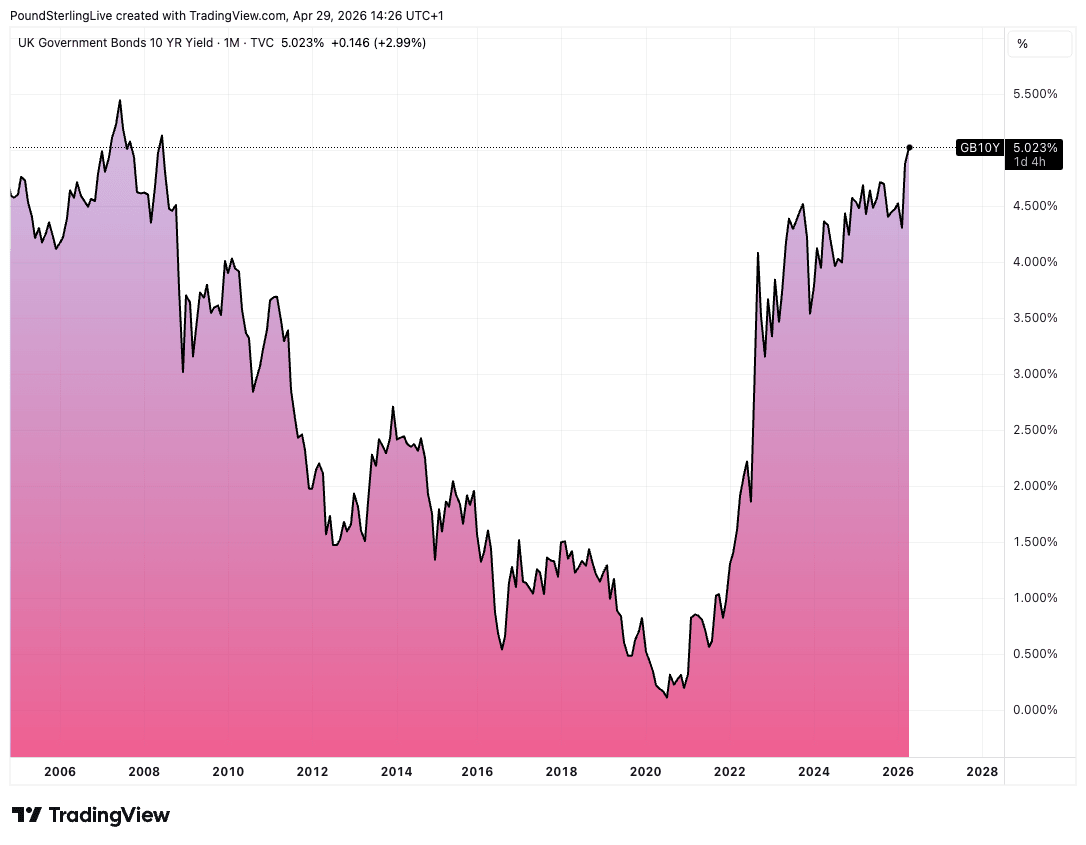
Developments in the UK Parliament come as UK ten-year bond yields trade near their highest levels since 2008, which effectively means the cost of government borrowing is at multi-decade highs.
UK bond yields are also higher than comparable peer countries, meaning lenders are asking for a premium to hold UK government debt.
For the pound, fears of change at the top of government are a persistent headwind.
"The PM’s political capital continues to drain away. The risk of left leaning challenger usurping Starmer, resulting in additional pressure in the long end of the Gilt curve, (10-year Gilt yields continue to oscillate around 5.00%), remains a likely drag on underlying Sterling sentiment," says Jeremy Stretch, Chief International Strategist at CIBC Capital Markets.
Analysts at Bank of America and Société Générale meanwhile warn the pound tends to struggle in May on difficult seasonal headwinds.
They say this year the pound is all the more likely to fulfil predictions for drawdown in May because of heightened political risks.
"Sterling rallies are selling opportunity before 7th May local elections and bearish seasonality next month," says a weekly strategy note from Société Générale.
"May is unlikely to be forgiving," says Kamal Sharma, FX Strategist at Bank of America. "With a little over one week to go, markets appear to have taken a relaxed view to the May local elections. We see some value in owning some optionality ahead of the event on the likelihood that political noise will intensify in the days following the results."
ING's Smith says Britain’s local elections are a potential market flashpoint that is not adequately reflected in sterling markets. "Minimal political risk is priced, even as bond yields hit post‑2008 highs of 5%. Borrowing costs could initially climb if the political situation worsens," he warns.
For the pound, any unruly rise in yields would trigger a sudden slide, as was the case last July amidst speculation at the time that Starmer would ditch Reeves over a bungled attempt to cut welfare spending.