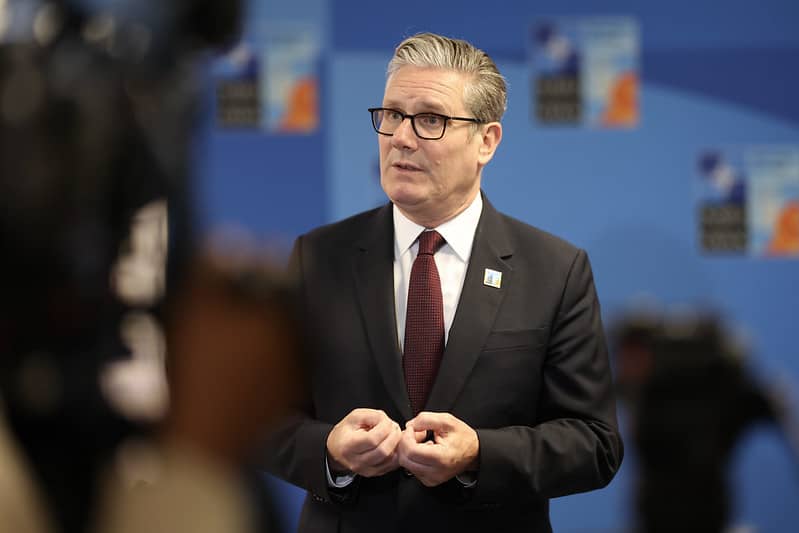
File image of Prime Minister Starmer. He's under immense pressure to shift government policy leftward. That's a worry for the pound heading into the May election. Source and credit: Simon Dawson / No 10 Downing Street.
The British pound fell to a four-month low against the dollar and a one-month low against the euro in early trade Tuesday.
Losses were primarily driven by a market adjusting to the Middle East energy shock which will see net energy importers like the UK suffer a growth and inflation penalty in the coming months.
Overnight it's reported an Iranian drone hit a fully laden Kuwaiti oil tanker off Dubai in one of the most significant attacks on a vessel in a month of war.
U.S. President Donald Trump has meanwhile told aides he’s considering ending the military campaign against Iran even if the Strait of Hormuz remains largely closed, in what amounts to a surrender to Iran. That will end hostilities but allow Iran unfettered control over the Strait and the ability to impose hefty toll charges on shipping.
The environment is therefore primed for elevated oil and gas prices relative to before Trump's foray into the Gulf, and that's supporting the dollar while weighing on pound sterling.
GBP/USD falls to 1.3159, GBP/EUR to 1.1496.
Analysts at Barclays meanwhile warn in a new quarterly FX report that domestic drivers aren't helpful for sterling: we're into April tomorrow, and the final countdown to the May local elections begins.
"Geopolitical developments have pushed UK politics to the background, but risks of a more expansionary fiscal policy have likely risen in the wake of the energy shock and the upcoming May local elections," says Lefteris Farmakis, analyst at Barclays.
"Accordingly, we pencil in a modest re-widening of the GBP's fiscal premium in Q2 closer to levels prevailing in November," he adds.
If we look at what that 'premium' might be, we can start by looking at the charts: pound-euro traded at 1.13 at its November lows and pound-dollar at 1.30.
If GBP breaks toward these lower levels, waiting risks locking in a materially worse rate; you can set a target rate now with a specialist provider or secure protection against further downside.
Should the pound rebuild similar premiums, then there's a notable downside in the pound to prepare for during the coming quarter.
The UK government is heavily indebted, and the rise of the populist left-wing Green Party means its big-spend socialist economic policies are finding a natural affinity with the substantial left-wing rump of the parliamentary Labour Party.
This restive contingent of the party is already pushing for a leftward turn in policy, most recently, the abandonment of the government's changes to Indefinite Leave to Remain, which would allow for millions of post-2021 immigrants to be granted British citizenship. They argue the policy must be abandoned in order to extend welfare payments to millions of immigrant families to pull them out of poverty. The programme will cost the government billions in extra spending in the coming years.
Barclays forecasts show that a recovery is likely through the second half of the year, allowing the pound to "recover a gradual normalisation towards the middle of the post-EU referendum range."
For pound-euro, that amounts to a recovery to 1.1627 by the end of the year.