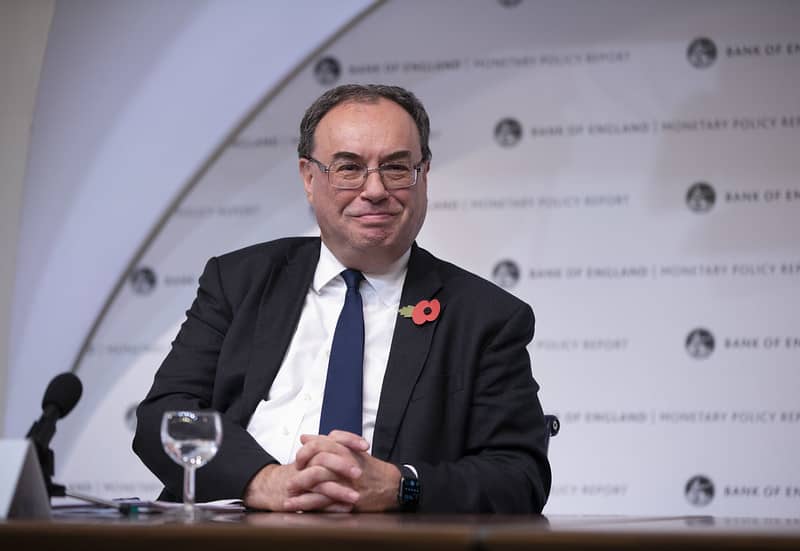
Above: Bank of England Governor Andrew Bailey delivers a post-MPC press conference in November. Image courtesy of the Bank of England, reproduced under CC licensing conditions.
The British pound fell but soon recovered after the Bank of England set up a December interest rate reduction.
The Bank of England kept its basic interest rates unchanged in November, but showed it is ready to cut again soon.
It's that promise of further cuts that initially weighed on sterling:
📉 The pound to euro conversion dropped to 1.1338 from 1.1368 in the first few minutes following the announcement. The pound to dollar conversion went from 1.3091 to 1.3060.
📈 Fast-forward to early afternoon London time and those losses were erased and both headline pairs are where they were just ahead of the announcement.
Off the bat: the Bank's Monetary Policy Committee voted by a majority of 5–4 to maintain Bank Rate at 4%.
But what's clear is the Bank thinks it's time to sharpen the knife: "If progress on disinflation continues, Bank Rate is likely to continue on a gradual downward path."
This was made clear by a barrage of statements issued to make it clear the Bank thinks it's well placed to push inflation back to 2.0%:
💬 "I see further policy easing to come if disinflation becomes more clearly established in the period ahead," said Governor Andrew Bailey in his assessment.
Bailey is a key swing voter who looks set to flip to favouring a cut in December.
But just to hammer home the point, the Bank's statement fired off the following lines:
- "CPI inflation is judged to have peaked.
- "Progress on underlying disinflation continues.
- "Easing of pay growth and services price inflation
- "Subdued economic growth and building slack in the labour market.
- "The risk from greater inflation persistence has become less pronounced recently, and the risk to medium-term inflation from weaker demand more apparent
So a December cut is nailed on. And, the market will likely price in further cuts in February and maybe again in H1 2026.
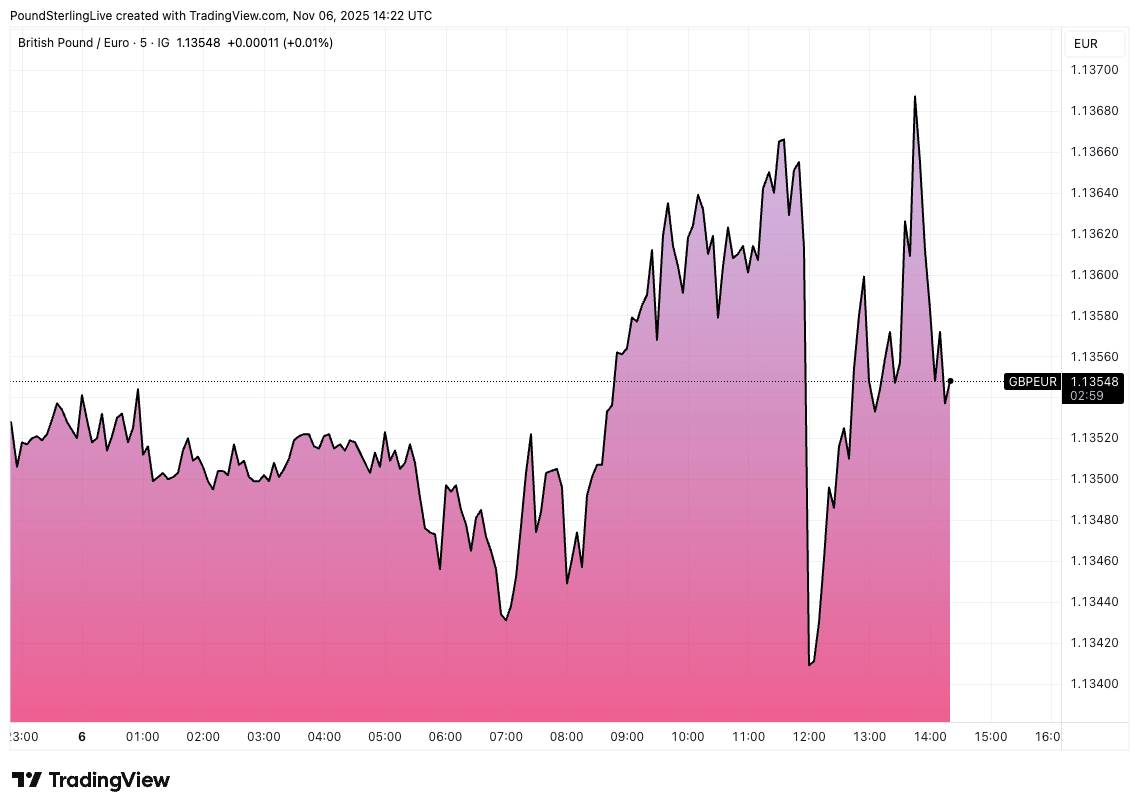
Above: Sterling recovers initial losses, reflecting the pre-decision assumption that if the Bank didn't cut today, it would have cut in December.
Why did the pound recover? Despite the initial knee-jerk move lower by sterling, we always thought it would be insulated against a massive downside move from here.
Heading into the November decision, markets saw a 50/50 chance of a cut in November but a 100% cut by December. So big picture, not much has changed on a two-month timeframe: a cut was always coming.
Given this, there was a high bar to leap for further GBP weakness.
🔎 "It isn’t easy to see GBP getting much of a lift, but the market is short, and sentiment is dire," says Kit Juckes, lead FX analyst at Société Générale.
FX strategists at Barclays say a cut by the Bank of England this week is unlikely to move the terminal Bank Rate much below 3.25% (from c.3.35% currently).
The policy meeting will struggle to "validate the already very dovish market expectations and thus could prop up the beleaguered GBP," says Valentin Marinov, head of FX strategy at Crédit Agricole. "A lot of negatives are in the price of the currency."
The Bank's own forecasts back up the view that the floor isn't going to open up underneath UK interest rates, and therefore, the pound.
📊 The new forecasts use market pricing for Bank Rate that shows it settling at 3.50% in 2026 (which matches the consensus estimate).
Inflation forecasts, meanwhile, show headline inflation trundles along to 2.5% in the fourth quarter of next year and the 2.0% target in the fourth quarter of 2027.
So, as the Bank has been saying ever since it started cutting interest rates, inflation will fall to the 2.0% target in the medium term.
Unfortunately for UK businesses and consumers, the medium-term never gets any closer.