Euro exchange rate complex forecasts at the start of February confirm the euro's strength may be starting to fade.

The euro fell back at the end of January despite positive inflation data on Friday which saw Core Inflation beat estimates in January, and this unusual reaction bears testament to the new dictator of global currency markets – risk.
Risk is important for the euro as it tends to benefit when markets are running scared. It is this relationship, for example, that has allowed it to pummel the British pound since December.
Why does the euro benefit when markets are in the red? The euro is cheap - the base lending rate at the ECB is now at 0.05% ensuring it is cheap to borrow euros to finance a whole plethora of higher-yielding investments across the globe.
The problem is that these investments don’t look so rosy at the moment with China offering investors reason to sell up. All those cheap euro=based loans will therefore need to be repaid, this in turn drives up the exchange rate as the capital is repatriated.
The euro gains when markets are in risk-off mode - it stands then that the shared currency should lose out when markets are confident.
Latest Pound/Euro Exchange Rates
  | Live: 1.187▲ + 0.03%12 Month Best:1.1913 |
*Your Bank's Retail Rate
| 1.1466 - 1.1514 |
**Independent Specialist | 1.1704 - 1.1751 Find out why this is a better rate |
* Bank rates according to latest IMTI data.
** RationalFX dealing desk quotation.
We saw the euro exchange rate complex suffer towards the end of January as markets turned positive.
“Surprise stimulus from Japan ignited a global risk party, sending stocks and other risky assets higher at the expense of low yielders like the euro. Consequently, the euro found little love from constructive news on inflation whose 0.4 percent increase was the highest in 15 months,” says Joe Manimbo, Chief Market Strategist at Western Union.
At the start of February, however, Chinese Manufacturing Data throws up the risk that markets could start to fear a hard-landing in China, if the data is worse-than-expected; this would ultimately help the euro after its transformation into a global safe-haven.
Eurozone Data Will be Key
On Tuesday, there is some major high tier data in the guise of Euro-zone Unemployment, which came out at 10.5% previously, as is forecast to continue its down-trend; then German Unemployment is released (6.3% previously) and German Unemployment Change (-14k prev).
Unemployment could be key to the euro-zone exchange rate as it is one of the areas of the economy which is recovering well, along with bank lending and housing.
These three growth areas appear to be keeping the euro well-bid even through the release of normally weakening news, such as the recent more dovish ECB rhetoric and positive data for its counter-parts.
The next release comes on Wednesday when the Consumer Confidence Index for Jan is released (42.7 prev); this is succeeded by Euro-zone Retail Sales which showed a 1.4% rise in the previous month (year-on-year).
On Thursday German Construction PMI will hit analyst’s in-trays, with a 55.5 previous result to beat; simultaneously the ECB will release their Economic Bulletin, giving their latest views on the outlook for the region.
This will be important for gauging how the recovery narrative is evolving, and therefore whether the fundamental backdrop for the euro remains benign.
Both German and Euro-zone PMI are also due for release on Thursday with Germany having given a 50.5 previous reading and the Euro-zone 49.
On Friday German Factory Orders yoy in December are expected, with a previous 2.1% result in November.
Euro Forecasts: Is the Shared Currency Failing?
The EUR/USD is still stuck in its gently-sliding, sideways channel, after the initial post-ECB booster.
"Last week’s EUR/USD failure at 1.0968 is bearish, targeting the 1.0776/11 January lows. This failure occurred slightly below tough resistance at 1.1000/1.1060," says Axel Rudolph at Commerzbank.
These are the recent highs and the 200 day ma, the 2014-2016 downtrend and 55 week ma and we view the market as bearish while capped here. "Our target remains the 1.0523 recent low," says Rudolph.
Really, our forecast has not changed much, as we still see risks biased to the upside given the euro’s new role as international ‘safe-haven’ and risks still tilted to more shocks from the China-Oil complex.
Yes, things have calmed down - and everyone came together at Davos to cheer China on and wave away hard-landing fears as over-exaggerated - however, a fall in the Caixins could see the spectre of risk-aversion rise up again and this would spell dollar-weakness and EUR/USD upside.
As such Pound Sterling Live sticks to its forecast of a break above the 1.0985 Jan 15 highs leading to a probable move up to the 200-day MA at 1.1050.
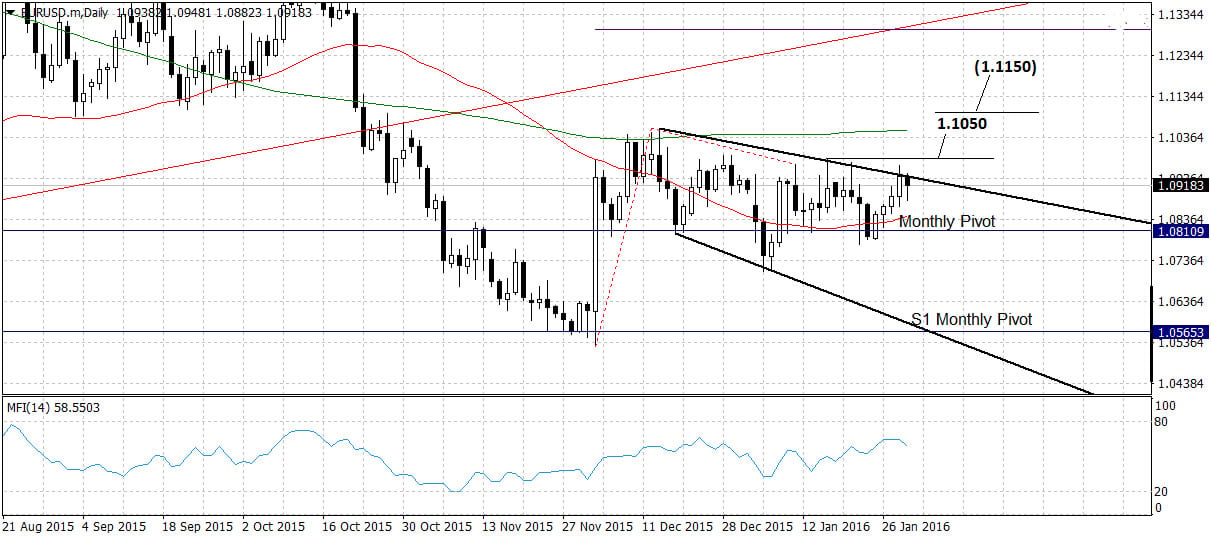
This might be followed by a break above the 200-day MA and move up to a possible eventual target at the 61.8% Fibonacci extension of the height of the consolidation at 1.1150.
Such a move might be risky, but could gain confirmation from a 40-point clearance above the 200-day, with a break above 1.1090 likely to lead to a continuation higher.
GBP to EUR Forecast: Daily and Weekly Outlook
The weekly chart of GBP/EUR appears to be reflecting the increased possibility of a Brexit sell-off after painting a bearish pattern at the highs.
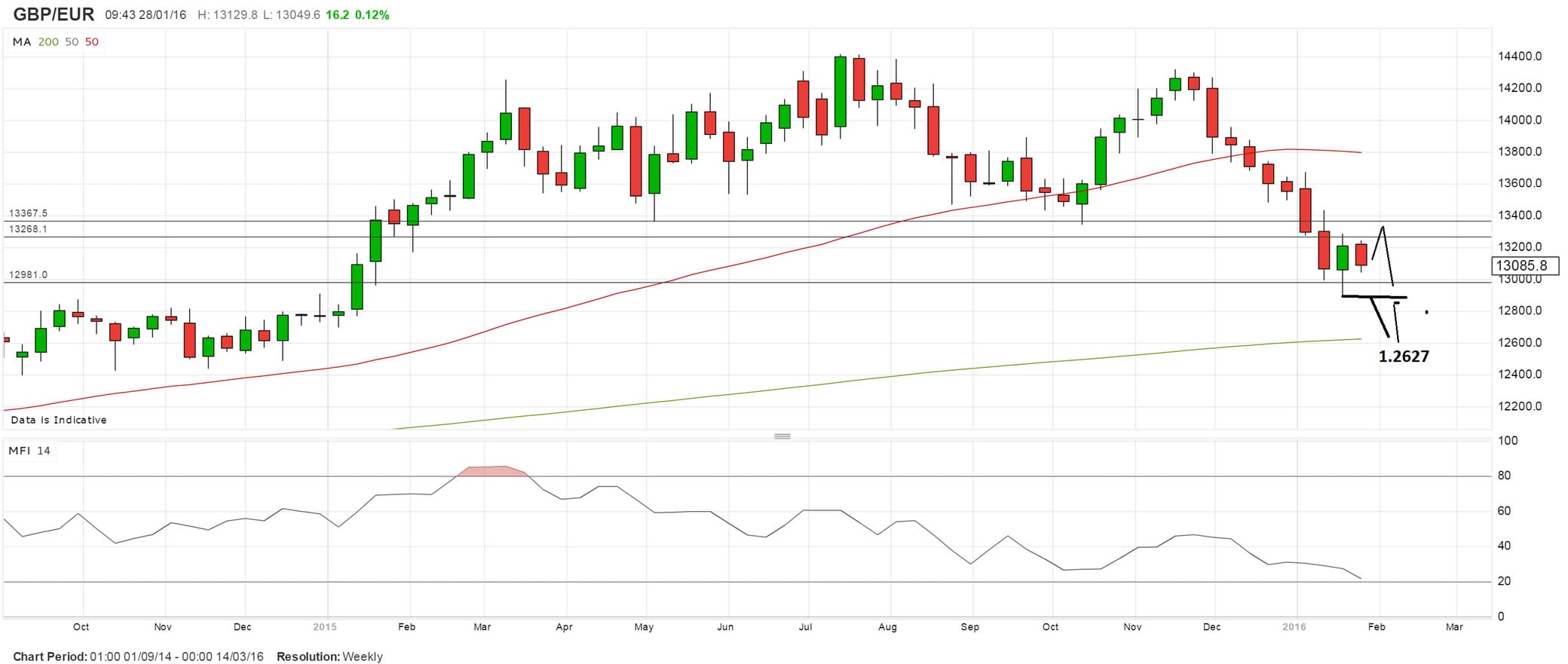
The real concern for sterling traders over the medium term are Brexit fears and for the technically inclined these are reflected by the giant head-and-shoulders pattern bearing down on the weekly chart.
The pattern’s neckline at 1.3367 has already been breached and the exchange rate has moved down to 1.2893 lows, however, from there it has bounced back up to 1.3288. Currently it is languishing in the 1.3130s.
For confirmation of a continuation lower the conservative trader would look for a break below the recent 1.2893 lows leading to a move down to the 200-day MA at 1.2627, those with a greater stomach for risk would go for a short at the high point of the throw-back, with a tight stop just above the level of the neckline.
On the daily chart GBP/EUR has broken back inside its descending channel.

The previous breakdown below the lower edge of the channel may have been an exhaustion move, signalling the termination of the previous down-trend.
It is too early to say that the down-trend has completely reversed, but the incidence of three up-days in a row at the end of a down-trend is a bullish signal in itself.
There are two layers of strong resistance directly above the exchange rate, which stand in the way of more robust gains, these are the S1 Monthly Pivot at 1.3268 and the neckline for the large head and shoulders pattern visible on the weekly chart, a bit higher at 1.3368.
The Chaikin Money Flow Index is supporting more upside as it diverges with price.
Ideally for conformation of more up-side I would want to see a breach clearly above the neckline, confirmed by a move above the 1.3450, with a target at the 50-day MA at 1.3600.
Alternatively, a resumption of the dominant short-term down-trend is also possible, with a break below the 1.2893 lows, leading to a move down to support from the 200-week MA at 1.2615.