Image © Adobe Images
Analysts at Morgan Stanley says the euro-dollar is well placed to retest 1.20.
"The pathway to DXY weakness is widening, not narrowing," says the U.S. investment bank in a recent strategy update.
"A cease fire may be positive for risk currencies in the near-term, but we think medium-term USD weakness may be more concentrated versus major peers (EUR, JPY, CHF)," it adds in a note released Tuesday.
The call comes as the euro-dollar extends a recovery back to the 1.18 area, meaning it has fully unwound its war premium.
The dollar has weakened broadly despite the situation in the Middle East not being fully resolved, and oil still hovering near $100 / barrel, conditions that are naturally supportive of the world's reserve currency.
Morgan Stanley says a slowing U.S. economy is a key driver of a USD outlook that is vulnerable to further decline:
"We think the Defense Regime is the next natural stage for markets as they focus increasingly on growth weakness. Indeed we estimate that higher energy prices may more than fully offset increased tax refunds - a key argument previously espoused for a stronger USD - while financial conditions have tightened on net to the equivalent of two Fed rate hikes."
The analysis explains that U.S. growth concerns suggest lower real rates, tighter breakevens, and the outperformance of low yielders versus the USD.

Concierge Money Transfers
For high-value transfers, you need high-value service: dedicated account management, on-point pricing, insight into market conditions and trends, help with structuring your payment, and execution support at key moments.
Learn More →"While we are neutral on EUR/USD for now given the elevated level of uncertainty and volatility, we think the case for EUR/USD above 1.20 in the medium term has strengthened," says Morgan Stanley.
Strategists at Société Générale said on Tuesday the euro-dollar exchange rate looks to be on the march back to 1.20.
"There is a very good chance now, that if we do indeed see a fresh de-escalation of the conflict (and in particular, reopening of the Strait of Hormuz), EUR/USD will breeze back above 1.20 on a wave of positive sentiment," says Soc Gen's head of FX strategy and research, Kit Juckes.
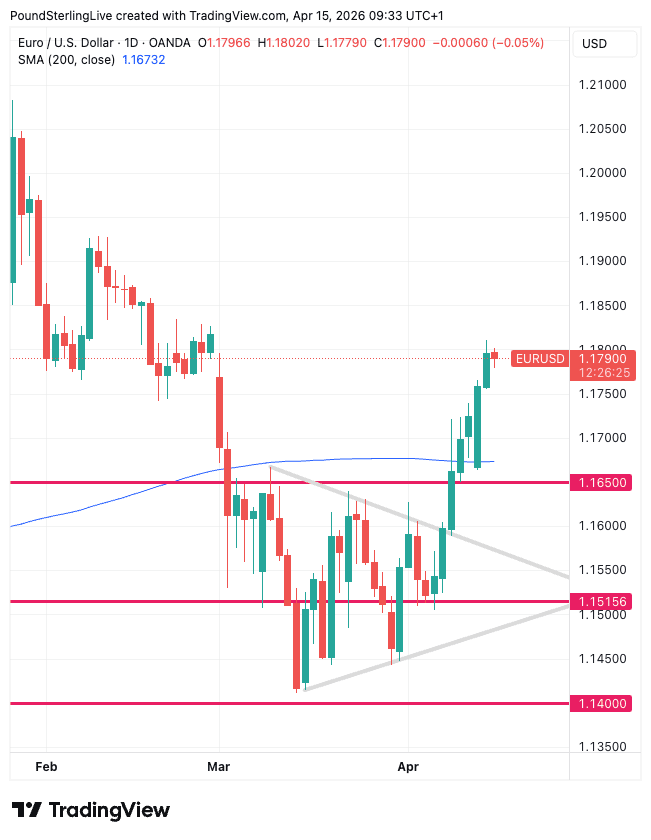
EUR/USD reached 1.18 on Tuesday and holds those gains into the midweek session, making for a 3.40% recovery since March's lows.
"The Euro has managed to post gains amid renewed hopes for an agreement in the Middle East conflict," says Ralf Umlauf, analyst at Helaba Bank. "At its peak, it was trading at 1.1811, placing it clearly above all common moving average lines. The next resistance levels are visible at the recent interim highs in the 1.1825 area and around 1.1920."
He adds that support - in the event of any slipups - can be found at the aforementioned average lines, which are situated within a zone ranging from 1.1672 to 1.1699.
Gains by the euro reflect growing hopes that the damage to the Eurozone economy will be relatively contained, given hopes that the blockage of the key Strait of Hormuz will soon be ended by a meaningful deal.
Don't let the rate decide.
You decide.
News media continue to report that the U.S. and Iran will likely resume talks in the coming days.
For its part, the European Central Bank (ECB) isn't overly concerned. We heard from ECB President Christine Lagarde on Tuesday that the euro area economy has moved away from the ECB's Iran-war baseline, but not enough yet to justify leaning toward rate hikes, noting that "we are in between the baseline and the adverse" scenario.
"It doesn't predicate that we'll go in one direction or the other and it certainly does not determine a rate path that I can confirm today," she said in an interview with Bloomberg. "Any of the colleagues who are confident that it's going to be one way or the other don't know, honestly."
The market had steadily raised bets that the ECB would respond to the war by raising interest rates in the coming months, but Lagarde is clearly trying to caution against that assumption.
For now, easing rate hike bets are considered supportive of the economy, which is helping the euro advance against the dollar. However, with hikes still anticipated by the market, there's also some support for the euro-dollar via the interest rate channel.
"The pullback in oil prices, together with comments from C. Lagarde, helped bring down ECB tightening expectations, with the market now pricing just over two rate hikes for this year. The 2Y Schatz yield fell by about 10bp to 2.54%... The 10Y Bund yield dropped 7bp, returning close to 3%," says a note from Natixis, the French investment bank.