✳️ Secure today's exchange rate for a future payment. You may also book an order to trigger your purchase when your ideal rate is achieved. Learn more.
Image © European Central Bank
The euro has turned the tables on the dollar, and more gains are possible as a result.
The dollar has come under renewed pressure against the euro following the sharp sell-off in U.S. regional bank stocks.
Zions Bancorp fell by 13% after a USD50 million charge-off tied to a California Bank & Trust loan, while Western Alliance Bancorp dropped by 11% after revealing exposure to the same borrowers.
The developments point to potential cracks opening in America's credit markets.
And when market concerns are centred on U.S.-specific issues, the dollar tends to come under pressure: the euro to dollar exchange rate jumped to as high as 1.1720 in the wake of the headlines.
However, with the selloff spreading to mainstream bank stocks in Europe on Friday, that U.S.-centric theme fades somewhat, allowing the dollar to recoup a portion of those losses, taking EUR/USD back to 1.1690.
Nevertheless, the dollar is down 0.65% against the euro on the week, and EUR/USD is pointing higher once more amidst a shift in momentum, with some analysts eyeing a potential test of 1.18 before long.
Helping the euro was the survival of French Prime Minister Lecornu in two no-confidence votes on Thursday.
He survived after announcing plans to suspend pension reforms until after the next Presidential election in 2027, sacrificing fiscal discipline for political necessity.
A stable, albeit shaky, French government is "enough for the euro to price out a good portion of the French risk premium," says Francesco Pesole, FX strategist at ING Bank.
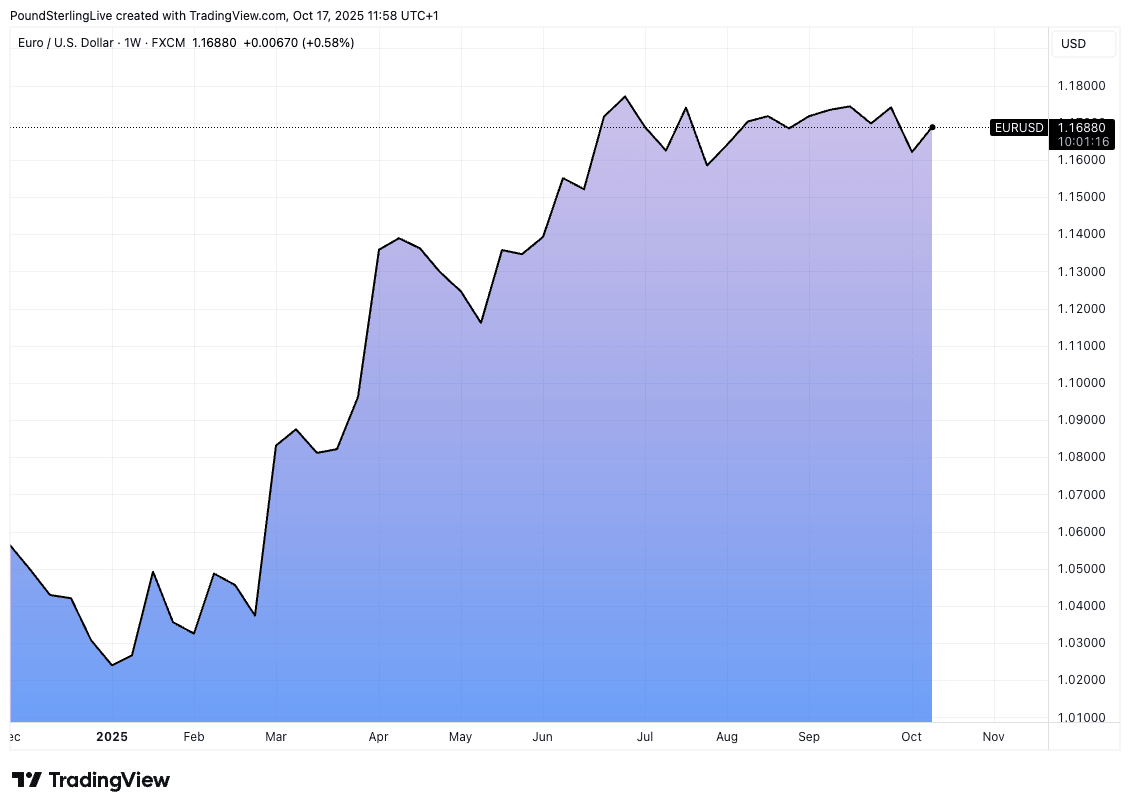
Above: Multi-week, the euro looks well supported against the dollar.
"Barring a new government collapse before year-end, this should allow EUR/USD to refocus on canonical market drivers (rates and equities)," he adds.
Analyst Lee Hardman at MUFG Bank says the political developments not only boost the euro, but diminish the shine of the USD as a safe haven.
"The U.S. dollar has continued to weaken," says Hardman. "The reversal of those dollar gains over the past week has encouraged an easing of political uncertainty in France and Japan. French Prime Minister Lecornu survived two no-confidence votes yesterday."
Kevin Ford, FX analyst at Convera, says the dollar has also been pressured by the Federal Reserve's ambition to deliver another quarter-point rate cut at its October meeting as it seeks to support growth while not stoking inflation.
As a result, EUR/USD "is now eyeing early-October resistance at 1.1750/1.1770," he says. "The Fed’s dovish tone has anchored EUR/USD around the 1.18 level, with that gap to be quickly filled amid the above developments."
✳️ Secure today's exchange rate for a future payment. You may also book an order to trigger your purchase when your ideal rate is achieved. Learn more.
Jerome Powell said in a speech given to the NABE Annual Meeting this week, "this policy stance, which I see as still modestly restrictive, leaves us well positioned to respond to potential economic developments."
In this context, Powell is saying the Fed has ample room to cut interest rates without risking stimulating inflation. An ensuing rally in stocks and a fall in the dollar confirm this interpretation was adopted by traders.
Given developments, analysts at ING eye the 1.18 level as a potential near-term target for euro-dollar:
"The dollar remains in a fragile spot, and a break above 1.750 is surely possible, with 1.180 starting to look very realistic again. The upcoming meeting between Trump and Putin could also attract EUR-positive speculation on a Ukraine truce," says Pesole.