The EUR to GBP conversion has hit 0.8833 on Wednesday morning as Sterling's sell-off extends into fifth consecutive day.
~ The Pound to Euro exchange rate today: 1.1322
~ The Euro to Pound Sterling exchange rate today: 0.8833
Sterling has fallen to 31-year lows versus the U.S. Dollar today and 5-year lows versus the Euro.
The UK currency had been under pressure for the past few weeks but now that key support levels have been broken, many are even wondering if the British Pound will hit parity versus the US Dollar and/or the Euro.
The key driver for the declines is a market apparently gearing up for a 'hard brexit' - one in which the UK government seeks full autonomy from Europe, even if the cost of doing so is losing unfettered access to the single markert.
It seems to us that the worst-case scenario is being priced into Sterling and leads us to wonder whether all the bad news could soon actually all be absorbed and a limit to the EUR/GBP's advance could therefore soon form.
Whatever the case, for those using Euros to buy Pounds you are looking at the best exchange rate to do so since 2011.
While spot is quoted at 0.8834 we see bank accounts offering payments from between 0.8587 and 0.8525. Independent providers are quoting rates of between 0.8754 and 0.8693.
How High Can the Euro Go?
Judging from the research from several analysts there is a good chance the Euro will continue advancing against the Pound.
A move up to 0.8815 is expected in the long-term according to analysis from Swissquote’s Peter Rosenstreich, even though he sees weakness in the short-term:
“In the long-term, the pair is currently recovering from recent lows in 2015. The technical structure suggests a growing upside momentum. The pair is trading far above from its 200 DMA. Strong resistance can be found at 0.8815 (25/02/2013 high).”
After the break higher on Monday morning analysts at Lloyds Commercial Banking expect further upside to new highs, albeit in the final wave higher of a tired up-trend:
“The cross has re-tested and progressed through resistance around 0.8720 this morning, with a clear break shifting the market’s focus to previous weekly highs from 2013 at 0.8770 and 0.8815.”
Latest Pound/Euro Exchange Rates
  | Live: 1.1685▲ + 0.19%12 Month Best:1.1828 |
*Your Bank's Retail Rate
| 1.1288 - 1.1334 |
**Independent Specialist | 1.1521 - 1.1568 Find out why this is a better rate |
* Bank rates according to latest IMTI data.
** RationalFX dealing desk quotation.
Echoing the 0.8815 target is Commerzbank’s market technician, Karen Jones.
“Upside scope remains intact for a retest of the 0.8724 high and a break above here to the 0.8815 February 2013 peak,” remarks Jones, adding:
“Please note that we have various Elliot wave counts that suggest that the move will extend longer-term towards the 0.9250 area.”
From a fundamental perspective, the uptrend is also well supported.
Strategists Stay Bullish on the Euro
Most institutional analysts appear to be sticking with their bullish view of the Euro even with the worrying deteriorating in sentiment towards the Eurozone's banking sector, largely lead by the fall in Deutsche Bank’s share price.
The Deutsche Bank crisis is not likely to heavily influence the trajectory of the Euro since, say J P Morgan in a recent note as the European Central Bank has made ample amounts of liquidity to the sector available.
In short, extrapolating similarities between the 2008 crisis and 2016 is unlikely to yield many predictive powers when it comes to calling a banking crisis.
Morgan Stanley expects the Deutsche Bank crisis to actually propel the Euro higher as it will encourage more Eurozone banks in general to sell their risky foreign assets and repatriate their Euros.
“We think that worries about the European banking sector are actually a bullish sign for the currency (the Euro) as it may lead to banks selling off foreign assets and bringing the money back home,” say Morgan Stanley in a research note to clients.
And, the view that low-interest rates are partly to blame for Deutsche Bank’s woes suggests the ECB may hold back from further stimulus which would be negative for DB as well as Eurozone banks in general.
The ECB keeping policy settings and avoiding further interest rate cuts would certainly aid the Euro higher as it is central bank stimulus that is keeping it at these long-term lows against the Dollar.
The banking crisis limits how much the ECB can do since any move to lower rates any further, will lead to an even narrower margin of profitability for Eurozone banks’ lending on to customers, as they will be unable to charge very high interest.
“Stabilising ECB rate expectations have been keeping the single currency broadly stable of late. Given an empty calendar when it comes to market-moving data releases this is unlikely to change this week,” say Credit Agricole giving their input on the matter.
Furthermore Credit Agricole note:
“If anything there may be some focus on September PMI readings, which are likely to confirm moderately expanding business activity.
“However, considering it will be final readings, there is only limited surprise potential. In terms of speeches, ECB Governing Council Knot will be in focus.
"He is unlikely to make a case of changing monetary policy expectations.
“This, in turn, should leave the single currency driven by external factors such as global risk sentiment and Fed rate expectations."
An analysis of different bond yields also suggests the euro is likely to go sideways or even higher.
Societe General point to how stubbornly US 10-year bond yields remain below 1.6% despite ongoing talk of a December rate hike.
This would be negative for the dollar, at least.
“After another frustrating week, when, despite OPEC agreeing to production cuts and Fed officials working hard to point the market towards a December hike, 10y nominal US yields are still below 1.6%, and it’s hard to get excited about shorting the Euro,” Societe Generale said in a recent note.
Analysts at the French bank see potential upside for the Euro versus the Pound and the Yen from a pure yield comparison point of view since both these currencies are unlikely to see higher yields, whereas the US may if the Fed make a surprise move.
Generally, FX flows go to the higher yielding side of a pairing as foreign investors tend to invest their capital in higher yielding vehicles.
“Maybe we’re just in for a long period of going sideways. But I have two more sources of concern, which may argue for Euro longs, against GBP* now and against the yen before long. EUR/JPY is attractive because while USD/JPY is equally sensitive to 10y real yield moves, there’s less upside risk to 10y JGB yields, particularly adjusted for inflation, and the Fed is less sensitive to USD/JPY than EUR/USD, given their relative importance in the TWI baskets," conclude Societe Generale.
Technicals: Further Gains Likely
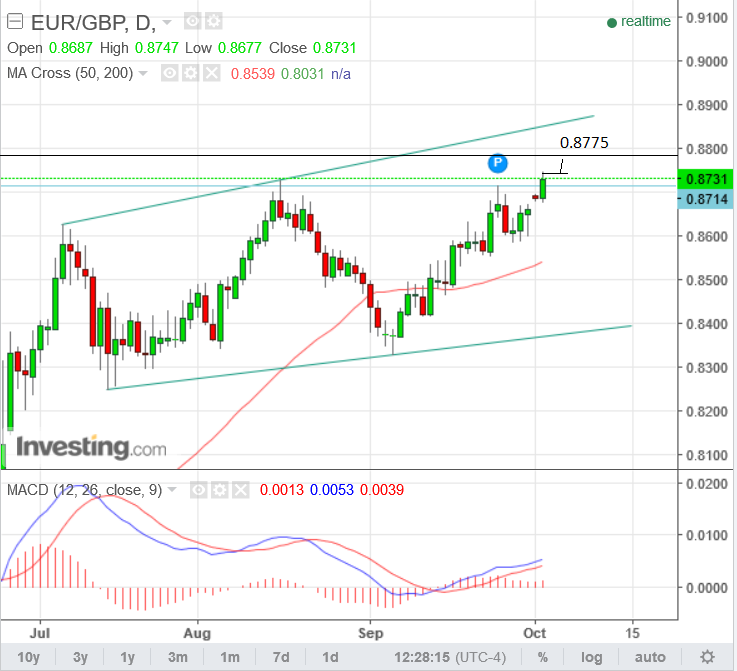
From our own technical veiwpoint we see a strong possibility of a continuation of the trend higher to a near-term target at robust resistance at 0.8775.
A break above the 0.8747 highs would provide confirmation of the move.
The fact the MACD is above the zero-line and that it is not crossing below the signal line supports a continuation of the uptrend.