The GBP to EUR exchange rate finds itself perilously to the wrong end of a key technical level which could open the door to the 1.20 region in coming days.

The sterling to euro rate has managed to close the week just above the 1.30 region. The Bank of England’s Inflation Report did not go to plan for sterling bulls and we have seen the rebound recorded in late January undone.
The resumption in the euro’s strength vindicates strategists, such as those at Lloyds and Commerzbank, who warned that the euro was merely taking a break.
That said, the case for a stronger February for the pound remains compelling for a number of reasons, as argued by ING here. While much of ING's arguments have been invalidated there remains the issue of the European Central Bank which could announce an agressive cut to interest rates to stem the strengthening euro.
Either way, we warned that the pound was at a cross-roads on the charts in our mid-week reporting as the GBP’s short-term uptrend ran into the longer-term downtrend.
We said resolution of this cross-road was key to the evolution of the GBPEUR story.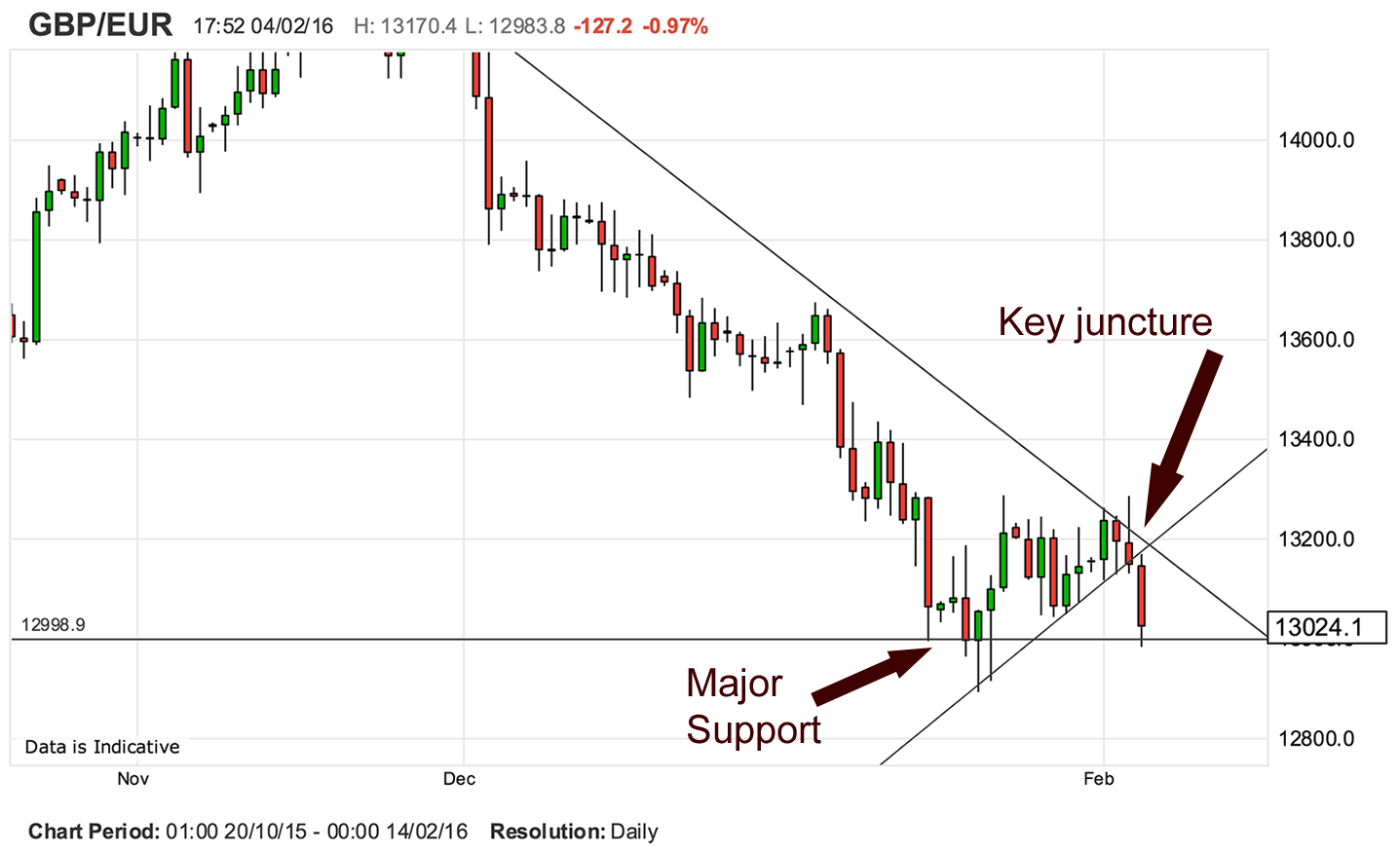
The downside won, as it should; longer-term momentum is a stronger force and should be favoured.
However, we find ourselves at another key juncture in the form of the 1.30 support zone, another long-term level of support.
There will be a plethora of speculators who will have placed their stop-losses just below 1.30 when buying the GBP dip.
Beware, should the support level at 1.30 break we could witness a rapid descent into the 1.20s.
Latest Pound/Euro Exchange Rates
  | Live: 1.1888▲ + 0.19%12 Month Best:1.1913 |
*Your Bank's Retail Rate
| 1.1484 - 1.1531 |
**Independent Specialist | 1.1722 - 1.1769 Find out why this is a better rate |
* Bank rates according to latest IMTI data.
** RationalFX dealing desk quotation.
Such a move would echo the fate of the euro / dollar exchange rate mid-week which surged above the 1.10 zone as it broke out of the shackles of the longer-term sideways-trending range.
The market here was laden with stop-losses in the 1.1050-1.1150 zone, placed by traders who were betting on a return to the bottom of the range.
Poor US economic numbers caught markets by surprise and pushed EURUSD into the landmines above 1.10. The result was a huge amount of dollars dumped onto the market when these stop-losses were triggered.
The snowball effect took the euro/dollar sharply higher into what could now be a new range for coming weeks and even months.
This fate could well await the pound/euro over coming sessions should 1.30 fail.
But, Storm Clouds Gather for the Euro
The euro exchange rate complex is strengthening once more. Most notably we have seen the EUR/USD rate break decisively out of a long-established containment area to reach levels above 1.12 once more.
The implications of the move are negative for Eurozone exporters who have been leaning on a weaker currency to ensure their goods remain competitive on the global stage. In short the strengthening of the euro represents a threat to the Eurozone recovery.
"A modest weakening of eurozone data, tighter financial conditions as well as a more dovish Fed, BoE and BoJ increase the potential for a more aggressive ECB easing," says Mark Wall at Deutsche Bank.
All eyes are therefore on the ECB's policy meeting on the 10th of February at which analysts expect policy makers to warn it is not comfortable with the euro's recent strength.
Capital Economics believe that implied interest rates are at such levels that the ECB will have to announce a cut of more than 10 basis points in March, the date of the next 'live' meeting.
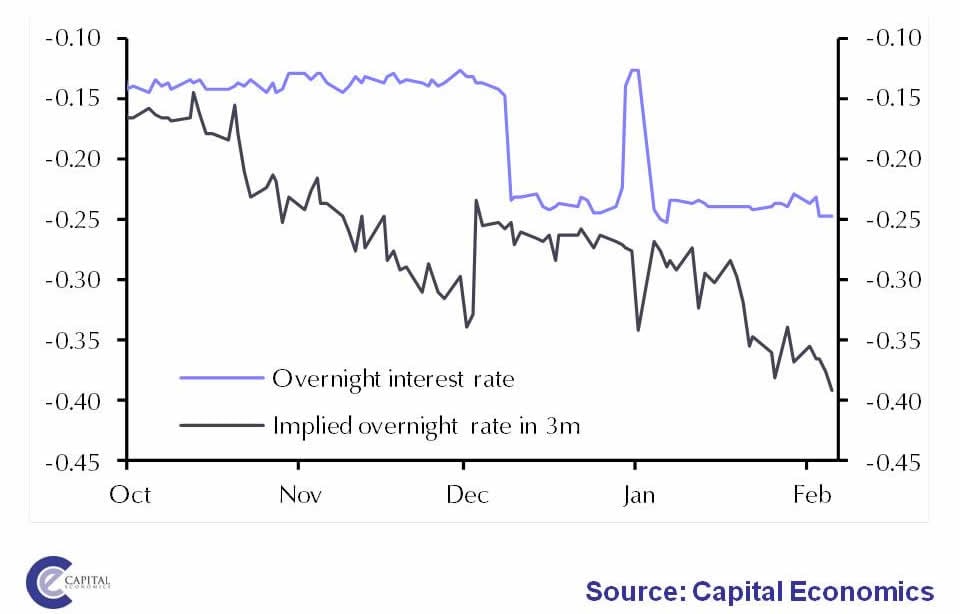
Deutsche Bank's Wall warns that while he sees a deposit rate cut as a near certainty, it won’t be enough.
"We persist with our call for an increase in the synergies between the negative deposit rate, QE and TLTROs. Furthermore, we think that data will have to surprise on the upside to avoid a temporary acceleration of the monthly QE purchases," says Wall.
The euro area final January PMIs confirmed the softer flash reading. Despite the monthly decline, all the major activity indices remain consistent with ongoing recovery.
The negative news was the slightly larger decline than before in the prices indices, adding to ECB concerns over low inflation.