Image © Adobe Images
PMIs, consumer confidence, retail sales and government borrowing all point to a deterioration in conditions.
A series of official data prints and economic surveys confirm the UK economy lost steam in the lead up to the November budget, raising the odds of a faster rate of interest rate cuts at the Bank of England.
🔻 S&P Global's monthly PMI survey of the economy showed a drop in private sector momentum as the Composite PMI declined from 51.8 to 50.5, due to a softer rise in service sector activity.
"Some of this malaise has been blamed on paused spending decisions ahead of the Autumn Budget, but there’s a real chance this pause may turn into a downturn," says Chris Williamson, Chief Business Economist at S&P Global Market Intelligence.
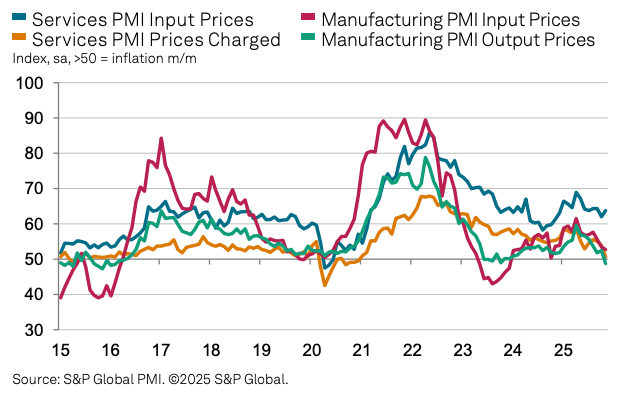
A subcomponent of the report showed a welcome deceleration in inflationary pressures facing firms as S&P Global said average output prices rose at their slowest rate in nearly five years.
This will advance the view that underlying inflation in the economy is rapidly slowing and opens the door to a series of interest rate cuts at the Bank of England.
💬 "We expect the MPC to cut rates by 25bp in December, and then another four times next year, taking the bank rate to 2.75%, a level we judge to be broadly neutral. In contrast, financial markets are pricing a 70% chance of a rate cut in December, and for the bank rate to end next year at 3.4%," says Daniel Vernazza, Chief International Economist at UniCredit bank in London.
📉 Earlier in the day it was reported that the UK Consumer Confidence Index fell by two points to -19 in November.
"This is a bleak set of results as we head towards next week’s Budget," says Neil Bellamy, Consumer Insights Director at GfK. Particularly concerning was a drop in confidence over the economic outlook for the coming 12 months, which contributed to a drop in big-ticket purchase intentions.
✳️ Secure today's exchange rate for a future payment. You may also book an order to trigger your purchase when your ideal rate is achieved. Learn more.
🛒 Corroborating a potential retracement in consumer activity was the official ONS retail sales report, which read at -1.1% year-on-year in October, undershooting the 0% expected.
"Weakness was relatively broad-based: food store sales were down by 1.1% and clothing and footwear store sales fell by 3.3%," says Sandra Horsfield, an economist at Investec.
The ONS blamed the retail sales slowdown on consumers holding back spending in anticipation of Black Friday sales.
💬 "Nevertheless, with GfK November consumer confidence falling 2pts to -19 and the press release describing fears of a ‘difficult’ Budget, there looks to be more to it than just a pre-sales lull," says Sam Hill, Head of Markets Analysis at Lloyds Bank.
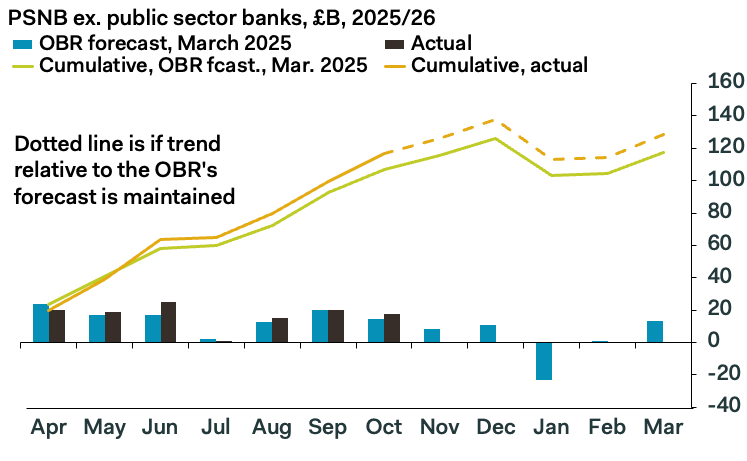
Image courtesy of Pantheon Macroeconomics.
The government's budget, due to be set out next week, is expected to detail significant tax rises, which risk squeezing the economy further.
The scale of the tax increases rest with a significant borrowing requirement by the government, with the ONS confirming on Friday the government borrowed £17.43BN in October, versus £15.2BN expected and head of the OBR's projections by £3.1BN.
"October borrowing illustrates the difficult backdrop to the upcoming Budget. Borrowing has now overshot the fiscal watchdog’s projections in four of the seven months," says Elliott Jordan-Doak, Senior U.K. Economist at Pantheon Macroeconomics.
✳️ Secure today's exchange rate for a future payment. You may also book an order to trigger your purchase when your ideal rate is achieved. Learn more.