Above: File image of Federal Reserve Chairman Jerome Powell. Image © Federal Reserve.
The U.S. labour market remains resilient, despite a surge in high-profile layoff announcements.
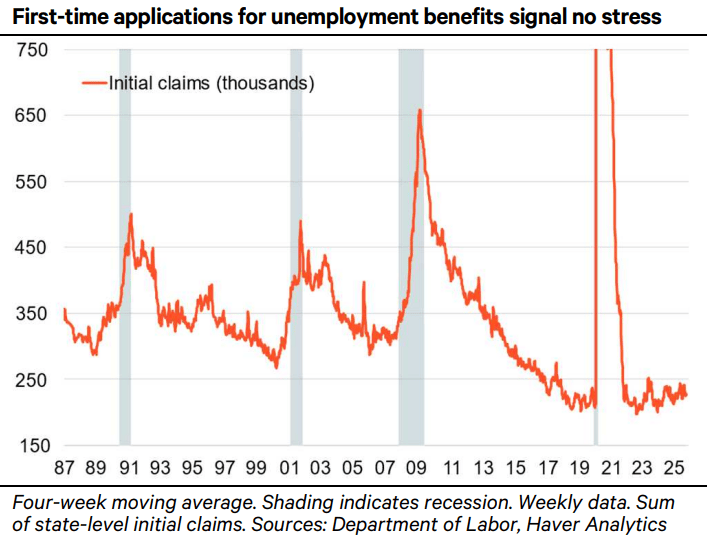
According to a new assessment by economists at Berenberg Bank, state-level unemployment filings show the U.S. unemployment rate has been "roughly stable since August," confirming a still-robust economy and employment situation.
This headline casts doubt on the prospect of a December interest rate cut by the Federal Reserve and risks disappointing market expectations, where the odds of a 25bp cut sit at 75%.
With official data suspended owing to the government crackdown, economists are flexing their skills and modelling the state of the U.S. economy using an array of alternative sources.
Berenberg's Chief Economist Holger Schmieding has looked at state-level employment data and finds that:
"As of the last week of October, these figures are consistent with an unemployment rate that has remained roughly stable since August.
"We expect this stability to persist through year-end as labour demand recovers amid resilient economic activity and easing fears of a sharp slowdown in consumer spending."
He cites corroborating evidence from the Chicago Fed Labor Market Indicator, which projects a 4.35% unemployment rate for October, after 4.34% in September and 4.32% in August.
This week's economic highlight out of the U.S. was the Challenger, Gray and Christmas report that found U.S. employers announced 153,074 job cuts in October, up 175% from a year earlier and 183% from September.
The consultancy said it was "the highest total for October in over 20 years" and compared the current disruption to the early-2000s technology wave.
The report was interpreted in some corners of the market and economist community as evidence the Fed would need to cut rates in December.
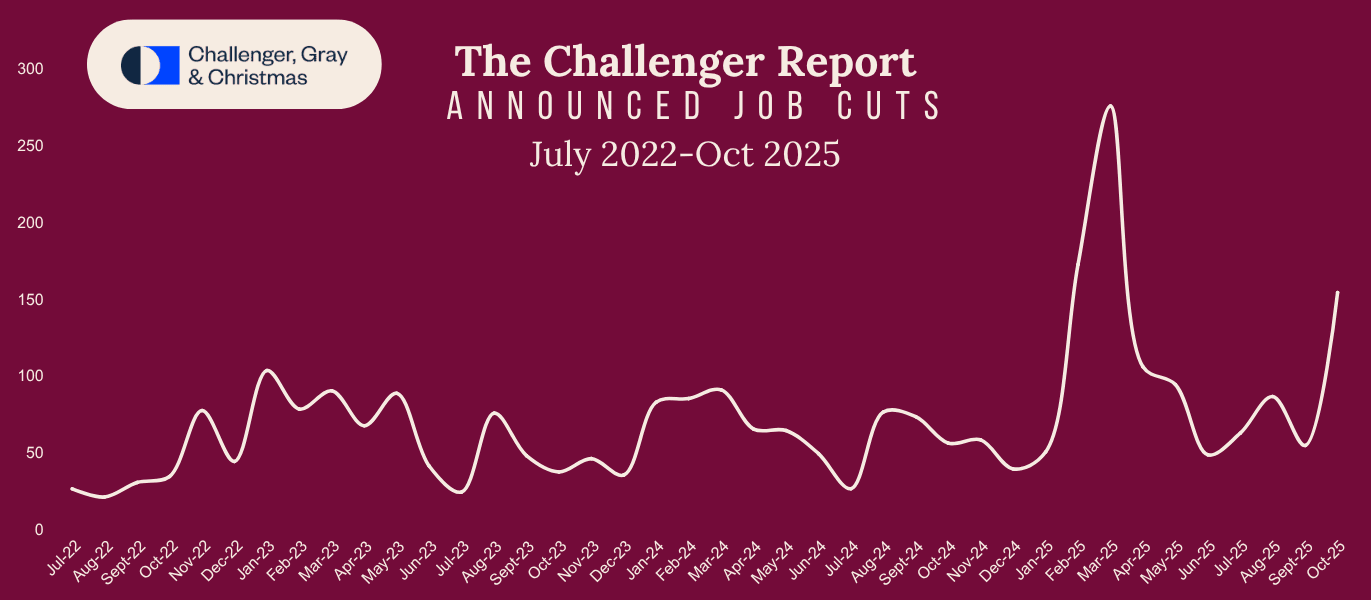
However, Schmieding argues that these headline-grabbing layoff announcements "misrepresent the healthiness of the broader labour market."
The San Francisco Federal Reserve's weekly Labour Market Stress Indicator meanwhile shows that only four states out of 50, well below the threshold of 30 indicating recessions, recorded accelerating unemployment as of the last week of October.
This marks the lowest reading since December 2022.
Berenberg says the U.S. employment situation is at a “curious kind of balance”, echoing Federal Reserve Chair Jerome Powell’s remarks at Jackson Hole.
Minneapolis Fed research shows declining net immigration accounts for 40-60% of the recent drop in U.S. job growth.
Schmieding questions whether lower interest rates would offer any benefit.
"If companies stop hiring and start layoffs as they invest in artificial intelligence, and the labour supply shrinks due to the immigration crackdown, how can the Fed address these structural challenges?" he asks.
Kansas City Fed President Jeff Schmid recently warned that "a 25-basis point reduction in the policy rate will do little to address stresses in the labour market that more likely than not arise from structural changes in technology and demographics."
For that reason, Schmieding concluded, "a broadly stable unemployment rate should keep the Fed from cutting rates at the 17-18 December meeting."