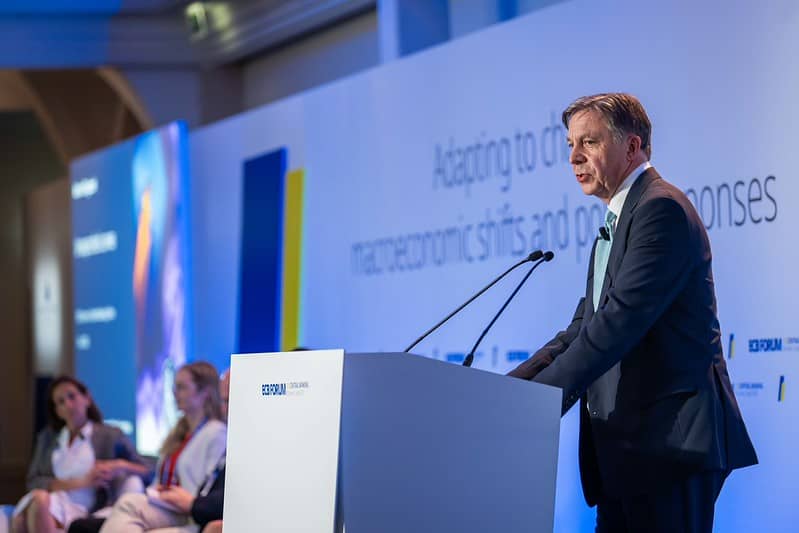
File image of Alan Taylor. Image source and licensing: ECB.
Interest rates are too high and risk sending the economy into a "bumpy landing".
This is according to the Bank of England's Alan Taylor, who has today indicated he is ready to slash interest rates at the November Monetary Policy Committee (MPC) meeting.
His argument is that the economy is already at risk of an unduly harsh slowdown because monetary policy is still too restrictive.
"I see the upside risks to inflation as low compared to the downward trajectory in output and inflation fundamentals," he said in a speech delivered at King’s College, Cambridge.
Taylor's reading is that most inflation expectation measures remain moderate and "the inflation hump" the UK is currently riding will dissipate in early 2026.
Inflation is forecast to have reached 4.0% in September, double the Bank of England's target.
But Taylor's argument is that inflation will fall in 2026 as "taxes and administered price hikes from earlier this year roll off."
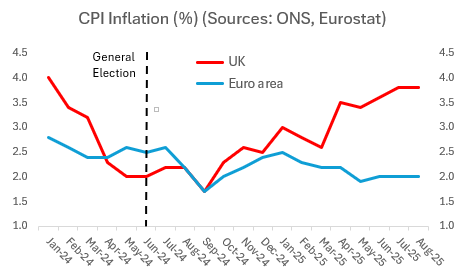
Above: The UK's inflation rate is an outlier when compared to comparable countries. Image courtesy of Julian Jessop.
He does not account for another round of taxes and administered price hikes being announced at next month's budget.
"Still, I see the upside risks to inflation as low compared to the downward trajectory in output and inflation fundamentals," he adds.
Taylor has voted to cut interest rates in five of the last seven votes on the Bank's Monetary Policy Committee (MPC), which casts him as an 'arch dove', alongside Swati Dhingra.
Taylor argues that because the MPC didn't vote with him, they have left interest rates at levels that are too restrictive, which means there are heightened risks that the economy hits a rough patch.
"By maintaining what I think is a too restrictive path of interest rates, we may have braked too hard, such that inflation cannot smoothly return to target with the economy close to potential, as my votes have indicated," he says.
Given this, the economy is headed for a "bumpy landing," he argues.
Here, "inflation undershoots, and goes below target in late 2026, and the economy moves into a weakened state for a sustained period, with output and employment below potential, leading to undue damage to economic activity."
He adds that a "hard landing" scenario is now another possibility that must be considered. In this scenario:
"Weak demand at home can lead to a more forceful downturn, where recession dynamics start to kick in that can be very difficult to contain or even reverse. The economy has been flirting with zero growth, and the realisation of negative readings could easily change the future path for the worse. The probability of this outcome is now not trivial."
Taylor's vote for a rate cut will be opposed by other members of the MPC, including Megan Greene, Catherine Mann and Huw Pill.
Pill, the Bank's Chief Economist, last week warned that the Bank must be focused squarely on inflation control at this point.
There is a clear split on the MPC and it will fall on Governor Andrew Bailey to cast the deciding vote on whether to lower rates when the time comes next month.
Clearly, the odds of a cut are finely balanced, which is at odds with market pricing that suggests there is a lower chance of such an outcome.
It means the market is underpricing a cut, putting the pound at risk of another adjustment lower in the event that it is delivered.