
Image © Adobe Images
A measure of UK business confidence has plummeted to its lowest recorded level amidst heightened uncertainty ahead of November's budget.
With taxes set to be ratcheted up again, businesses are concerned they will be hit hardest, as was the case with the 2024 budget.
"Business confidence has plumbed new depths in September, following a fleeting improvement at the tag-end of summer. Conditions worsened across the board, with cost expectations hitting a record high, driven notably by employment costs," says Anna Leach, Chief Economist at the Institute of Directors.
The IoD Directors' Economic Confidence Index, which measures business leader optimism in prospects for the UK economy, fell to -74 in September 2025 from -61 August.
This exceeds the recent record low of -72 in July 2025 and marks the lowest reading of the Index since its introduction in July 2016.
"Investment expectations declined again, although remained somewhat above the most recent low in November 2024. Meanwhile headcount expectations continue to seesaw as the effects of the April rises in employment taxes and the living wage, alongside future concerns over employment regulations, continue to reverberate across companies," says Leach.
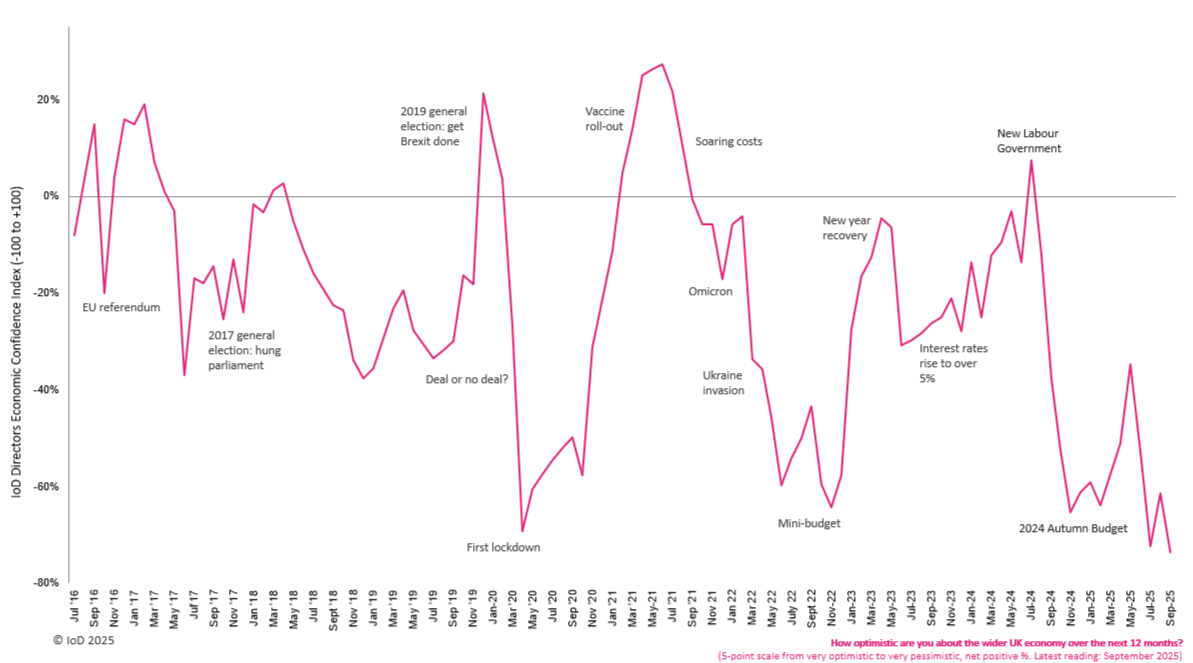
Businesses investment and confidence are a key driver of economic growth, and these findings paint a subdued picture of the UK economic outlook into year-end.
Any hopes that inflation will fall notably in the coming months are compromised by businesses reporting their cost expectations rose to +89 in September 2025, from +85 in August.
This is the highest reading of the indicator since its introduction in November 2017 and exceeds the previous series high recorded in February 2025 (+87).
Linked to cost expectations are wage expectations, a key driver of inflation, which jumped to +64 from +42 in September.
The Bank of England could keep interest rates unchanged until 2026 on account of rising inflation, which is expected to peak at double the 2.0% target rate this September.
It suggests the cost of borrowing for businesses is unlikely to fall materially for the foreseeable future.
The jobs market has meanwhile deteriorated in recent months, and the indication from businesses is that no turn for the better is likely soon.
The IoD's measure of headcount expectations fell to -13, from -4.
"Persistent fears that taxes on business and assets will rise are stifling confidence, holding back investment, and threatening growth and living standards," says Leach.
"Business leaders are calling for a reduction in government-generated costs – whether through a lower tax burden or lighter regulation. But crucially they are seeking a more coherent and credible plan for growth," she adds.