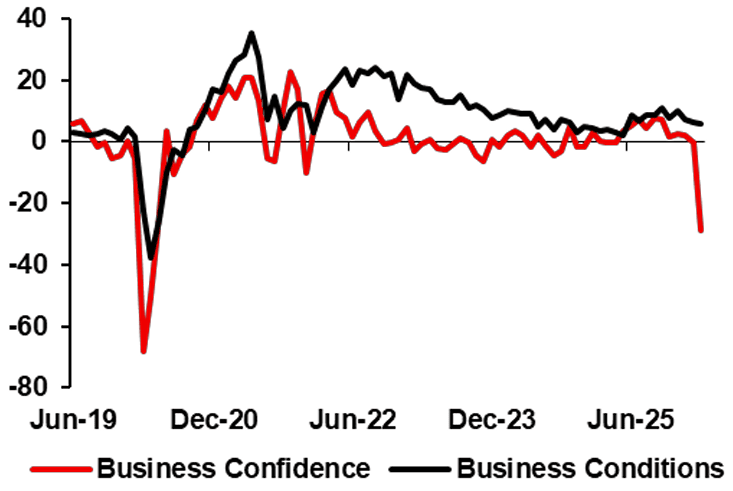
The fuel shortage was always going to sap confidence and cool a hot economy.
The Australian dollar outlook has turned less bullish, with new data confirming the war in the Middle East has had a tangible negative impact on domestic sentiment, which is likely to knock economic activity.
The March NAB Business Survey revealed business confidence collapsed in response to the outbreak of the Middle East conflict.
Confidence fell 29pts to -29, the second largest monthly fall in the survey’s history, while current assessments of business conditions remained stable at 6.
"AUD/USD decreased modestly to near 0.7080 because of weak domestic sentiment data," says Samara Hammoud, FX analyst at Commonwealth Bank of Australia. GBP/AUD steadied above 1.9050, ensuring 0%-fee transfer rates at the most competitive providers defended 1.90 while high-street bank median rates were nearer 1.8550.
The survey is the first to provide a complete read on business conditions and confidence since the outbreak of the Middle East conflict, surging fuel prices, fuel shortages and RBA rate hikes in February and March.
When fuel shortages were first reported in Australia, we said their impact on the economy would be via the confidence effect and that they would therefore help cool demand.

Concierge Money Transfers
For high-value transfers, you need high-value service: dedicated account management, on-point pricing, insight into market conditions and trends, help with structuring your payment, and execution support at key moments.
Learn More →The Reserve Bank of Australia has raised interest rates twice already this year, judging that demand in the economy was too hot and was creating uncomfortably high levels of inflation, even before the war in the Middle East began.
"The economy had carried a healthy level of momentum heading into the unfolding shock," says Michael Hayes, Economist at NAB. "The forward orders measure fell 6pts to -1 index points, erasing the gains made so far through 2026 and possibly reflecting rising uncertainty."
The knock to confidence will ease the need for further rate hikes at the RBA if, as the survey data suggests, the war helps cool some of that hot demand and lower inflation expectations.
The Australian dollar surged in January and February as the RBA shifted into rate hiking mode, confirming how central interest rate expectations are to the currency. Therefore, any downshift in rate hike expectations in the coming weeks and months would lower odds of further AUD outperformance.
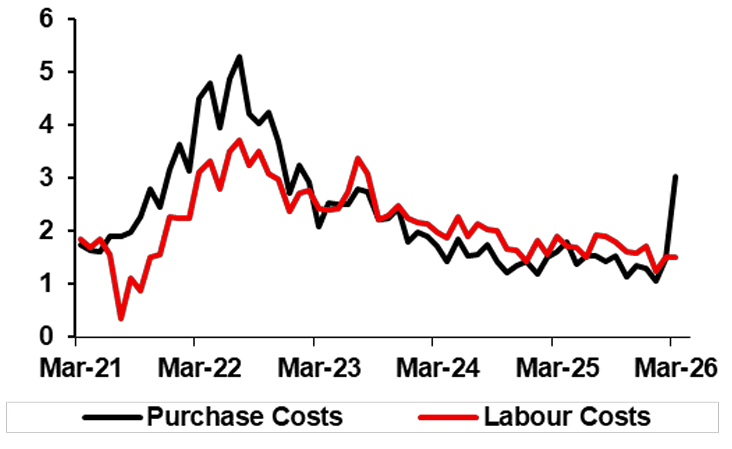
Above: Cost Growth, SA (% Qtly Eq.)
Of course the picture is complicated by the outright inflationary effect of rising energy prices. RBA Deputy Governor Andrew Hauser alluded to this on Tuesday, saying the central bank will need to set interest rates at a level that brings inflation back to the 2‑3% target.
He said the RBA's board does not have "high confidence" that they are there yet.
This is a 'hawkish' take and suggests the RBA is still ready to raise rates and suggests it will take more than just one survey to shift the conversation.
Nevertheless, the NAB confidence data offers a strong hint that Australia will see evidence of cooling domestic conditions as imported inflation rises. How the RBA responds to the mix will be key to AUD performance.