- GBP/AUD vulnerable amid Russia-Ukraine risks
- Position cuts & commodity demand lifting AUD
- GBP weakens with reserve FX as RUB steadies
- GBP/AUD may hit 1.8587, test major averages

Image © Adobe Images
The Pound to Australian Dollar exchange rate slumped amid the financial fallout over Ukraine, which could potentially push Sterling as low as 1.8587 against its antipodean counterpart in the days ahead.
Sterling, the U.S. Dollar, Japanese Yen and Chinese Renminbi all sustained varying degrees of losses on Tuesday while the Euro featured as the only constituent of the International Monetary Fund Special Drawing Right basket to rise amid the fallout over Russia’s actions against Ukraine.
Major reserve currencies came under pressure as the Rouble rebounded strongly from the November 2020 lows reached after President Vladmir Putin said on Monday that Russian soldiers would enter breakaway regions of Ukraine.
While Tuesday's bounce in stock markets appears to suggest a recovery in investor risk appetite that could explain why major reserve currencies like Sterling were under pressure, sanctions are another candidate explanation for weakness in the Pound and are an added risk for Sterling during the weeks ahead.
"We are even, with our American friends, going to stop them trading in pounds and dollars," Prime Minister Boris Johnson has recently been quoted as telling the BBC. "That will hit very, very hard."
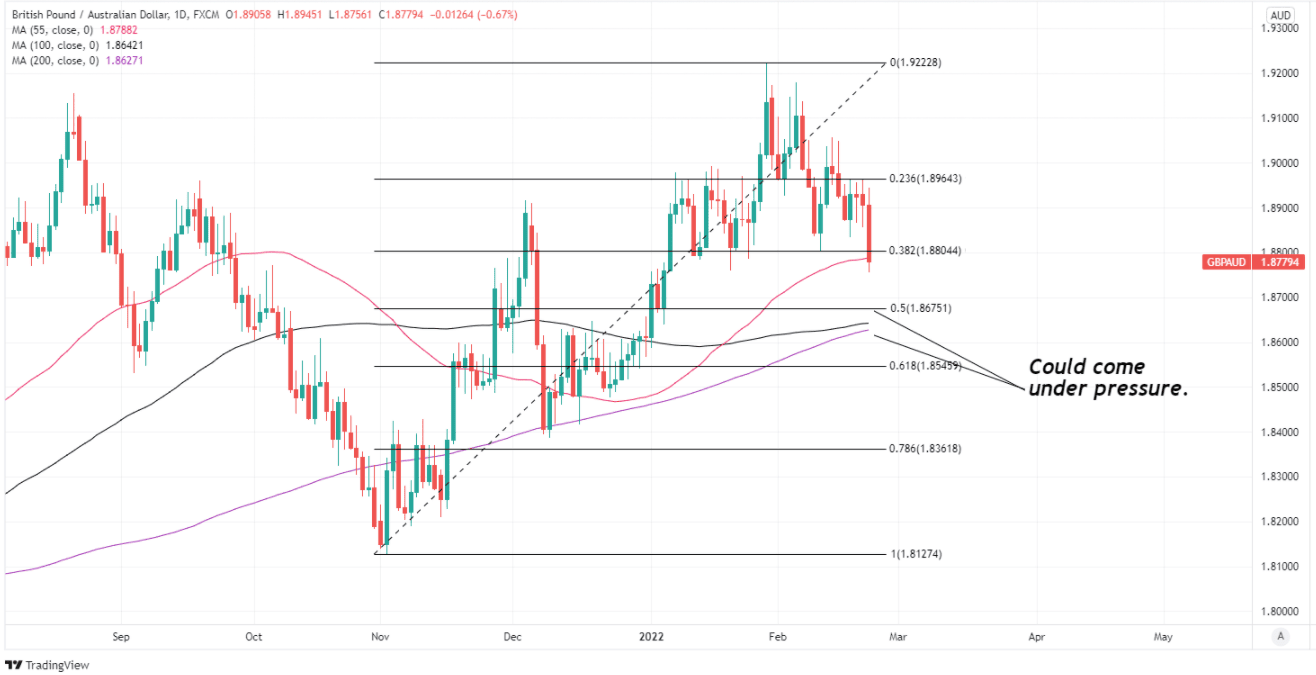
Above: GBP/AUD shown at daily intervals with Fibonacci retracements of November rally indicating possible areas of technical support for Sterling, alongside selected moving averages.
- GBP to AUD reference rates at publication:
Spot: 1.8775 - High street bank rates (indicative band): 1.8118-1.8250
- Payment specialist rates (indicative band): 1.8606-1.8681
- Find out about specialist rates, here
- Set up an exchange rate alert, here
The prospect of further sanctions is something that could potentially encourage selling of Sterling and other reserve currencies by Russian government entities as well as companies and individuals, both in Russia and in the UK.
Tuesday's rebound in commodity currencies has been the dominant driver of declines in the Pound to Australian Dollar rate, however, and it remains the most prominent risk for the days and weeks ahead.
"Although the size of the moves in the FX market this week have been overshadowed by those in commodity prices, exchange rates are also displaying a paring back of stress; the RUB has turned around and the safe haven USD has given back some ground vs. the EUR. It would appear that for now investors may have adopted a pragmatic approach to the news that Putin has recognised the independence of two rebel states in Eastern Ukraine," says Jane Foley, head of FX strategy at Rabobank.
Australia's Dollar rose strongly on Tuesday and may have benefited from multiple tailwinds including the uplift in risky assets like stocks, increases in commodity prices and the antipodean unit's prominence among the currency market's biggest 'short' trades.
{wbamp-hide start} {wbamp-hide end}{wbamp-show start}{wbamp-show end}
Many of the market’s recently favoured trades appeared to go into reverse in price action that could have reflected continued risk reduction among speculative traders, and these had included selling the Euro and Australian Dollar.
“Commodity prices likely lent AUD a helping hand,” says Kim Mundy, a senior economist and currency strategist at Commonwealth Bank of Australia.
“Tonight’s Q4 2021 wage price index is likely to have more bearing on AUD (12:30am London time). The Q4 2021 wage report will be crucial in forming market expectations for a near term increase in the cash rate,” Mundy and colleagues said on Tuesday.
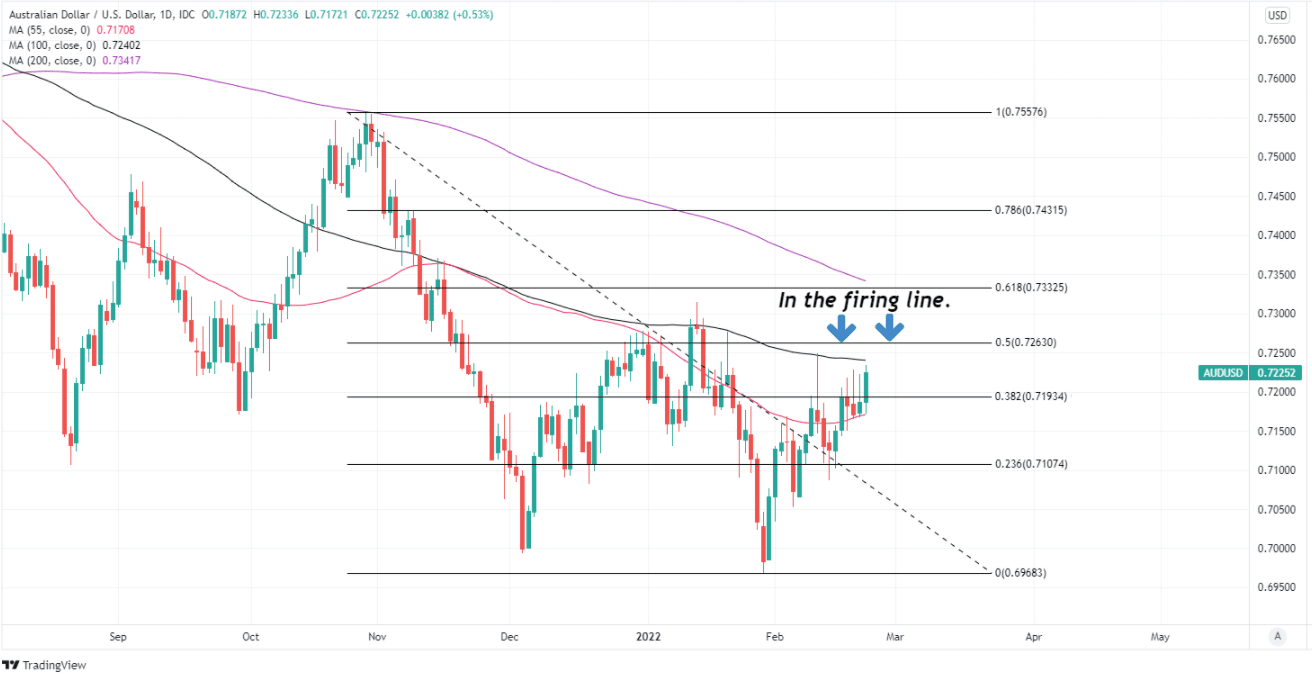
Above: AUD/USD shown at daily intervals with Fibonacci retracements of November decline indicating possible areas of technical resistance for AUD.
GBP/AUD sustained some of Sterling’s heaviest losses as the above factors drove a negative divergence between GBP/USD and AUD/USD.
GBP/AUD tends to closely reflect the relative performances of the latter two, although declines in GBP/USD were modest in comparison to the rally in AUD/USD, which remains the bigger downside risk for Sterling.
GBP/AUD would fall as far as 1.8587 if AUD/USD breaks above its nearby 100-day average at 0.7240 to test the 50% retracement of its November 2021 decline.
That would leave the Pound-Aussie rate in a vulnerable position where it would be at risk of reversing a year-long uptrend, although it would be an unlikely outcome unless GBP/USD remains under pressure at the same time.
"The AUD remains the largest short in G10 FX at present and experienced mild selling interest last week, predominantly driven by Crédit Agricole CIB flows. Our FX flow data points at corporates and hedge funds inflows as well as banks and real money investors outflows," says Valentin Marinov, head of FX strategy at Credit Agricole CIB. "Following the latest developments, the GBP positioning indicator is no longer in negative or overbought territory."