
File image of Shigeru Ishiba. Photo Credit: Dean Calma / IAEA.
The Japanese Yen is the top-performing major currency after weekend election results were announced.
JPY is registering gains against all its G10 peers, indicating a clear outperformance, which looks to be a result of domestic developments.
Following a national vote, Shigeru Ishiba's Liberal Democratic Party (LDP) and its coalition partner Komeito lost control of the upper chamber of the National Diet, Japan's national legislature.
The coalition already lost control of the lower house last year, potentially leaving Japan without a strong policy steer.
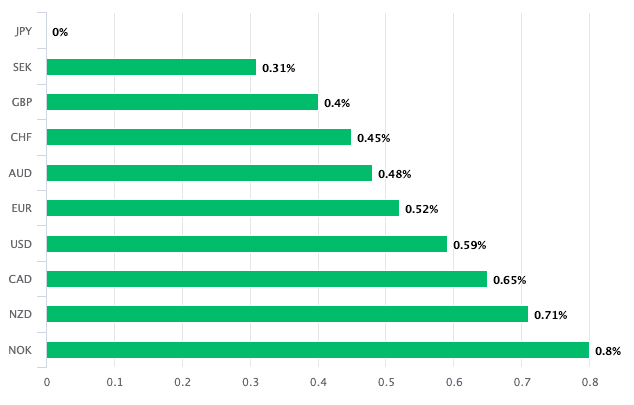
Above: JPY on July 21.
This is not a market-friendly result, and one would expect the yen to be weaker.
Yet, markets have long been prepared for the outcome, and there is potentially nothing new to see here. In fact, Yen strength looks to be a classic case of 'sell the expectation, buy the fact.'
"JGB and JPY markets have largely priced in the defeat of the ruling coalition," says Lhamsuren Sharavdemberel, FX strategist at Barclays.
| 5% | ... More Currency Achieved on Our Transfers Than a Typical Bank Delivers. |
 | Get Your Quote |
Zooming out a bit, the Yen is the worst-performing G10 currency over a one-month timeframe, indicating markets have been preparing for the market-unfriendly result over recent weeks.
This means the fundamentals haven't changed and the relief-style rally we see on Monday is not necessarily likely to last. "There is a risk of a further bear-steepening of JGBs and depreciation of JPY amid political uncertainty and looser fiscal policy risk," says Sharavdemberel.
Currencies dislike uncertainty, and Japan offers that in spades right now: Not only is the position of Prime Minister Ishiba uncertain, so too is the outcome of current trade negotiations with the U.S.
Recall Japan and the U.S. have until August 01 to reach a new trade agreement, but there are fears that the weakened hand of the government means a worst-case outcome, or potential delays to negotiations.
Uncertainty is the watchword for now, and for JPY, this is not helpful.
"We also think that JPY’s recent depreciation seems to reflect not only fiscal concerns, but also a decline in safe-haven demand due to a declining global equity risk premium," says Sharavdemberel.