GBP/USD began selling off heavily on Monday after investors started stockpiling dollars, as a result of the positive US jobs report showing the US economy added over a quarter of a million jobs in July.
The Pound to Dollar pair has broken below the 1.30 psychological support level in a sign of intensifying selling pressure on Sterling.
The fresh selling pressures on the British Pound come as it is reported that the Bank of England has been active on the UKs Gilt market and is buying up government debt as per their announcement made on Thursday the 4th of August.
The Bank committed to buy up to £60BN worth of debt, £50BN of which will be UK government debt, or Gilts.
Action at the start of this week saw the Bank stoke heavy demand for UK debt, a move which forced down the yields Gilts pay.
Ten-year and five-year yields hit new record lows of 0.603 percent and 0.152 percent respectively
UK gilts outperformed their U.S. equivalents, with 10-year Treasuries offering the biggest yield premium over gilts since 2000 at almost a full percentage point.
It is this growth in premium that has seen the US Dollar bid higher against the Pound, something that is likely to continue as the Bank sucks up the debt it has promised to purchase.
Latest Pound / US Dollar Exchange Rates
  | Live: 1.3379▼ -0.15%12 Month Best:1.3867 |
*Your Bank's Retail Rate
| 1.2925 - 1.2978 |
**Independent Specialist | 1.3192 - 1.3246 Find out why this is a better rate |
* Bank rates according to latest IMTI data.
** RationalFX dealing desk quotation.
So where is GBP/USD headed?
From being poised to break higher after forming a compelling bottom reversal pattern called an inverse head and shoulders (H&S) the pair now appears to be breaking lower and targeting the 1.2860 barrier.
The break below the trend-line linking the ‘head’ of the H&S and the right shoulder has been breached negating the validity of the pattern, and downside is now favoured.
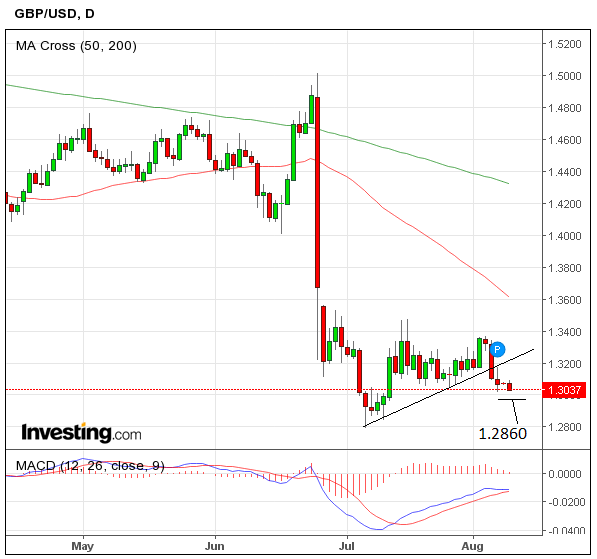
A move below the psychologically significant 1.3000 boundary into the netherworld of the 1.20s would probably be the necessary confirmation for a bearish forecast.
As such a break below, confirmed by a piercing below 1.2980 would probably lead to more downside to the target at 1.2860, and perhaps even lower thereafter.
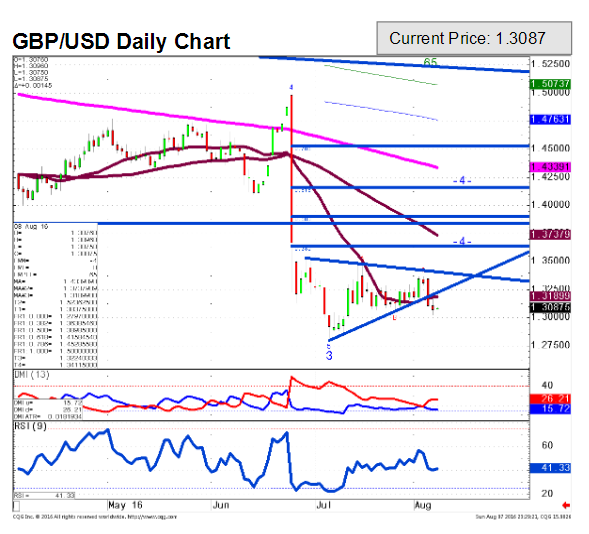
Other analysts are also bearish the pair, including Commerzbank’s Karen Jones, who notes the pair breaking down out of a triangle formation at the bottom (see chart below), and says, “this is very negative.”
Analysts at Citi see further weakness for the pair too, and have highlighted a new downside target post BOE bazooka of 1.2798.
UK Consumer Spending Holds Up: Visa
New data from Visa shows that UK consumer spending did not fall off a cliff in July, as many had forecast.
The data adds to observations that the impact of the Brexit vote on the economy may prove to be a temporary one.
If the economy does return to strength sooner than anticipated, then the Bank of England could well announce no further interest rate cuts or quantitative easing will be required in the future.
The Visa Consumer Spending Index rose 1.6% on an annualised basis, up from the 0.9% recorded in June.
Markets are focussing on any scrap of data that July has to offer, and this is perhaps why the Visa data, which is often overlooked, is in focus.
Visa reports that, "UK consumer spending is holding up despite ongoing uncertainty following the referendum."
“Looking at the sectors, the longer term trend we’ve seen for increased spending on leisure and recreation is enduring. And the high street saw its strongest annual growth rate in five months with clothing retailers in particular bouncing back after a fall in June,” says Kevin Jenkins, UK and Ireland Managing Director at Visa.
Is a US Rate Rise a Done Deal?
The improved outlook for the US economy increases the probability that the Federal Reserve will move to increase interest rates before the end of the year, a measure which would almost certainly lead to a rise in the dollar, as higher interest rates tend to attract more flows of foreign capital.
The move down on Monday was contained however with traders left considering a report in the Financial Times citing Jerome Powell, a voting member of the Fed’s rate setting committee, who advocated patience when it came to raising interest rates due to concerns about subdued growth in the economy.
Some analysts share Powell’s concerns, such as David Rees of Capital Economics, who said in a recent note that the strong July jobs report would not be enough to, “trump weak US Q2 GDP,” and trigger a rate hike.
Therefore while expectations are high that US interest rates will continue to move in favour of the US Dollar in expectation of a 2016 rate rise, there are still obstacles to such an event.
Were the Fed to shy away from raising rates, then the broad-based Dollar rally could stall.