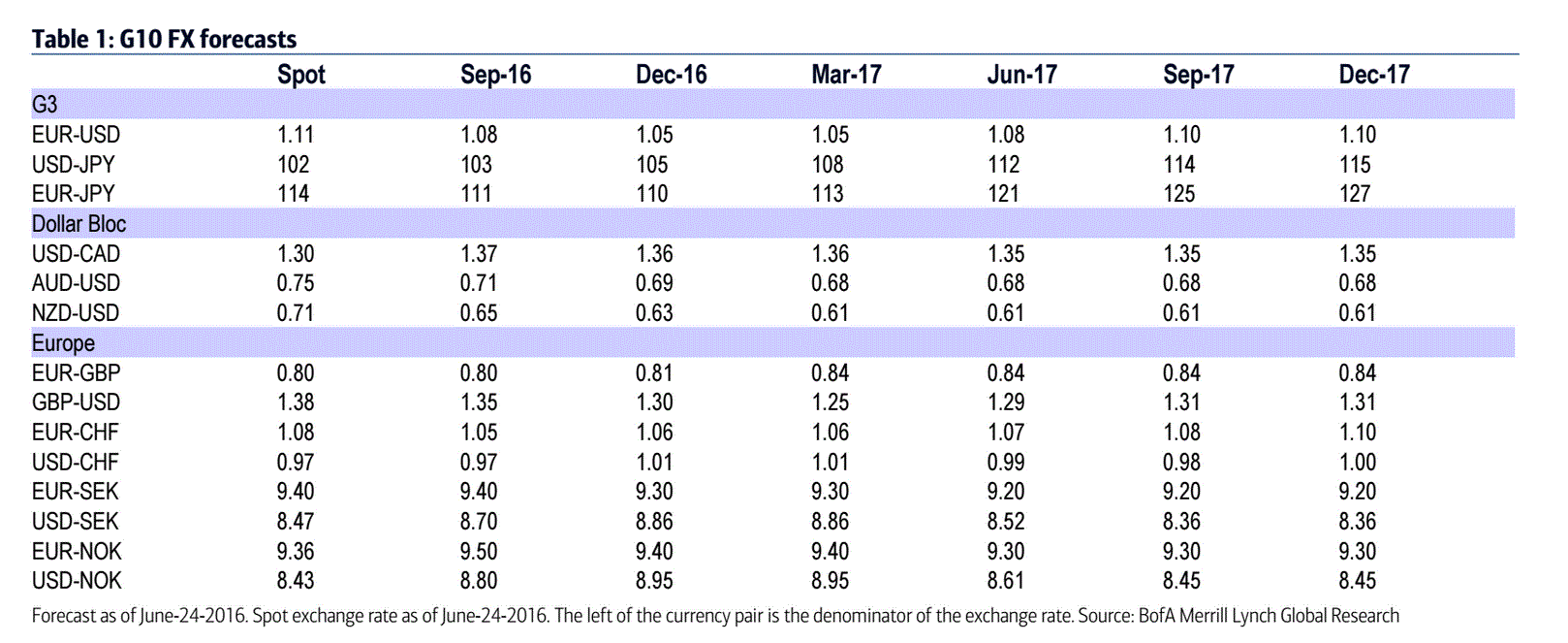
Bank of America Merrill Lynch (BofA) have revised their forecasts following the Leave victory in the UK's EU referendum held one week ago.
The British pound is falling against the US dollar at the time of writing as the initial post-referendum runs out of impetus.
While the FTSE 100 soared higher mid-week to recover its post-referendum losses, it must be remembered that the FTSE 100 is a global stock exchange with a good chunk of its constituents doing business outside of the UK.
The recovery in GBP/USD was by no means convincing and it should ultimately slip lower again and fulfil predictions for a rate that is now going to trade closer to 1.30.
The lowest levels reached in the post-Brexit shock was 1.3121.
In GBP, positioning appears to be approaching record shorts, fast money is seen as one of the main sellers with flows stretched but longer-term real money investors are yet to unload suggesting major pressures lie down the road.
Bank of America Merrill Lynch Global Research's FX Strategist, Athanasios Vamvakidis, expects major sterling pairs, as well as major global currency pairs to hit new lows in the wake of Brexit, with GBP/USD at 1.30 by year end, EUR/USD at 1.05 and USD/JPY at 105.00.
Further, the strategist sees these levels as higher than the expected lows, due to the possibility of moves below these in the interim as a result of central bank intervention, to help support slowing growth between now and the end of the year.
This might happen, for example, if the Bank of England (BOE) were to reduce interest rates or increase the level of asset purchases, also known as quantitative easing (QE), which is essentially a form of money-printing. The increased supply of pounds resulting from these ‘interventions’ could lead to pairs going even lower before rebounding later in 2016.
Vamvakidis sees the potential for a chain reaction from Brexit, reaching well into the future, with hard-to-fathom effects:
“FX markets were surprised by the Brexit vote. Brexit could trigger a chain of non-linear events well into the long term that are hard to forecast and may seem unrelated today, a butterfly effect on steroids. It could prove to be just the end of the beginning.”
Latest Pound / US Dollar Exchange Rates
  | Live: 1.3547▲ + 0.05%12 Month Best:1.3867 |
*Your Bank's Retail Rate
| 1.3087 - 1.3141 |
**Independent Specialist | 1.3358 - 1.3412 Find out why this is a better rate |
* Bank rates according to latest IMTI data.
** RationalFX dealing desk quotation.
In particular, he sees the UK and Eurozone economies hit the most, and therefore their central banks most likely to take action:
“In the short term, the negative market impact could be partly offset by action by major central banks. Indeed, we expect BoE and ECB easing.”
He also sees the Fed holding off from making any rate hikes at all in 2016.
Vamvakidis also notes how Brexit will actually give ECB and Fed policymakers “an excuse” to extend QE beyond March in the case of teh ECB and stay on hold in the case of the Fed.
The deciding factor in the medium to long-term will be how negotiations go between the UK and Europe and the UK and the rest of the world.
Vamvakidis sees a “tail risk” (impacting negatively on the euro) of the EU starting to break up as a result of copycat referenda in other countries.
He suggests that two factors which could increase the risk of other members following the UK, would be whether the divorce was a 'quickie', and whether the UK managed to renegotiate a beneficial trade agreement.
“We would expect markets to start pricing some tail risks that other countries may decide to leave the EU as well. Although we do not see this as an immediate risk, some political parties in EU members are already calling for an EU referendum. Many of the questions we receive from investors are indeed about such risks. Indeed, we would argue that the faster the UK negotiations progress and the better the eventual deal, the more likely other countries could be tempted to follow a similar path.”
The weakness of the EU’s recovery is a further factor which could increase support for breaking up the union.
BofA’s FX team sees the most likely BOE response to be of supporting growth rather than the pound, which suggests looser policy and possibly money-printing.
This would suggest deeper declines for sterling. The BOE will also want to help fill the gaping hole in the current account given the expected fall in inward investment due to the prolonged expected period of uncertainty ahead. It would therefore be in Britain’s best interests to have a weaker pound, which would boost exports and help close the trade deficit.
Vamvakidis sees the dollar winning in the battle versus the euro and EUR/USD falling, as extended Brexit uncertainty and the possibility of copy-cat referenda weigh on the single currency more than a delay in the Fed raising rates will burden USD.
Whilst him and his team see GBP/USD ending the year lower at 1.30, they are actually overall quite optimistic about the pound’s ability to bounce back, which has been historically proven:
“Indeed a push below 1.30 cannot be ruled out. However, the history of GBP crises highlights that such sharp sell-offs have generally proved to be temporary. A move well below 1.30 in the short term could prove a buying opportunity.”
Nevertheless, the Strategist is quick to point out that this does not necessarily mean the pair will make a strong rebound either:
“Nonetheless, a rebound is also likely to be limited, as we believe that a vote to leave the EU will be the pre-cursor for a further deterioration in UK macro data and confidence indicators. We therefore expect further GBP weakness in 2017.”
BofA’s Vamvakidis sees the outlook for sterling as dependent on the UK rebuilding investor confidence in it, which itself depends on how negotiations with the EU go, however, overall he expects the pound to stay within a, “new structurally lower equilibrium level outside EU.”