Image © David Holt, Accessed: Flikr, Licensing Conditions: Creative Commons
Pound Sterling eased against the dollar and euro on Thursday, extending losses on signs the UK economy will experience a notable slowdown in the coming months.
Investors have already pared back expectations for further Bank of England tightening over the past 48 hours as fears of a retrenchment in domestic demand grow. On Thursday, the British Retail Consortium's consumer confidence measure plummeted in March.
Its measure of expectations for the economy over the next three months plunged to -53 in March from -30 in February, marking the worst reading since the survey began in March 2024.
"Consumer confidence collapsed as the Middle East conflict raised the prospect of higher inflation in the months ahead," said Helen Dickinson, chief executive of the BRC. "Just as the economy was beginning to turn a corner on inflation, the rise in global energy prices is particularly unwelcome for businesses and families."
The British consumer is the backbone of the country's services-oriented economy, and falling demand points to a slowdown in the coming months.
Market pricing for additional rate increases has softened markedly, with traders now anticipating around 60 basis points of tightening this year, down from roughly 86 basis points expected last week.
Traditional FX market dynamics mean falling rate expectations would be expected to weigh on the pound:
GBP/EUR trades at 1.1560, and the month's high is at 1.1612. GBP/USD trades at 1.3366, down from 1.3479. (See how your bank shapes up against specialist FX providers when it comes to transferring funds overseas, here).
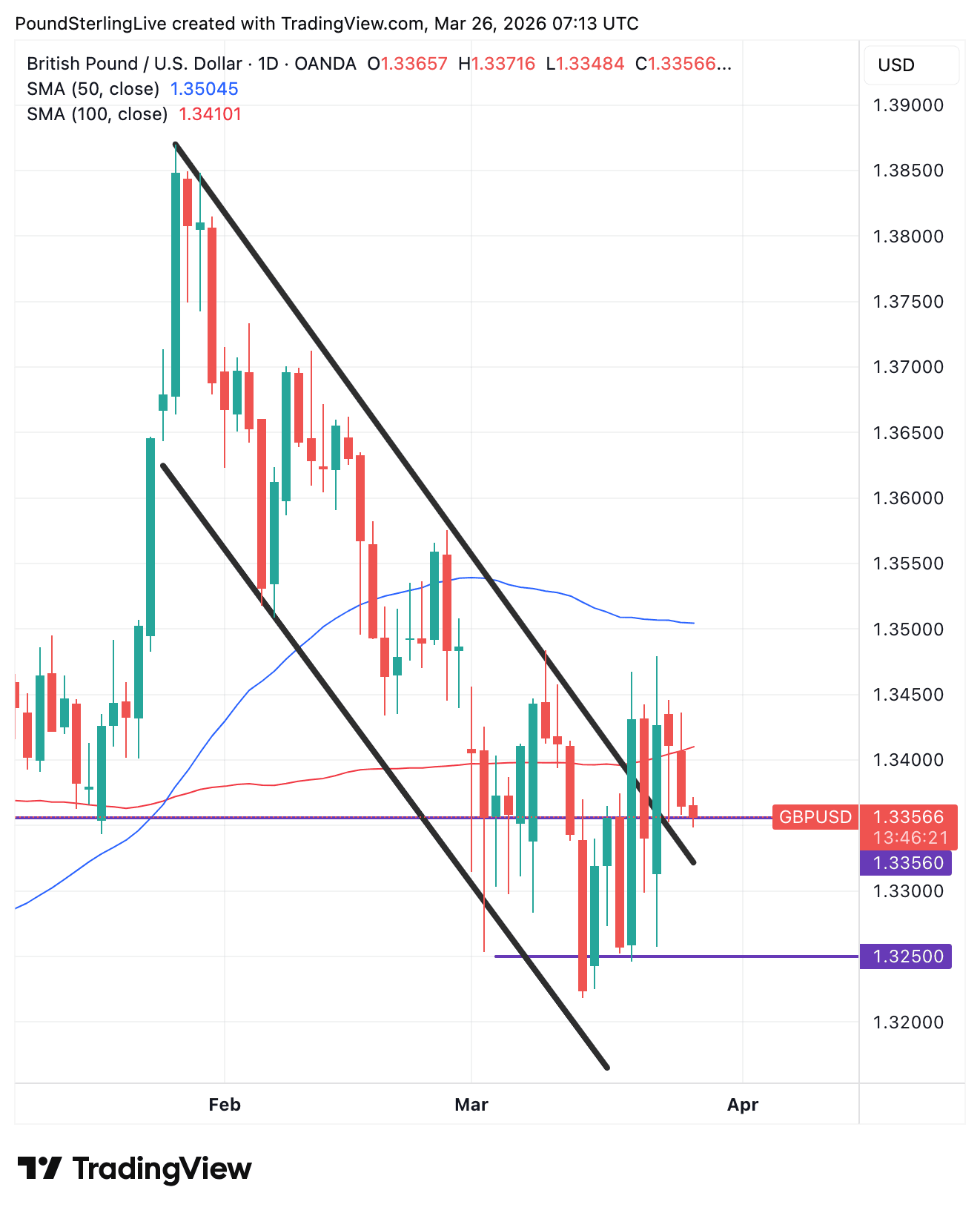
Above: GBP/USD at daily intervals.
Megan Greene, considered one of the more 'hawkish' members of the Bank of England's interest rate-setting committee, said the economy is weaker now than it was heading into the 2022 energy price shock caused by Russia's invasion of Ukraine.
Back then, interest rates were lower and households were flush with Covid-era savings, which helped fuel a significant spike in inflation.
Greene said that inflation risks are higher owing to the Iran conflict but there is also increased downside risk to demand, meaning any sharp slowdown in consumption could help limit the pass-through of higher energy costs into core inflation.
Her message is contrary to a market that is aggressively poised for up to three rate cuts this year. If bets for further rate cuts continue to fall, the pound could retreat further, particularly if concerns about the economic outlook continue to grow.
"We believe the ECB is more likely than the BoE to raise rates in response to the energy crisis from the Iran war, while market pricing for both the ECB and BoE suggests they will respond in practically the same way," says Andrzej Szczepaniak, an economist at Nomura.
If this assessment is the correct one, it means there will be a faster decline in UK rate expectations relative to the Eurozone. Traditional FX feed-through would imply that the pound falls under the euro under such a scenario.
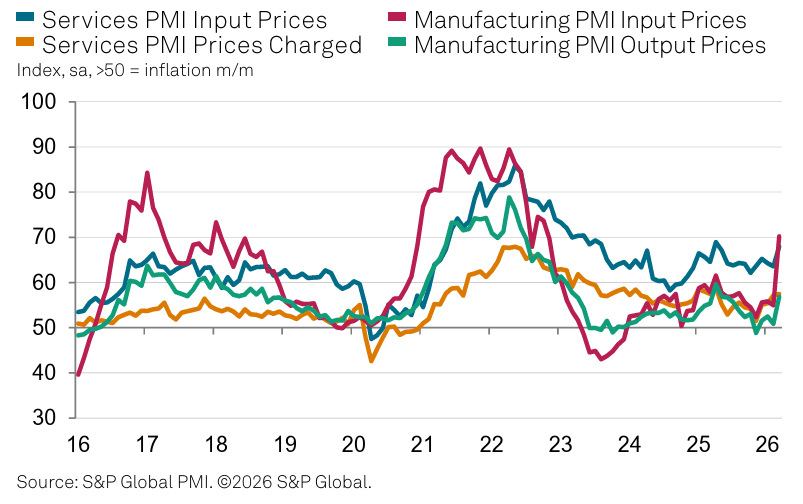
Incoming survey data confirms both consumers and businesses are fearful of the looming inflationary impact caused by the war, with fuel bills rising now, and gas and food prices to follow in the coming months.
Tuesday's release of PMI survey data from S&P Global showed businesses experienced a sharp increase in price pressures in March, as seen in the chart above.
"Inflationary pressures have surged higher on the back of rising energy prices and fractured supply chains. The acceleration in cost growth in the manufacturing sector was especially severe, being the sharpest since the depreciation of sterling following Black Wednesday in 1992," says Chris Williamson, Chief Business Economist at S&P Global Market Intelligence.
"While faster hikes from the BoE and ECB may offer some near-term support for the euro and pound by lifting yields, those gains could ultimately prove short-lived if tighter monetary policy alongside higher energy prices trigger a deeper economic slowdown/recession for European economies," says Lee Hardman, FX analyst at MUFG Bank Ltd in London.