✳️ Secure today's exchange rate for a future payment. You may also book an order to trigger your purchase when your ideal rate is achieved. Learn more.
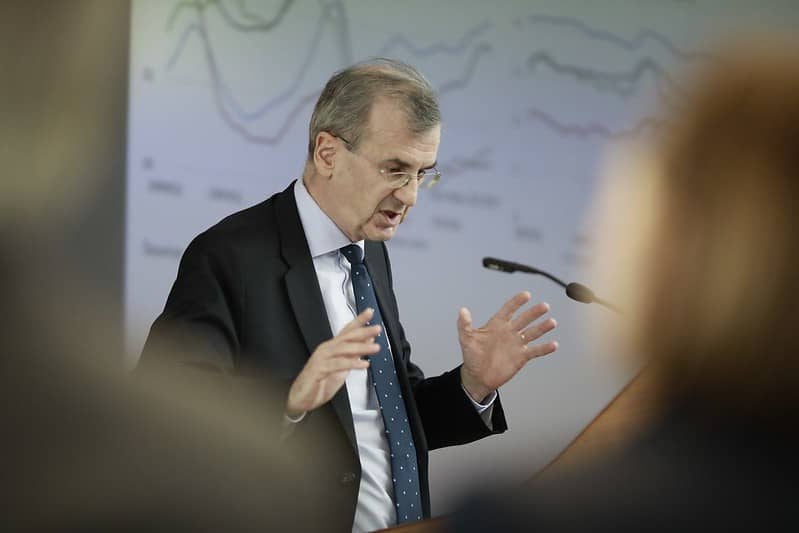
Above: File image. Francois Villeroy de Galhau, Governor Banque de France, Image: Deutsche Bundesbank, Nils Thies.
Expect talk of European Central Bank (ECB) rate cuts to increase in tempo.
Increased hedging activity by foreign investors in European stocks and speculation of another interest rate cut at the ECB should weigh on the euro says Bank of New York (BNY).
"We continue to see the EUR struggling for the rest of the year," says BNY analyst Geoffrey You in a new research briefing.
The euro has been one of 2025's better performing currencies, thanks in part to the ECB's decision to end its interest rate cutting cycle ahead of other peer central banks.
However, BNY thinks a deterioration in the Eurozone's manufacturing sector will put rate cuts at the ECB back in the frame for the fourth quarter.
The U.S. and China have once again escalated long-running trade tensions, and BNY warns that Europe won't be immune to the effects. Yu warns of "trends we are already seeing in the manufacturing sector... as leading indicators are starting to show some sign of deterioration again."
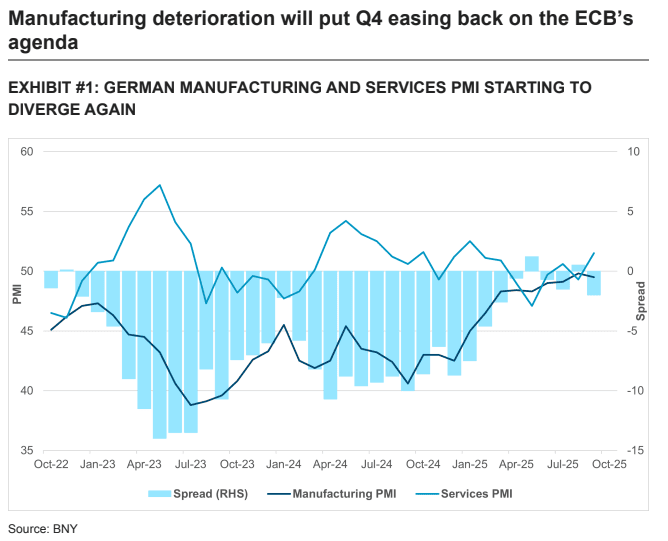
Image courtesy of BNY.
Ongoing slowdown risks in France's economy are also elevated owing to recent political turmoil.
Yu says all this means the ECB risks being dislodged from "its good place".
Consensus projections for the next four quarters, compiled from leading investment banks.
Access the full forecast →
Recently Christine Lagarde, ECB President, said interest rates were at a "good place" that means they were neither inflationary or disinflationary, effectively killing off speculation for further cuts.
However, France's representative on the ECB's decision-making board, François Villeroy de Galhau, said this week that the ECB's next move is more likely to be to lower rates than raise them.
He cited a greater number of downside dangers to the inflation outlook.
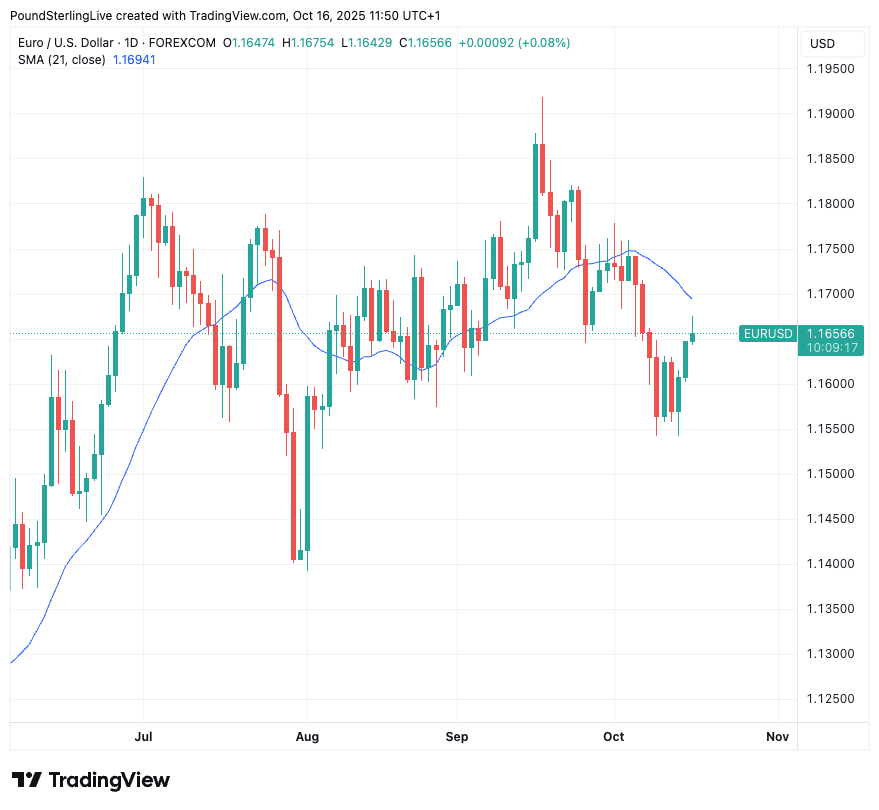
Above: EUR/USD at daily intervals.
To be sure, many of his colleagues on the ECB's board don't share this view, but BNY thinks the data will push the ECB's hand.
"Downside surprises in upcoming PMI prints could open the door to December being a live meeting," says Yu.
With markets not prepared for such an eventuality, the euro would come under pressure if it were to become more mainstream.
Another headwind to the euro into year-end is hedging activity.
"European equity holdings also appear to have run their course in terms of holdings gains," says Yu. "We don’t see material liquidation from current levels but incremental FX hedging may start to pick up to reduce exposures, especially while costs are relatively low for key investors in the U.S. and the U.K."
Foreign investors who own euro-denominated stocks (for example, shares listed in Frankfurt or Paris) often hedge their currency exposure to protect themselves against adverse exchange rate movements that could erode their returns when converted back into their home currency.
If the euro weakens, even strong stock performance can be wiped out when returns are converted back. To avoid this volatility, investors hedge the euro exposure.
The most common method of hedging involves the investor entering a EUR/USD or EUR/GBP options trade that sells euros forward for their home currency.
Buying these options adds to downside pressures on the euro.
"The ECB and markets that are overweight European assets this year will need to manage risk more actively to stay in a 'good place'," says Yu.
✳️ Secure today's exchange rate for a future payment. You may also book an order to trigger your purchase when your ideal rate is achieved. Learn more.