✳️ Secure today's exchange rate for a future payment. You may also book an order to trigger your purchase when your ideal rate is achieved. Learn more.

Image © European Commission Audiovisual Services
Euro rally to restart in 2026 amidst a soft run of domestic data.
A soft spell of data out of Germany and the Eurozone speaks of a potential decline in the euro to dollar exchange rate (EUR/USD) over the coming weeks, although analysts at a leading Swiss private bank think 2026 can see a longer-term rally reignite.
J. Safra Sarasin, the Basel-based private bank, tells clients "a significant improvement of economic activity in the euro area will be needed for the euro to move meaningfully higher from here."
The call puts the 1.20 year-end target for EUR/USD in doubt.
The euro has struggled this week amidst French political uncertainty and this week's data showing German Industrial output plunged 4.3% m/m in August, the worst monthly drop since March 2022, driven by a collapse in auto production.
Today, it was reported that German exports were down 0.5% m/m in August.
These data warn of another disappointing quarter for Germany, which will follow the -0.3% q/q reading of the second quarter.
For the euro, the soft activity of Europe's largest economy spells caution, particularly if traders are minded to raise bets that the European Central Bank (ECB) will lower interest rates again.
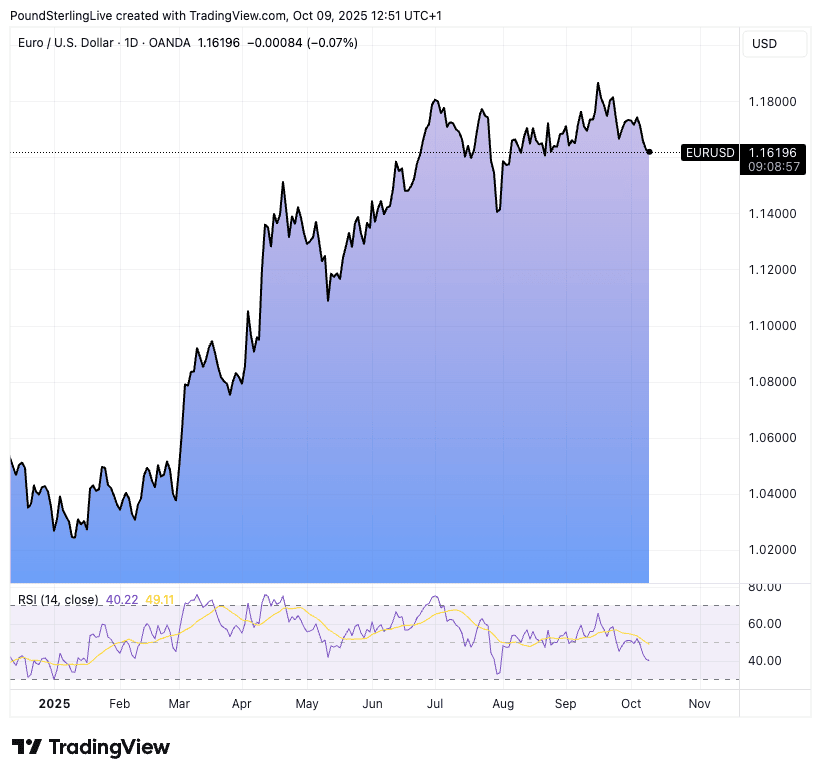
Above: The daily EURUSD chart showing a pause in the longer-term rally.
"Euro area growth continues to stagnate. Hence a significant improvement of economic activity in the euro area will be needed for the euro to move meaningfully higher from here," says Claudio Wewel, FX Strategist at J. Safra Sarasin.
That boost could yet arrive, with J. Safra Sarasin predicting that "the historic debt-financed German infrastructure package worth €500BN, which is set to be spent over the next twelve years, along with a considerable increase in defence spending, improves the medium-term growth outlook for Germany and the euro area."
✳️ Secure today's exchange rate for a future payment. You may also book an order to trigger your purchase when your ideal rate is achieved. Learn more.
Analysts expect the positive effects on activity to become visible in 2026, "which should allow the euro to embark on another leg higher."
Given this, the euro should also benefit from a reversal of financial flows back from the US to the euro area as growth is set to moderate in the US, and the Swiss bank expects structural dollar selling to remain a euro-positive factor.
Downside risks to the single currency's outlook include the renewed widening of peripheral spreads in the euro area on the back of the political crisis in France, which constitutes a downside risk.
The issue that has weighed on the euro this week following the resignation of France's third prime minister in 11 months. For now the risks associated with French political deadlock and the country's rising deficit are relatively contained, but it does present a significant hurdle to further euro area fiscal alignment and integration.
Point forecasts for euro vs. dollar from J. Safra Sarasin are 1.21 for Q1 2026, 1.22 for Q2, 1.23 for Q3 and 1.24 for Q4.