✳️ Secure today's exchange rate for a future payment. You may also book an order to trigger your purchase when your ideal rate is achieved. Learn more.
Image © Adobe Images
The quarter-4 strategy update from UniCredit Bank explains why the euro to dollar exchange rate can climb above the 'hard ceiling' at 1.20.
Signposts from the Milan-based bank show that further U.S. Dollar weakness is likely, even if the market might be overestimating how much further the Federal Reserve can lower interest rates.
Economists see U.S. growth rising modestly in the second half of this year due to looser financial conditions, an easing of trade policy uncertainty, and supportive fiscal policy.
Based on this, the Fed is expected to cut once more in 2025 and then again in 2026.
"We still see a weaker USD, with EUR-USD slightly above 1.20 over the medium term," says UniCredit.
Strategists remain bearish on the USD on prospects of more Fed easing on account of signs of a deteriorating labour market; however, weakness should be relatively contained by the constraints placed on the Fed's ambitions.
"Our expectation of only 50bp in additional rate cuts in the U.S. by June 2026 will limit the upside potential for EUR-USD much above 1.20," says the bank.
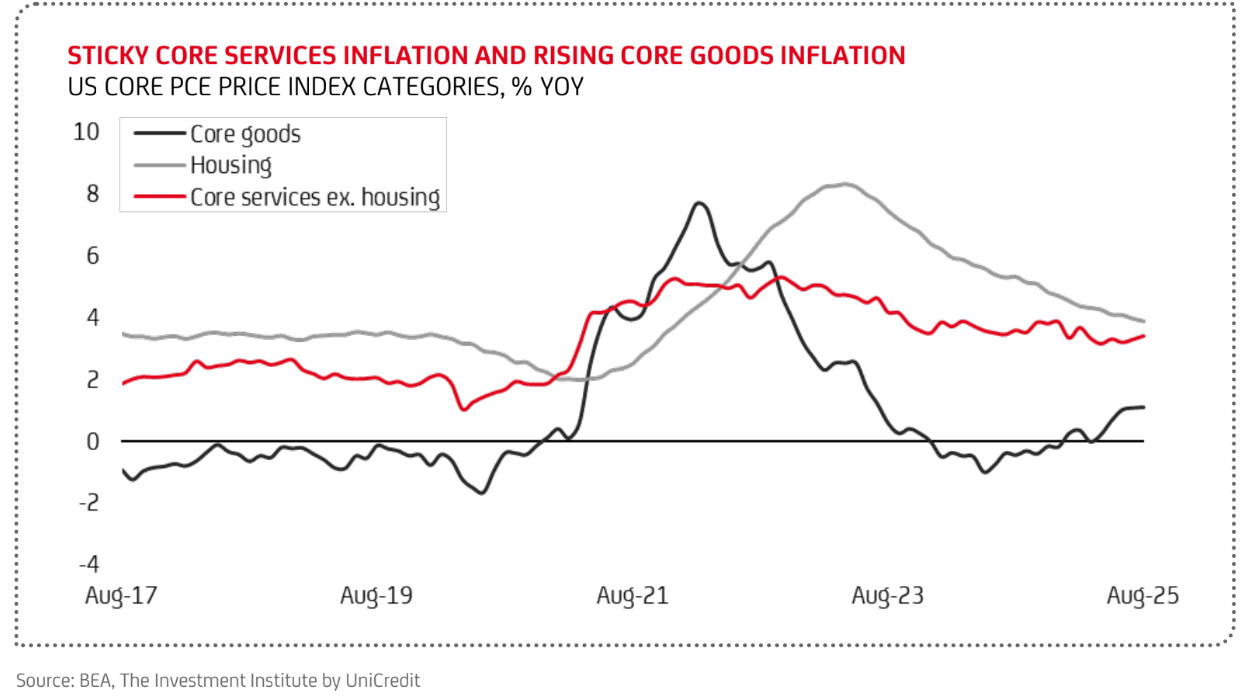
Above: Sticky U.S. inflation will ultimately limit the Fed's rate cutting ambitions.
Expectations for just 50bp of cuts contrast with a market that sees more. In fact, 50bp over the remainder of this year is seen as the minimum, ahead of further cuts next year.
This speaks of the potential for U.S. Dollar resilience.
✳️ Secure today's exchange rate for a future payment. You may also book an order to trigger your purchase when your ideal rate is achieved. Learn more.
Despite the potentially USD-supportive implications of a market mispriced on the Fed, UniCredit doesn't see this as a game-changer for the Euro-Dollar's trend.
"This is unlikely to spark a trend reversal, as uncertainty continues to surround Trump’s policies," says UniCredit. "We still forecast EUR-USD at 1.20 by 4Q25 and at 1.23 by 4Q26."
However, the message is clear that upside will be slow in coming, resembling a slow grind higher more than anything.
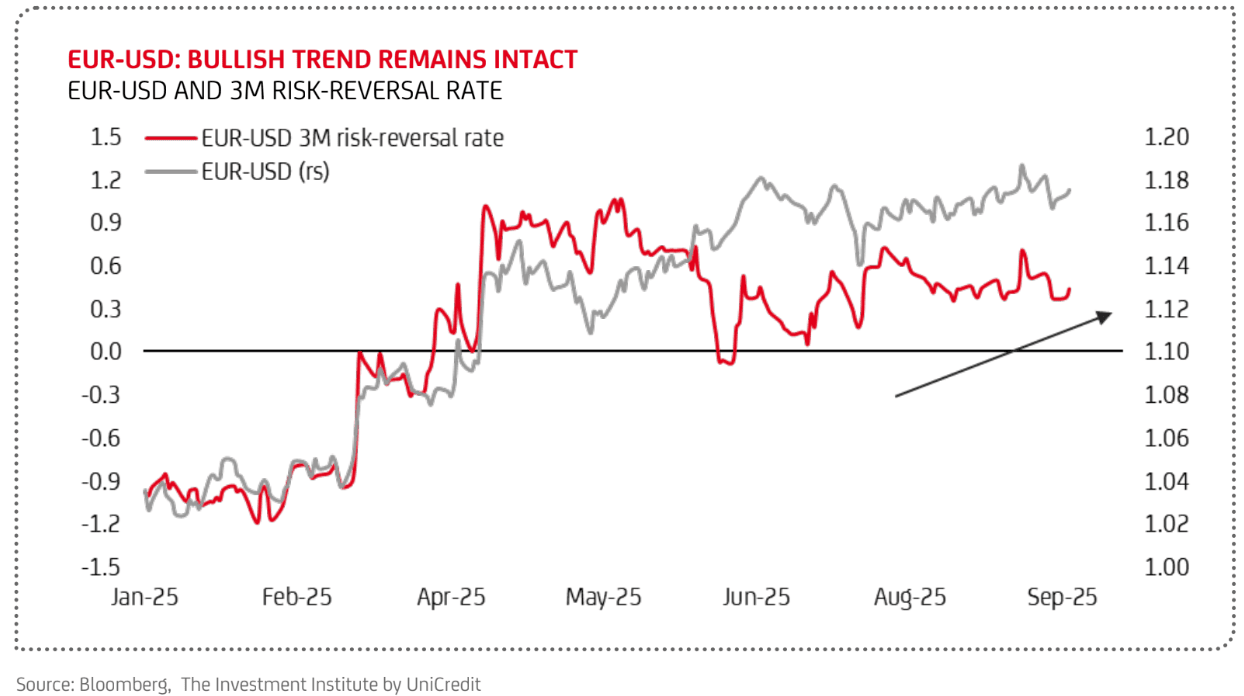
"Another EUR-USD rally with the same intensity as this year (nearly +13%) would probably be quite challenging," note analysts.
However, the bottom line remains that the Fed will still cut more than the European Central Bank, which should underscore further Euro-Dollar upside from here.
Domestic drivers of growth are expected to keep the Eurozone's economy on "a path of moderate expansion".
Fiscal support - spearheaded by Germany - will also kick in next year.
Inflation has converged to the ECB’s 2% goal and UniCredit says it will likely stabilise at around this level for the foreseeable future.
"We see the deposit rate remaining at 2% through to the end of 2026," says UniCredit.
Looking at disruptors to this view includes downside risks to the U.S. Dollar on "a politicised Fed."
This would "push the U.S. towards faster rate cuts, higher inflation and inflation expectations," says UniCredit.
Most analysts are in agreement that the erosion of Fed independence and independent functioning poses a major downside risk to the dollar in the coming months.
✳️ Secure today's exchange rate for a future payment. You may also book an order to trigger your purchase when your ideal rate is achieved. Learn more.