
✳️ Secure today's exchange rate for a future payment. You may also book an order to trigger your purchase when your ideal rate is achieved. Learn more.
Image © Adobe Images
The euro is recovering from its post-Fed hangover.
It was a case of too fast, too soon for the euro last week when it surged to a new 2025 high against the dollar on the day the Federal Reserve cut interest rates again.
Trade into the Wednesday decision was frantic, with traders dumping the dollar and chasing stocks to fresh records, excited that the Fed was about to fire the starting gun on another wave of rate cuts.
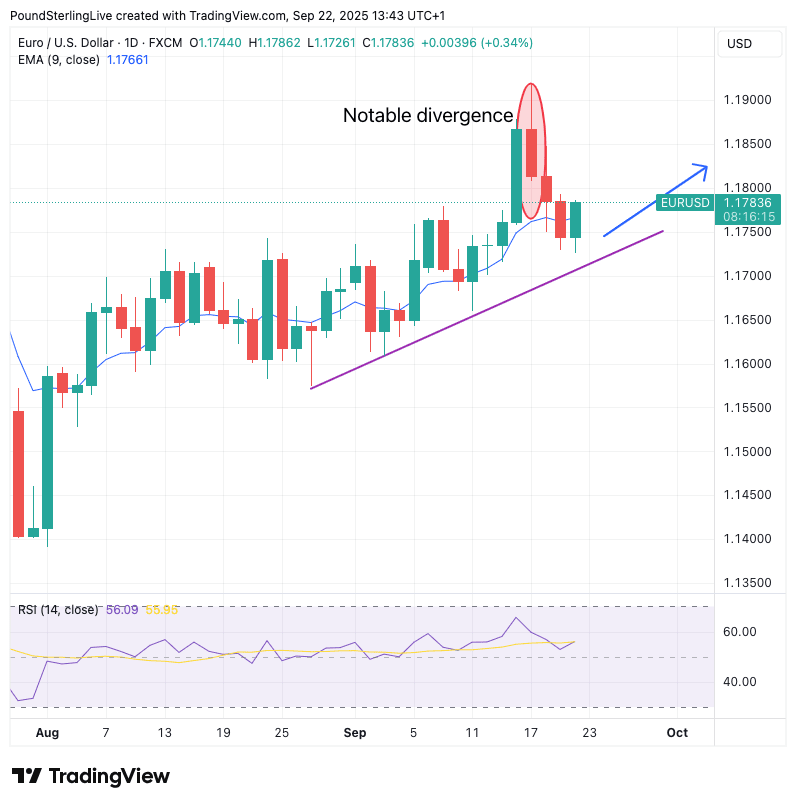
The euro to dollar exchange rate torched its way to the 1.19 level amongst this heady optimism, but this soon left it looking overbought on short-term timeframes.
We like to watch an exchange rate's relationship with its nine-day exponential moving average (EMA), noting the two tend to maintain relatively close contact. When the exchange rate and EMA diverge, and a sizeable gap opens between them, it hints that some mean reversion is required.
Last week, EUR/USD leapt too far away from its nine-day EMA, and the subsequent fall from 1.19 could be interpreted as such a mean reversion.
As of Monday, the pair has reestablished contact with the nine-day EMA and we think this is a potential sign that the FX market has recovered from its post-Fed hangover.
If correct, further consolidation around 1.1780 becomes likely in the next couple of days ahead of a renewed move higher.
The 1.1918 high of last Wednesday becomes the upside target, but we would imagine that this would be achievable in October in a less volatile trading environment.
Volatility is likely to drop away this week as the Fed fades into the background and there are no front-line data on the docket.
Sure, Friday's PCE inflation release should be considered top-tier stuff as it is the measure of inflation the Fed bases its policy on, but it never quite delivers the market reactions this importance would imply.
Ahead of the PCE release is Tuesday's S&P PMI survey for September, which should give a timely snapshot of the economy and reveal it retains a decent degree of momentum heading into year-end.
That said, we would expect sub-components like hiring intentions to confirm an ongoing slowdown that is consistent with the official data, underlining why the Fed think now is the time to cut interest rates.
Consensus projections for the next four quarters, compiled from leading investment banks.
Access the full forecast →
"The direction of the Dollar and policy will naturally depend on the data, and in particular, measures of slack like the unemployment rate. While many investors are increasingly focused on the potential for reacceleration in the not-too-distant future, our economists’ baseline expectations are for a further modest loosening in the labour market," says a weekly currency note from Goldman Sachs.
The highlight of the week for the euro will be Tuesday's S&P Global PMI release, where a composite PMI of 51.1 is anticipated for September, a shave higher than the 51 reported in August.
This would suggest a relatively robust economy, and underpin a view the European Central Bank (ECB) is done cutting interest rates, which should support the euro.
"We continue to think the ECB will keep the deposit rate on hold for quite some time, and actually expect the next move in rates to be a hike ,but not before 2027. If the Euro-area economy gathers pace as suggested by our baseline forecasts, also inflation pressures should gradually pickup and the bias of risks moves further from rate cuts towards rate hikes," says a new forecast note from Nordea Markets.
Nordea forecasts Euro-Dollar at 1.22 in three months on the basis that the Fed outcuts the ECB.
✳️ Secure today's exchange rate for a future payment. You may also book an order to trigger your purchase when your ideal rate is achieved. Learn more.