
Image © Adobe Images
The Euro to Dollar exchange rate (EUR/USD) risks a deeper setback.
Analysts say the Dollar now has the chance to refamiliarise itself with strong domestic fundamentals following the cessation of trade tensions that followed a recent EU-U.S. trade accord.
EUR/USD fell 1.30% on Monday, it's largest single daily decline since May, with further selling interest noted on Tuesday, with a new low at 1.1527 being printed.
"EUR/USD price action remains very poor. And if it can't rally above 1.1600/1625 on any good news today, it could well take out support – both at 1.1555 and 1.1500," says Chris Turner, head of FX research at ING Bank.
| 5% | ... More Currency Achieved on Our Transfers Than a Typical Bank Delivers. |
 | Get Your Quote |
The selloff is being widely attributed to interpretations that the deal was one-sided in favour of the U.S., with the 15% blanket import tariff on EU goods expected to put Eurozone exports at a disadvantage.
However, the more likely catalyst behind the sharp post-deal selloff is a rebalancing in market positioning away from the increasingly extreme one-way bet in favour of further Euro strength and Dollar weakness.
"Measures of USD sentiment have swung from extremely positive at the start of 2025 to extremely negative currently, and similar situations in the past preceded a recovery in the USD," says Kiran Kowshik, Global FX Strategist at Lombard Odier.
The risk for Euro 'bulls' is that a technical repositioning evolves into a more persistent selloff that effectively means the peak for 2025 is now behind us.
For the Dollar recovery to broaden, a rotation back into the U.S. 'exceptionalism' trade must occur, which could happen as the U.S. stock markets offer the AI exposure and associated outperformance that foreign investors are so keen on.
Also, U.S. interest rates are higher than elsewhere, which typically favours USD strength. Rates are underpinned by economic data that is proving more robust than expected just three months ago, with talk of a tariff-induced recession all but evaporating.
"The focus is now increasingly on monetary policy and economic fundamentals. In particular, the robust US labour market and the 2.4% growth expected for the second quarter are acting as catalysts for the dollar," says a currency note from Berenberg Bank released Tuesday.
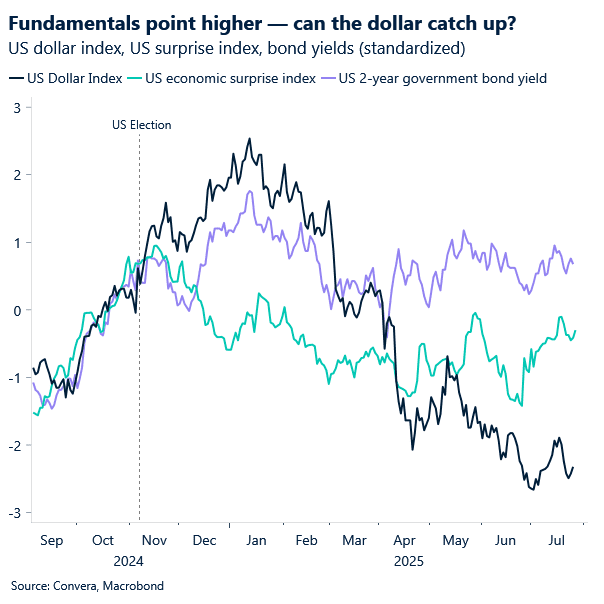
The relationship between the Dollar and global interest rate differentials has broken down markedly in 2025.
Typically the primary driver of FX movement, interest rates were pushed aside by trade war concerns, as well as other elements of President Donald Trump's agenda, including attacks on the Federal Reserve and the 'revenge tax' that was at one point proposed in the One Big Beautiful Bill.
With these distractions having faded, the market turns its attention back to traditional drivers, which advocate for a stronger Dollar.
"As attention shifts from trade deals to the implications of tariffs and macro fundamentals, monetary policy divergence is back in focus. The usual correlation between higher US yields and a stronger dollar broke down earlier this year amid concerns over fiscal sustainability and erratic policy signals, but recent developments suggest a recoupling is underway which is helping the dollar regain its footing," says George Vessey, Lead FX & Macro Strategist at Convera.