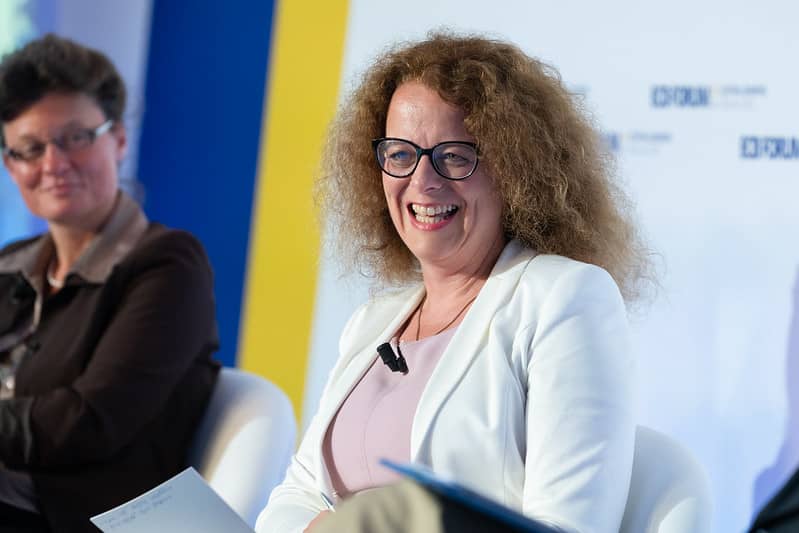
Image © Sérgio Garcia/Your Image for ECB.
ECB member signals policy won't be used to fight Euro strength.
The European Central Bank (ECB) won't fight the Euro's ongoing appreciation, according to an influential decision maker.
Isabel Schnabel, a member of the ECB's Governing Council, says the bar for another rate cut is set very high, a comment that will also reinforce the Euro's trend of appreciation.
Schnabel's guidance is held in high esteem and she is considered highly influential in overall ECB outcomes, meaning investors will be taking note.
She said in an interview released Friday that the Euro's ongoing appreciation is, in fact, a boon to the economy, via the confidence channel. "The stronger exchange rate is also a reflection of a positive confidence effect and investors' belief that the euro area's growth potential may be higher than thought."
| 5% | ... More Currency Achieved on Our Transfers Than a Typical Bank Delivers. |
 | Get Your Quote |
"Moreover, you see a rebalancing of investors into the euro area, which tends to lower the financing costs, counteracting the tightening effect of the exchange rate."
This counters the prevailing economic consensus that a strengthening interest rate lowers inflation because imports become cheaper.
Schnabel notes that more than half of the euro area's imports are invoiced in euros, which dampens the effect of the stronger exchange rate. Importers might also wish to hold onto realised profits, and not necessarily pass them on to consumers.
There is increasing speculation that the Euro's rise would dampen inflation projections for the euro area, which would prompt the ECB to cut further.
In fact, 1.20 in the Euro to Dollar exchange rate has been mentioned as a line in the sand that might trigger an ECB reaction.
By cutting interest rates further, the ECB would hope that it blunts the Euro's charge, which would boosting domestic inflationary forces.
The ECB projects 2026 HICP inflation at 1.6%, a level that is comfortably below target, and suggests there is scope for further rate cuts in the coming months.
However, Schnabel is fighting these assumptions, saying another rate cut would need a material deviation in inflation.
She argues that ECB rates have already become "accommodative" - in the sense that they are now low enough to stimulate growth and inflation - based on bank lending and overall economic resilience.
The neutral rate at the ECB - the rate at which point an interest rate level flips from being restrictive to stimulateive - is also higher than it was in recent years.
Part of the reason is Germany's decision to boost borrowing to finance investment in infrastructure and defence.
With the ECB unlikely willing to stand in the Euro-Dollar's way, confidence in a move to 1.20 will grow.