
Image © Adobe Images
The Euro remains overbought short-term, but the uptrend is powerful.
The Euro to Dollar exchange rate should pull back somewhat in the coming days, according to our rules-based Week Ahead Forecast model.
To be sure, the upside is firmly intact over multi-week timeframes, but when we look to the coming five days, overbought conditions are notable on the Relative Strength Index (RSI) and the Bollinger bands on the daily chart.
The problem is that this exchange rate is showing it can ride out overbought conditions for an extended period, which leaves us not 100% committed to the pullback narrative just yet.
As we can see, in the below, the pair has diverged from its moving average (the blue line) and is skirting the top of the upper Bollinger band. The rule book says it should ultimately mean-revert to that line. But, as already opined, it has shown a penchant for skirting these overbought conditions for some time; five consecutive days to be exact.
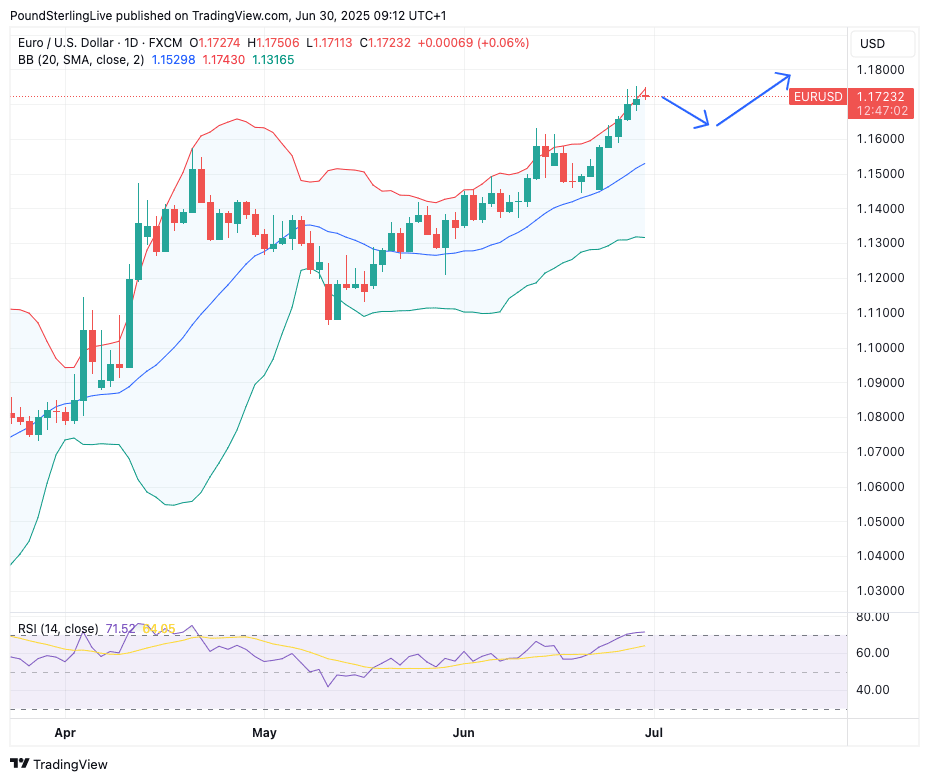
Above: EUR/USD at daily intervals.
The RSI is peaking above 70, the level at which momentum becomes overbought, in turn advocating for a calming in conditions. Note, an exchange rate merely has to stay still for the RSI to unwind, so it doesn't necessarily mean lower prices.
If a pullback occurs, it would meet the rising 20 SMA, which we think takes us back to 1.16.
Also, the fundamental narrative is also calling for a retreat, the Dollar fell last week despite some outright good news coming on the tariff front, as well as news the 'revenge tax' is likely to be omitted from the One Big Beautiful Bill.
"EUR/USD will likely be driven by the USD’s reaction to news of trade deals this week. If the US reaches agreements with several countries ahead of the 9 July tariff deadline, EUR/USD will ease in our view," says Samara Hammoud, Currency Strategist at Commonwealth Bank.
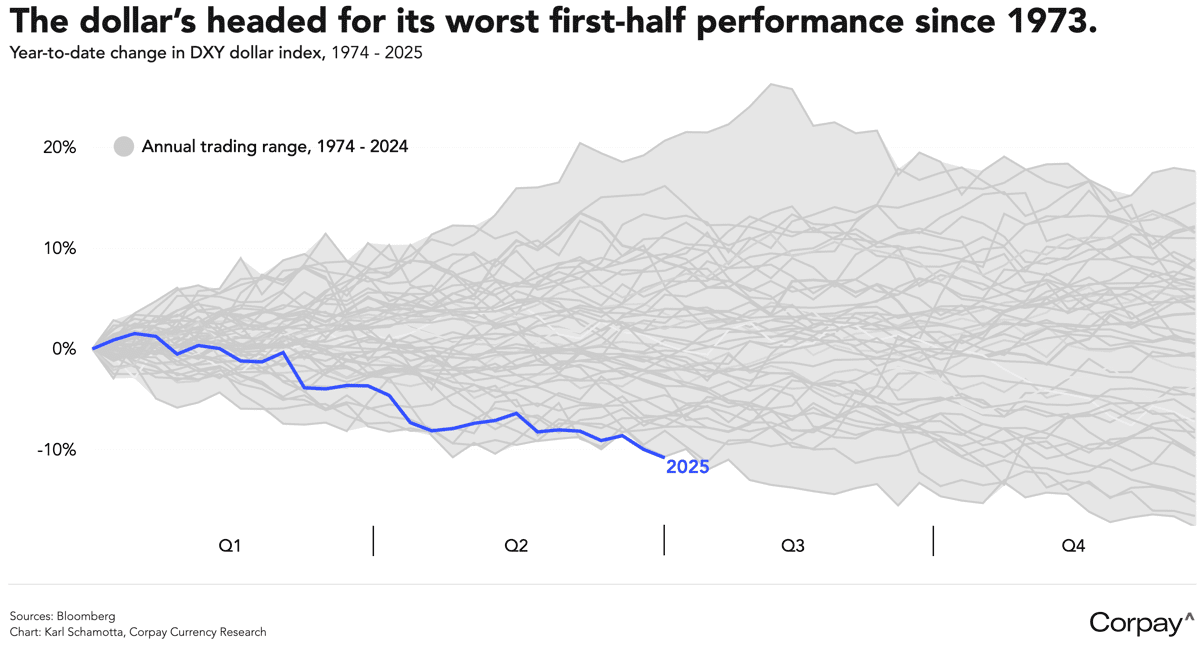
"Unless there’s a bounceback by Monday, the dollar looks set to end the first half with its worst performance since the Bretton Woods fixed exchange-rate system collapsed in 1973." - Karl Schamotta, Corpay.
U.S. President Donald Trump announced a raft of strong tariff measures on April 02, but put a moratorium on the measures until July 09, to allow for negotiations.
Last week, U.S. Commerce Secretary Howard Lutnick said a number of countries were close to signing, which lowers the odds of July 09 being a cliff-edge for markets. Good news on tariffs means good news for the Dollar.
Also note that positioning on the Dollar is particularly extreme, with the entire market and their dog betting against it. The latest data from the Commodity Futures Trading Commission for the week ending 24 June shows that speculators are now holding their largest net short positions in the US dollar since July 2023.
When positioning reaches extreme levels, it serves as a contrarian indicator that a counter move is in the offing.
So there's a lot going on that advocates for a stronger Dollar and lower EUR/USD.
Turning to the calendar, it's a busy week.
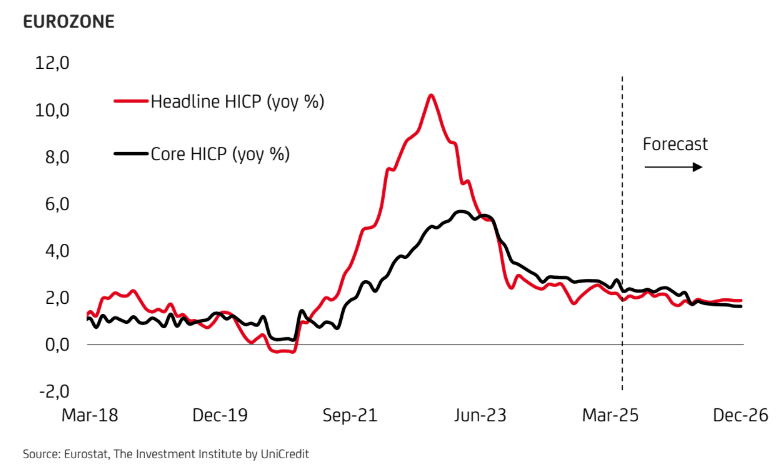
The focus will be on Eurozone inflation data out of Germany on Monday, which will give a good indication of where the Eurozone CPI inflation figure will land on release on Tuesday.
Data already out from France and Spain beat expectations, which suggests tomorrow's Eurozone release risks edging above the 2.3% the consensus expects.
Such an outcome is bullish for the Euro as it confirms the European Central Bank (ECB) can afford to wait when cutting interest rates further.
The next important U.S. data release is the June manufacturing ISM PMI survey, due on Tuesday. Based on regional manufacturing surveys published so far this month, the ISM likely remained weak under 50%.
As it is a new month, the U.S. labour market will also be in focus this week, including the non-farm payrolls report on Thursday.
Here, the headline is expected to be 100K additional jobs created in June, with the unemployment rate edging higher to 4.3% from 4.2%.
Markets are waiting for clearer evidence that tariff uncertainty is weighing on the U.S. jobs market, which would allow the Federal Reserve to cut interest rates as soon as next month.
With interest rates said by some analysts to be increasing in importance for FX markets again, this would weigh on the Dollar.
"We stay long EURUSD, but trail the stop, to lock-in further profits. Real money has begun to diversify away from the USD, with the case for more reallocations to depend on U.S. macro data, pending Fed rate cuts, but also the level of distrust in Trump’s policies (tariffs, budget, Fed dependence and so on)," says a note from the FX strategy team at Swedbank.