✳️ Secure today's exchange rate for a future payment. You may also book an order to trigger your purchase when your ideal rate is achieved. Learn more.
Image © Adobe Images
The pound to euro exchange rate (GBP/EUR) has been remarkably calm of late: this offers opportunity for those with transfer requirements.
Pound sterling is showing unusually stable conditions against the euro, with the exchange rate registering two identical daily closes; something that is largely unheard of in FX.
Tuesday's close at 1.1453 was exactly where GBP/EUR ended Monday, according to data from Intercontinental Exchange (ICE). Tuesday recorded a daily change of 0%, while Monday witnessed a 0.3% advance.
The previous Friday's close was at 1.1450, just three pips shy of the Monday and Tuesday closes!
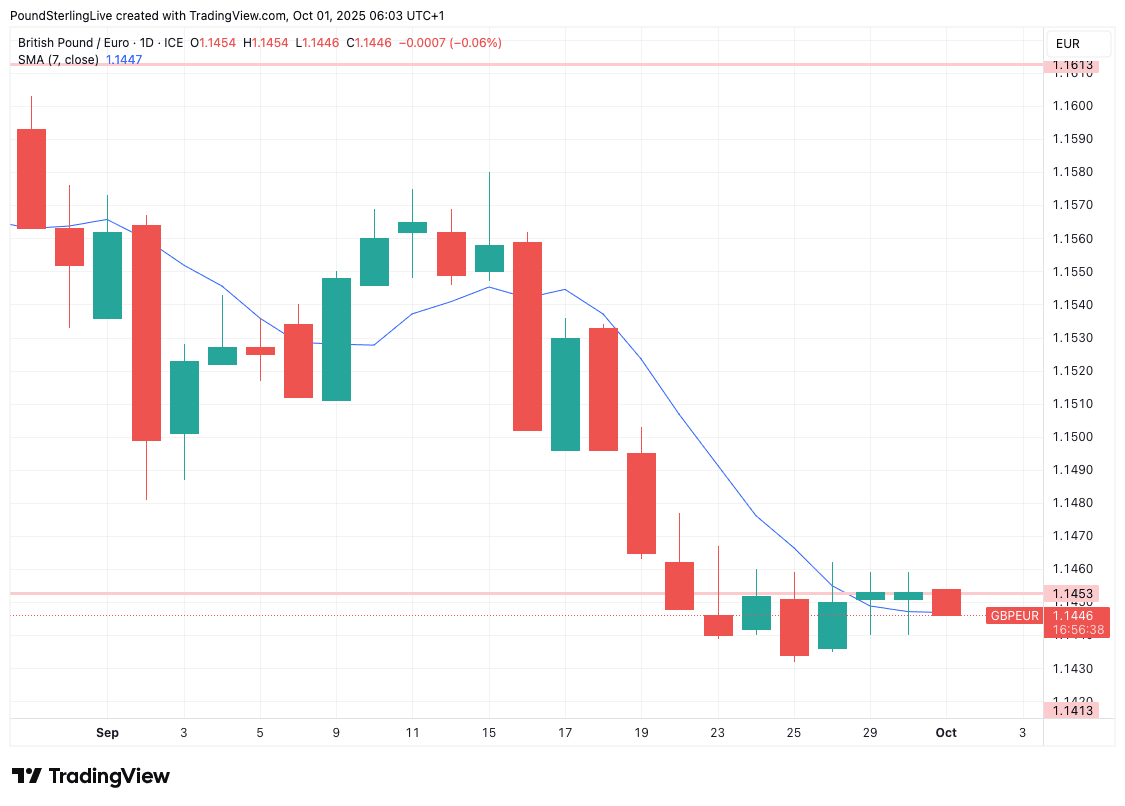
And last Wednesday's close was at 1.1452, which makes Thursday's 1.1434 a relative outlier.
The seven-day moving average is at 1.1447 and is pointing sideways, confirming an incredible volatility-free environment.
While not particularly exciting, the death of volatility is interesting and suggests a breakout is brewing.
But before the market starts moving again, we recognise that the stability is throwing up some quite favourable conditions for those making GBP into EUR international payments, or vice versa. This is because low volatility means low transaction costs and a perfect environment to book future transactions:
Predictability and Planning
With the pound holding a tight range around €1.1450, businesses and individuals can plan their transfers with more confidence.
Forward Contracts Become More Attractive
The calm backdrop means forward points (the cost of locking in a rate for the future) are less influenced by risk premiums. Securing today's stable GBP/EUR level for future invoices can remove uncertainty without a large cost penalty.
Better Execution
Payment providers like Pound Sterling Live can often achieve tighter spreads when market volatility is low, because the risk they take on in quoting rates is smaller. This can translate into marginally better pricing on transfers compared to turbulent periods.
Strategic Timing Flexibility
When markets are calm, payers have more breathing space to choose their settlement date. You’re not forced into rushing a payment out of fear the market might lurch against you overnight.
Ideal for Staging Payments
If you are splitting a large payment into tranches (e.g., 30% now, 30% later, 40% later), a sideways market reduces the risk that later tranches end up materially worse. This can be an attractive strategy in stable ranges.
Let's put some numbers on it:
We'll start from the current GBP/EUR level of 1.1450 (rounded from recent closes you listed).
Example: €50,000 Transfer Target
At 1.1450, to receive €50,000, you would need to send:
€50,000 ÷ 1.1450 ≈ £43,665
If GBP/EUR dropped by 1% (to 1.1335)
At 1.1335, to receive €50,000, you would need to send:
€50,000 ÷ 1.1335 ≈ £44,123
Cost increase: about £458 more
If GBP/EUR Rose by 1% (to 1.1565)
At 1.1565, to receive €50,000, you would need to send:
€50,000 ÷ 1.1565 ≈ £43,224
Cost saving: about £441 less
Consensus projections for the next four quarters, compiled from leading investment banks.
Access the full forecast →