Image © Adobe Stock
The Australian dollar hasn't enjoyed the war in the Middle East, and is vulnerable to further declines in the coming days.
The crisis has helped the pound-Australian dollar exchange rate recover from lows at 1.8690 to 1.94 and we would look for another test of this region in the coming week if the U.S. escalates its military campaign against Iran.
A deadline for Iran to open the Strait of Hormuz is set for 1 AM BST, presenting a significant risk to global markets. For now, traders are erring towards U.S. President Donald Trump finding some excuse not to bomb Iran back into "the stone age", as is so often the case when it comes to his deadlines.
(Those with transfer requirements should speak to a specialist about setting up market orders to both protect and benefit from upcoming moves. When the outlook is so opaque it pays to have a credible payments strategy).
Hopes of de-escalation have been apparent for a few days now and explains why GBP/AUD peaked at 1.94 on March 27, but has since retraced to 1.9136.
That being said, the pullback is relatively shallow in nature and losses are contained as the past four sessions have seen GBP defend the A$1.9136 level:
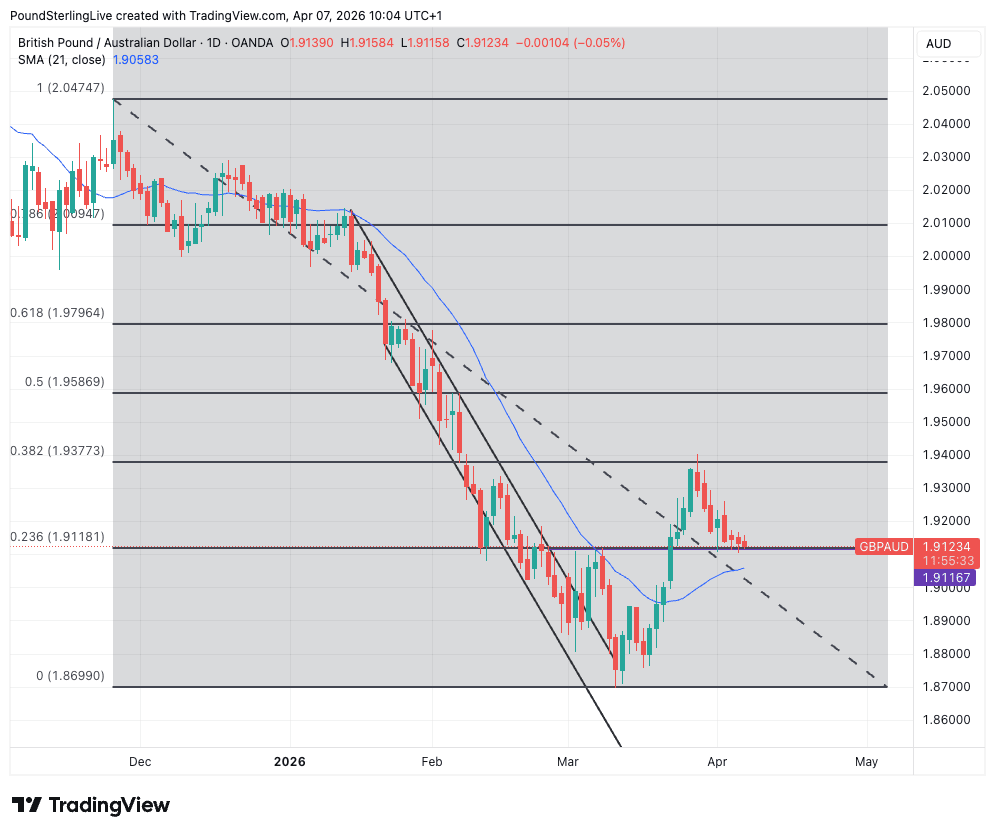
1.9136 is quite important as it's the 23.6% Fibonacci retracement level of the November-March selloff. Previously, the 38.2% fib level had acted as a resistance level that stopped the recovery, so we're minded to keep an eye on this indicator.
We would err towards expecting support at the 23.6% level to hold while hostilities continue in the Middle East, and look for a rebound to the 38.2% level in the near-term.
Partner alert: Horizon Currency say they can deliver up to A$1.3K more AUD on a 50K GBP transfers than your typical bank. Learn more here.
The Australian dollar has been penalised by its ties to Asian fuel refining: Australia gets its refined fuel from Singapore and South Korea, which in turn receive their oil from the Middle East. That's different to the UK and Europe, which rely heavily on Norwegian and U.S. oil and gas supplies.
In fact, last week we heard of a tanker filling up with diesel off the UK cost before heading of to Australia. Such a remarkable journey tells you there's a significant premium being paid by Australians for their fuel.
Some fuel station forecourts have run dry as consumers stock up, fearing shortages. That speaks of worried consumers, which should ultimately impact negatively on the economy.
The Reserve Bank of Australia will judge that this lessens domestically generated inflationary pressures, which it has been worried about in recent months, prompting a pair of 25-basis-point interest rate hikes.
Anticipation of those hikes drove AUD outperformance in December, January and February. If the need to hike recedes, Aussie dollar exceptionalism is a fade.
Should the war in the Middle East end - which is a distinct possibility for the coming days and weeks as Donald Trump is keen to exit what is an unpopular foreign war with his domestic voter base - then foreign currencies could mean-revert to pre-war levels.
For GBP/AUD, that risks a move back to 1.87.