
Image © Adobe Images
Pound holds its ground, but interest rate differentials are in the Australian dollar's corner.
GBP/AUD rose back above the 1.8860 support line in the latter part of this week to ensure its March consolidative phase extended.
Sterling has spent the month recovering against a number of its G10 peers, and in doing so arrests losses against the Aussie, and the daily chart shows 1.87 as the floor, but the 1.8863-1.9116 being the favoured zone for March:
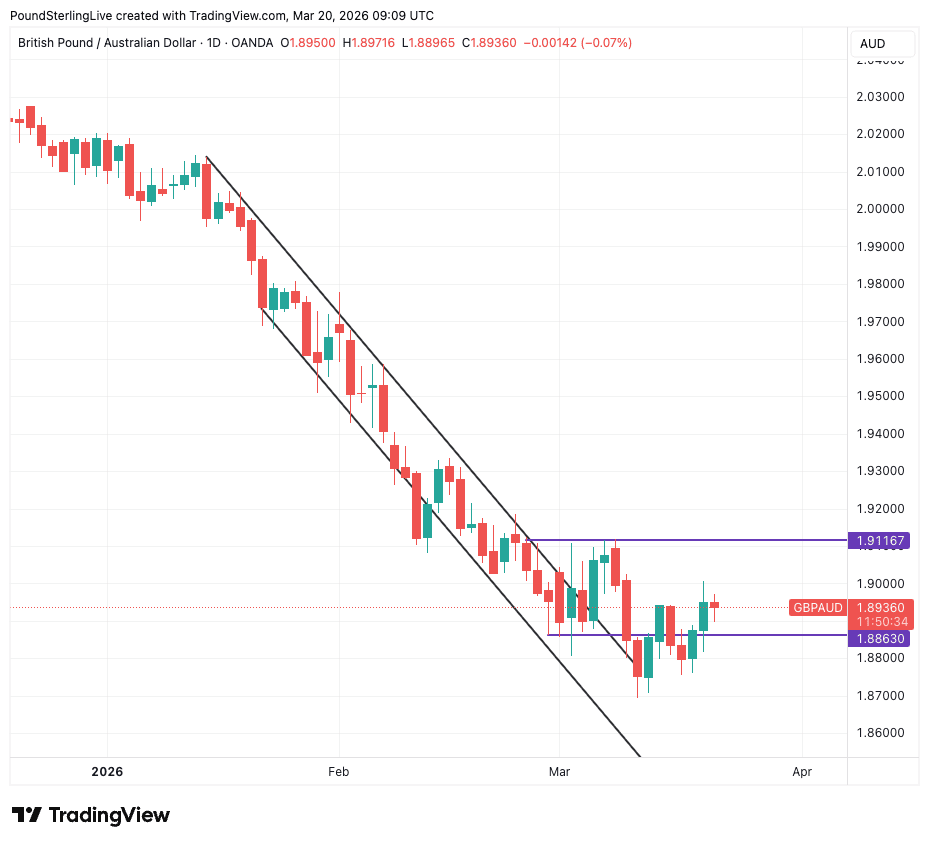
GBP/AUD has come under significant pressure in 2026, but has recently consolidated.
The consolidative phase brought to an end a frantic two-month selloff, yet the outlook remains firmly in the Antipodean's favour thanks to powerful bond market undercurrents.
Yields - the interest rate paid on Australian government debt (bonds) - are an important driver of FX performance: The Australian 10-year government bond yield hit nearly 5.00% on Thursday and Friday, its highest level since July 2011, as markets priced in both domestic rate increases and a global risk premium linked to the Middle East conflict and rising oil prices.
The Aussie benefits as global investor capital seeks out this relatively high yield (as a broad-brush example, you can borrow in Japan where the yield is 2.6%, and invest in Australia for nearly double the yield).
The two-year yield - which is closely tied to RBA rate expectations - surged to above 4.8% at one point to reflect Tuesday's 25 basis point rate hike and bets that more hikes are coming.
All four of Australia's major banks, ANZ, CBA, NAB and Westpac, now back a further 25 basis point rise in May, which would bring the cash rate to 4.35%. As of mid-week, markets were pricing in three additional hikes by year's end, which would push the cash rate to approximately 4.6%
That puts the all-important interest rate backdrop firmly in the Australian dollar's favour and explains the currency's ongoing outperformance.
"AUD/USD held onto yesterday’s gains near 0.7100 supported by higher Australian government bond yields," says Samara Hammoud, a strategist at Commonwealth Bank of Australia. "Australian two‑year bond yields increased by around 15bps to near 4.75%, the highest level since 2011. An increase in metal and precious commodity prices also supported AUD/USD."
GBP/AUD
The Reserve Bank's nine-member policy committee split 5-4 in favour of raising the cash rate to 4.1% from 3.85% on Tuesday, the first back-to-back hike since mid-2023.
The decision reflected the inflationary threats of the Middle East conflict, but even before the war started, the domestic economy was already facing inflationary problems.
Headline inflation stood at 3.6% for the quarter ended December, with the monthly measure rising to 3.8% in January.
The RBA's own statement noted that inflationary pressures had "picked up materially" in the second half of 2025, and that the risks had "tilted further to the upside, including to inflation expectations."
For GBP/AUD, interest rate and bond market dynamics continue to favour GBP/AUD upside:
The UK 10-year gilt yield climbed toward 4.7%, approaching last week's six-month peak of 4.78%, as soaring energy prices intensified inflation concerns. That puts Australia's 10-year approximately 25-30 basis points above the equivalent UK gilt.
Although GBP/AUD has stabilised in the near-term, should the war end, the downtrend would likely resume in earnest as Australia's organic inflationary pressures mean more rate hikes are coming, regardless of the war.