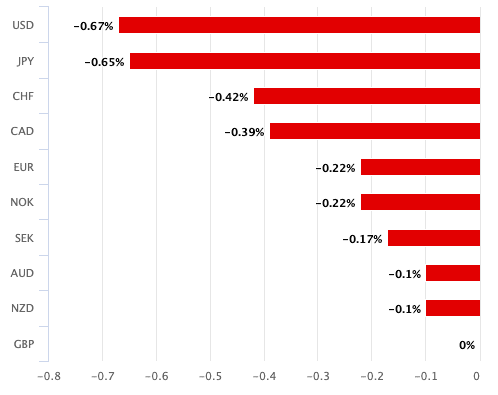
Image: GBP on Friday 13. Pound Sterling Live.
Britain's pound could finally be facing up to the negative realities posed by the conflict in Iran.
Sterling trades softer against the dollar, euro and all G10 peers on Friday in a sign of some targeted selling; across-the-board weakness appears linked to fears that the UK economy is particularly unsuited to withstand the coming inflationary impulse posed by the war.
Not helping is January GDP data that showed the economy flatlined, meaning it entered the Iran crisis from a poor starting point.
"GBP is the G10 underperformer amid a weaker than expected Jan GDP print," says Noah Buffam, FX analyst at CIBC Capital Markets.
GBP/EUR trades 0.22% lower on the day at 1.1564, GBP/USD goes down 0.65% to 1.3258.
Although local data was poor, it could be the Iran crisis that is finally catching up with sterling.
UK bonds - which the government issues in order to borrow - have been sold more aggressively than other developed market peers, indicating a premium is being asked by international investors.
Falling demand raises the yield these bonds offer, which ultimately puts pressure on the UK's already dire public finances.
Over the past two weeks, those rising bond yields have supported sterling, particularly against the euro, but there was always a risk that the situation would reverse if investors grew concerned about debt dynamics becoming unsustainable. We wonder if that reversal is here as sterling softens across the strip.
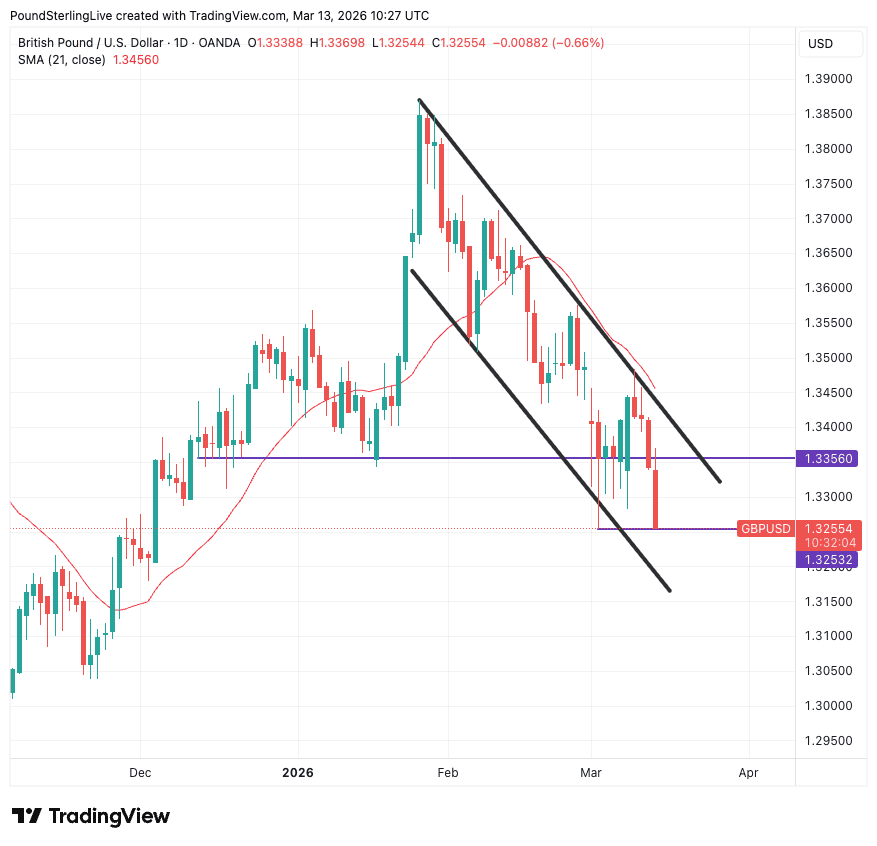
The UK enters the next war-induced inflationary impulse having not fully got a handle on inflation; core inflation at 3.1% in January indicates a high base entering a new crisis.
The Bank of England will therefore find itself unable to cut rates when it meets next week, which the moribund economy would have welcomed owing to the deteriorating employment situation.
"Consumption is likely to struggle however, amid the stagflationary energy price shock. We expect the BoE to signal an extended hold in next week’s meeting, as RPI fixings currently suggest inflation will remain far above target into the coming months," says Buffam.

Above: Cost of borrowing over the two-year tenor.
Despite the jitters, economist Alexandros Xenofontos at TS Lombard says UK-specific fears are overstated.
"Our central view is that markets are likely overstating the inflation implications of the current energy move; we are looking through the energy market gyrations," he says in a note out Friday.
While higher energy prices can still feed into inflation through fuel prices and downstream input price inflation - as well as anchor higher inflation expectations, Xenofontos explains the UK's macro environment differs materially from that of 2022.
"Slack is appearing in the labour market and inflation has already normalised a fair amount. Moreover, the next round of Ofgem energy price cap will be 6.6% lower QoQ until July. Until then the markets, and the BoE, have some breathing room to gauge and adjust policy," he says.