Israeli strikes on Lebanon continued, prompting Iran to block Hormuz transit. Image: Adobe Images.
Pound sterling bounced against the euro, but soon found its limits as the realities of the explosive Middle East stage gave reason for caution.
The GBP/EUR exchange rate was lifted by a global market sigh of relief to news of a Middle East ceasefire, rising to 1.1510 in midweek trade.
Gains didn't extend beyond here, with oil prices soon finding a floor as investors realised the dynamics around the Strait of Hormuz remain highly volatile.
Kuwait said it was enduring "intense" attacks from Iran all day, while Israeli strikes on Hezbollah in Lebanon continued.
The Strait of Hormuz is still effectively shut and just three ships were observed leaving the region on Wednesday, which will keep a floor under the dollar and limit sterling's gains.
"Stocks and bonds are giving up some gains, and the Brent crude oil price is hovering around $95 per barrel, after falling below $92 per barrel at one stage on Wednesday," says Kathleen Brooks, research director at XTB. "This is due to reports that Iran was closing the Strait of Hormuz after Israel continued to attack Lebanon."
The British pound rallied against the euro and dollar in early trade after the U.S. and Iran agreed a two-week ceasefire, ensuring U.S. President Donald Trump's threat to annihilate Iran unless it ceded ground failed to pass.
Market relief on signs of a road to de-escalation sent oil prices and the dollar lower, lifting 'risk-on' assets, such as GBP/EUR and GBP/USD.
But the realities of a partial and fragile ceasefire means GBP/EUR has since retreated below 1.15 again, to reach 1.1485 by Thursday. GBP/USD has retreated from 1.3480 to 1.3425.
With near-term highs potentially in, those with payments should consider clearing a portion of their outgoing GBP payments at current levels. As always, timing is everything at this juncture, and we recommend dealing with full-service providers to get you across the line.
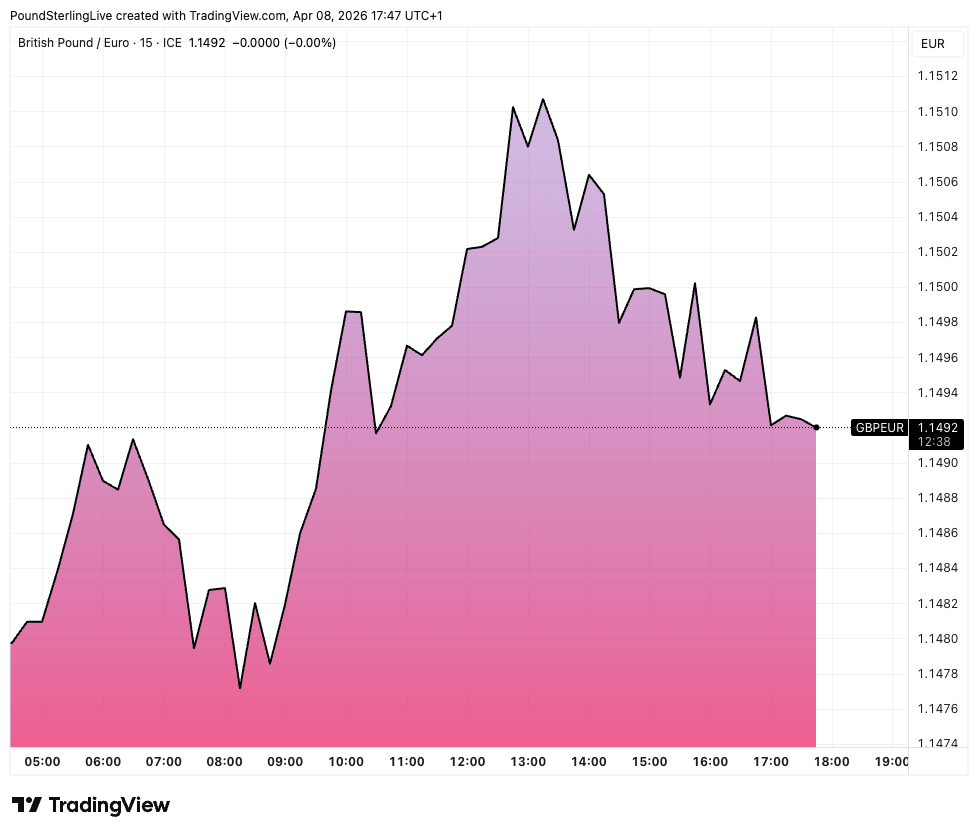
Above: GBPEUR off the highs. Benchmark your bank's GBP/EUR transfer rates against a specialist provider to estimate your cost risks with our co-branded calculation tool.
Sterling tends to rise against the euro and dollar but fall against the high-beta Aussie and Kiwi dollars when there are significant sighs of relief breathed across international markets.
However, there are limits to this trade: this is because domestic bond yields are falling relatively quickly and that can often be a headwind for the pound.
So we wouldn't be surprised if some GBP exchange rates soon succumb to gravity and feel the force of falling bond yields.
"Pricing in of rate hikes went too far in the escalation phase of the conflict, so some continued reversion back lower in expectations seems warranted on news of the ceasefire," says a daily note from Lloyds Bank.
- Iran and Hezbollah remain locked in conflict, with Iranian strikes continuing and Hezbollah firing rockets into Israel on Thursday.
- Iran says there will be no ceasefire implementation while this happens.
- Oil prices climb as the Strait of Hormuz remains shut to traffic.
- U.S. President Donald Trump said on Truth Social overnight that more work needs to be done to reach a "real agreement". U.S. forces will remain on standby as a result.
- Markets nevertheless remain cautiously optimistic: an Iranian delegation will arrive in the Pakistani capital, Islamabad, on Thursday night for talks to resolve the conflict with the U.S. and Israel.
Global bond yields surged as rising oil and gas prices meant the world's central banks would need to consider raising interest rates: short-term bond yields are particularly sensitive to central bank expectations.
That provided sterling some lift in the early stages of the Middle East conflict, but worries soon emerged that rising energy prices and bond yields would destabilise the country's finances.
So the ceasefire will be welcome in this regard and will offer some cushion to the pound. However, it looks like there are limits to recent optimisim owing to the apparently fragile state of the ceasefire.