

Image © Adobe Images
- Leverage trading lets you control a position larger than your own capital by posting a small amount as margin (collateral).
- Leverage is a multiplier that works both ways: it amplifies profits and losses by the same factor.
- You can go long if you expect a price to rise, or short if you expect it to fall.
- Liquidation is the forced closure of your position when losses eat through your margin — the single biggest risk to understand.
- Higher leverage means a smaller price move can liquidate you, so beginners should start low (around x5) and scale up only with experience.
- Stop-loss orders, sensible position sizing, and isolated margin are your core defenses against blowing up an account.
- On Margex, leverage runs from x5 to x100, and a demo account lets you practice the mechanics with zero risk first.
Leverage is the most powerful - and most misunderstood - tool in crypto trading. Used carefully, it lets a small amount of capital go a long way. Used carelessly, it can wipe out an account in a single candle.
If you have seen screenshots of huge overnight gains and wondered how they are possible, leverage is usually the answer. So is the quieter story of the accounts that got liquidated chasing them.
This guide explains, in plain terms, what leverage trading is, how it actually works, and how to manage its risks. Then it shows you how to put the theory into practice step by step. You can follow along on the official Margex platform, which offers a risk-free demo account so you can learn the mechanics before committing real funds.
What Is Leverage Trading in Crypto?
Leverage trading is a way to open a position larger than your own funds would normally allow. You put down a small amount of money - called margin - and the platform effectively backs the rest, multiplying your market exposure by a chosen ratio.
The simplest way to picture it: with x10 leverage, a $100 deposit lets you open a $1,000 position. Your $100 is the collateral; the leverage supplies the other $900 of exposure. If the market moves 5% in your favour, you earn 5% of the full $1,000 - a $50 gain, which is a 50% return on your $100. The catch is perfect symmetry: a 5% move against you is a $50 loss, half your margin gone.
In crypto, leverage is most commonly accessed through perpetual futures - contracts with no expiry date that track the price of an asset like Bitcoin. You never own the coin itself; you are trading a contract that mirrors its price, which is why you can profit whether the market rises or falls.
How Does Leverage Trading Work?
Every leveraged trade follows the same basic flow, whatever the platform:
- You deposit funds. This becomes your collateral, also called margin.
- You choose your leverage. A higher multiplier means a bigger position from the same margin - and more risk.
- You pick a direction. Go long if you expect the price to rise, or short if you expect it to fall.
- The position opens. Profit and loss are calculated on the full leveraged size, not just your margin.
- You exit - by choice or by force. You close the trade yourself to lock in profit or cut a loss, or the platform liquidates it if losses run too far.
A worked example
Say you have $200 and you are confident Bitcoin will rise. You open a long with x10 leverage, giving you a $2,000 position. If BTC climbs 8%, your position gains $160 - an 80% return on your $200. But if BTC falls 8%, you lose $160, leaving just $40 of margin. A further small drop would trigger liquidation. This is why the leverage ratio you choose matters so much.
Going Long vs Going Short
One of leverage trading's main advantages is that you can profit in either direction:
- Long (buy): You expect the price to rise. You profit if it goes up and lose if it falls.
- Short (sell): You expect the price to fall. You profit if it drops and lose if it rises.
Because you are trading a contract rather than owning the coin, shorting is as straightforward as going long - you simply click sell instead of buy. That flexibility lets active traders respond to falling markets instead of only waiting for them to recover.
Margin, Collateral, and the Two Margin Modes
Margin is the collateral you post to open and keep a position alive. There are two kinds worth knowing. Initial margin is the amount required to open the trade; maintenance margin is the minimum equity you must keep to avoid forced closure. Drop below the maintenance level and you get liquidated.
Most platforms, Margex included, also let you choose how your collateral is shared across trades. The difference is important for risk:
1) Isolated margin
Only the margin you assign to a specific trade is at risk. If that position is liquidated, you lose just the funds allocated to it - the rest of your balance is untouched. For beginners, this is usually the safer default.
2) Cross margin
Your entire available balance in that collateral currency backs the position. This gives a position more room to breathe before liquidation, but a bad trade can draw on your whole balance. On Margex, if the cross-margin level drops to or below 10%, the position with the largest loss is stopped out automatically. You can read the full mechanics in the Margex Help Center.
Liquidation: The Risk You Must Understand
Liquidation is the forced closure of your position by the platform when your losses push your margin below the maintenance threshold. It exists to stop your account going negative, but for you it means the trade is over and the allocated margin is gone.
The crucial relationship for beginners: the higher your leverage, the smaller the price move needed to liquidate you. The table below shows roughly how far the market has to move against you to wipe out your margin at different ratios.
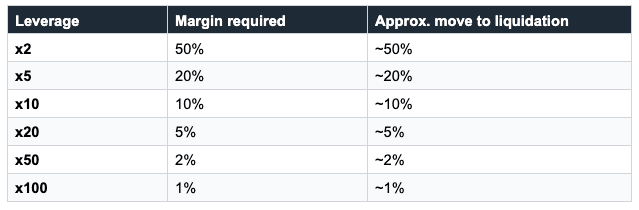
At x100, a 1% move against you ends the trade. Given how often crypto swings several percent in minutes, you can see why extreme leverage is closer to gambling than trading. The figures above are approximate and ignore fees and funding, which slightly tighten the buffer.
Want to see liquidation prices update in real time without risking a cent? Practice on the Margex demo account before you trade live.
How to Start Leverage Trading on Margex
Once you understand the concepts, the practical steps are quick:
- Create an account with your email and a strong password, then enable two-factor authentication.
- Fund your wallet with a supported asset, or buy crypto with a bank card through the Buy Crypto option.
- Open the trade page and choose your market, such as BTC or ETH.
- Set your collateral currency, order type, position size, and leverage (start around x5).
- Choose isolated margin, then click buy to go long or sell to go short.
- Immediately attach a stop-loss and take-profit. The order guide explains both.
If you want to read the markets before committing, the walkthrough on how to check crypto prices on Margex is a helpful next step, and you can cross-check charts on TradingView.
Risk Management: How Beginners Survive
Leverage does not punish ambition - it punishes recklessness. These habits separate traders who last from accounts that blow up:
- Start with low leverage. Around x5 gives real room for error. The headline x100 is for experienced traders, and you never have to use the maximum.
- Always use a stop-loss. It closes your trade automatically before liquidation can. Treat it as non-negotiable.
- Size positions sensibly. A common rule is to risk no more than 1-2% of your account on any single trade.
- Prefer an isolated margin early on. It ring-fences the damage if a trade goes wrong.
- Account for funding fees. Perpetual positions pay a periodic funding fee every 8 hours, which slowly erodes margin on positions held open.
- Never risk money you cannot afford to lose. Leverage magnifies volatility in an already volatile market.
Frequently Asked Questions
What is leverage trading in crypto?
It is trading with borrowed exposure: you post a small amount of collateral (margin) and control a much larger position. Profits and losses are calculated on the full position size, so a chosen ratio like x10 multiplies both by ten.
How does leverage trading work?
You deposit margin, choose a leverage ratio, and open a long or short position on a perpetual futures contract. The platform calculates your profit or loss on the leveraged amount. If losses push your margin below the maintenance level, the position is liquidated.
How do you calculate leverage and position size?
Position size equals your margin multiplied by the leverage. For example, $100 of margin at x10 controls a $1,000 position. The margin required is simply 1 divided by the leverage - x10 needs 10%, x100 needs 1%.
What is liquidation in leverage trading?
Liquidation is the automatic, forced closure of your position when losses reduce your margin below the maintenance threshold. You lose the margin allocated to that trade. The higher your leverage, the smaller the adverse move needed to trigger it.
What does 10x leverage mean?
x10 leverage means your position is ten times your margin. With $100 you control $1,000 of exposure, so a 1% price move changes your position value by $10 - a 10% swing on your margin. It also means a roughly 10% move against you wipes out that margin.
Is leverage trading risky for beginners?
Yes. Leverage amplifies losses as much as gains, and crypto is highly volatile. Beginners should start with low leverage, always use a stop-loss, practice on a demo account first, and never risk more than a small percentage of their capital per trade.
What is the best leverage for beginners?
There is no single right answer, but most experienced traders suggest beginners stay in the low range - around x5 or below - where there is more room for error before liquidation. You can raise it gradually as your risk management improves.