
Image © Adobe Images
The pound-New Zealand dollar exchange rate gapped higher on Monday's open in a reflexive response to Sunday's news that the situation in the Persian Gulf will likely escalate again in the coming days.
The U.S. decision to block Iranian-sanctioned maritime traffic through the Strait of Hormuz is being interpreted as a ploy to pressure Iran at the negotiating table, one that nevertheless comes with kinetic risks.
For New Zealand, the end of the war can't come soon enough, and any elongation of the timeline towards a reopening of the Strait raises the costs for the domestic economy. New Zealand is particularly vulnerable to the conflict due to its reliance on Asian fuel refineries, which tend to source their oil from the Middle East, leaving Asian and antipodean diesel prices trading at a massive premium to elsewhere.
However, as we move through the European trading session, it's clear that markets have a handle on the situation, viewing the latest developments as a progression in the unsteady journey to a ceasefire and reopening of the Strait of Hormuz to maritime traffic.
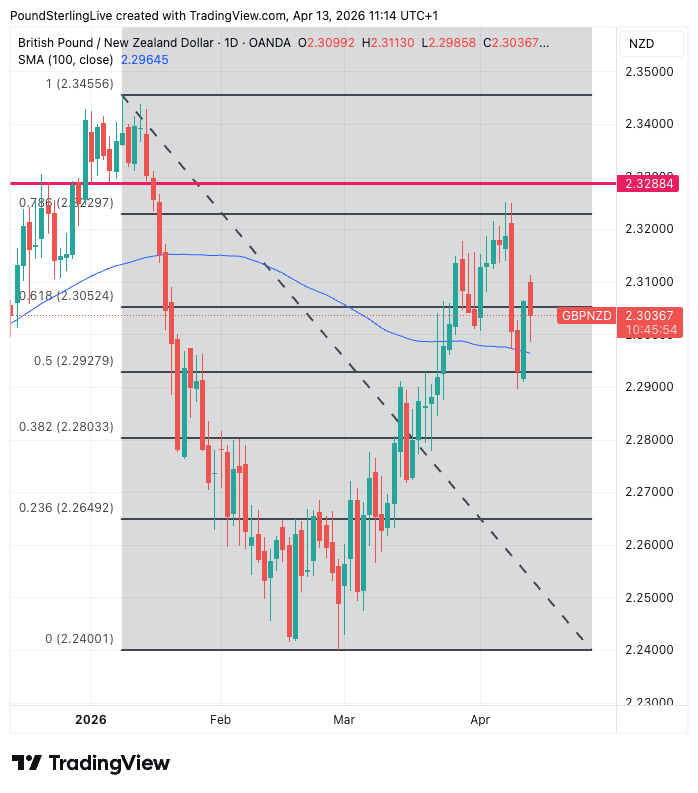
GBP/NZD opened the day at 2.3110 but has since retreated to 2.3030 amidst a NZD comeback.
The U.S. decision to block Iranian shipping doesn't actually alter global energy market dynamics: what's the difference between three ships getting through the Strait in a day versus zero? Nothing, when you consider the pre-conflict baseline is closer to 100.
And, bigger picture, the U.S. move is designed to pressure the Iranians at the negotiating table, which means we're still ultimately tracking towards a deal.
That's enough to limit NZD weakness for now.
Also, keep in mind that last week's big rise in the NZD had more to do with the RBNZ than the situation in the Middle East. The RBNZ kept rates on hold but warned that it sees increasing scope to raise interest rates again in the coming months.
The prospect of a more 'hawkish' monetary policy in New Zealand understandably lit a fire under the NZD and sent GBP/NZD down to 2.2896.
That looks to have ended a recent rally in the exchange rate at the 78.6% Fibonacci retracement level of the 2026 selloff that lasted through January and February.
Last week's post-RBNZ drop took the pair back to the 50% fib level at 2.2927, which looks to have held, and we're now potentially consolidating at the 61.8% fib level at 2.3052.
Support near that 50% level also coincides roughly with the 100-day moving average, which looks to have been successfully defended.
So, in all, we think GBP/NZD has exited its recovery sequence and is this week set to stabilise in a fairly wide consolidation zone that is centred around 2.3052.