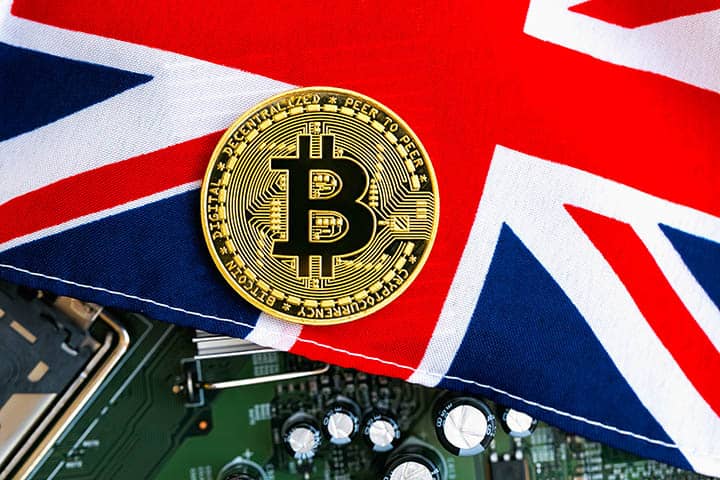
Image © Adobe Images
Inflation fears are back - but can Bitcoin finally prove it's the hedge it promised to be?
With crude oil climbing and price pressures building, Bitcoin's credentials as an inflation hedge enter the conversation again, but the macroeconomic backdrop that strengthens the case also carries risks that could undermine it.
Inflation Expectations Rise
For UK savers and investors, the economic backdrop has shifted uncomfortably in recent weeks. Crude oil prices have climbed, reawakening the kind of inflation anxiety that many hoped was firmly in the rear-view mirror.
Market expectations around the Bank of England's rate path have moved sharply from anticipated cuts to the possibility of further hikes as price pressures prove more stubborn than policymakers projected.
The question of where to put money when inflation erodes purchasing power is not a new one. It is prompting a fresh look at assets that were specifically designed, or at least marketed, as immune to that erosion. Bitcoin is one of them. Whether it actually delivers on that promise is considerably less settled.
Bitcoin's Promise and the Thinking Behind It
Bitcoin was built in the wake of the 2008-2009 financial crisis around a simple but radical proposition: a form of money whose supply cannot be expanded by any government, central bank, or institution.
Its total issuance is capped at just under 21 million coins - a limit enforced not by policy, but by the protocol itself. No committee vote, no emergency measure, and no quantitative easing programme can alter it.
New coins enter circulation through a process called mining, but the rate of that issuance is cut in half approximately every four years in what is known as a halving.
The result is a supply schedule that is entirely predictable decades in advance, something no central-bank-issued currency, including sterling, can claim.
For investors who view inflation as a monetary phenomenon, the consequence of too much money chasing too few goods, that design is the entire point.
Bitcoin, in this framing, is the antithesis of a system that printed money at scale through the 2008 financial crisis, the COVID pandemic, and the cost-of-living surge that followed.
The scarcity argument has recently gained a concrete marker. More than 20 million bitcoins, representing 95% of the total that will ever exist, have now entered circulation. The remaining 5% will be released gradually over the course of more than a century, with the final coins not expected to be mined until around 2140.
The inflation hedge case is grounded in the supply schedule, and the recent milestone is a measurable demonstration that Bitcoin's scarcity is not theoretical.
Compare that with sterling. The Bank of England's balance sheet expanded dramatically during successive rounds of quantitative easing, and UK government borrowing overshot forecasts by £6.9 billion in February alone. The supply of pounds is, by design, responsive to economic conditions; the supply of bitcoin is not.
That contrast sits at the heart of the investment thesis but it is also why, at moments of renewed inflation anxiety, the conversation around Bitcoin tends to resurface.
Counterargument and Debate
The case for Bitcoin as an inflation hedge is as simple as described above. The evidence for it, however, is inconsistent.
During the inflationary surge of 2021 and 2022, Bitcoin did not behave like gold as proponents of the inflation hedge thesis expected.
It sold off sharply as central banks tightened policy, falling in tandem with equities and other risk assets rather than moving against them. Bitcoin was treated as a speculative position to be unwound, not a store of value to be held.
The current macroeconomic environment contains the same ingredients as that pattern. Rising energy prices, geopolitical uncertainty, and the prospect of higher-for-longer interest rates tend to strengthen the dollar and drive capital toward traditional safe havens.
Bitcoin, in these episodes, has historically moved in the wrong direction for anyone seeking inflation protection.
Analysts point out that Bitcoin's volatility also works against its practical use as a hedge. An asset that can lose a third of its value in a matter of weeks introduces a different category of risk than the one it claims to offset.
The debate remains unresolved, and intellectually honest analysis should treat it that way.
Those who remain confident in Bitcoin's long-run inflation hedge credentials argue that the asset is still maturing.
Correlation with equities reflects a market that has not yet fully repriced Bitcoin as a distinct asset class. As institutional adoption deepens and the available supply continues to tighten, the relationship between Bitcoin and inflation may become more reliable over time.
On the other side, the argument is that volatility is not a transitional feature that Bitcoin will eventually outgrow, but a structural characteristic of an asset with no underlying cash flows, no yield, and a price driven primarily by sentiment and speculative demand. For a pension saver or a treasury manager weighing inflation protection, that profile is difficult to accommodate within conventional risk frameworks.
What It Means for UK Investors
Should a financially literate, attentive to sterling's purchasing power, and accustomed to thinking in terms of interest rate differentials and macro cycles reader consider Bitcoin, currently it presents to them a genuinely uncomfortable duality.
The structural case for holding a fixed-supply asset when fiat currencies are under inflationary pressure has not weakened. The consistency of demand to buy crypto with credit card on ChangeHero underscores the strength of the sentiment.
However, the behavioural track record of Bitcoin in precisely the kind of environment where that case should be strongest has, so far, not supported it.
Whether the next inflation cycle resolves that contradiction in Bitcoin's favour or confirms that its reputation as digital gold remains more narrative than reality is one of the more consequential open questions in financial markets. For now, the honest answer remains to be seen.