Image © Adobe Images
Easy wins for the GBP/USD as the dollar declines, but the GBP/EUR outlook is murkier.
The British pound is now at stronger levels against the dollar than it was before the outbreak of the war in the Middle East.
In fact, the Middle East conflict 'premium' is no longer evident in the main GBP pairs, with GBP/USD on Tuesday rising to its highest level since February 26, an exchange rate last touched before the outbreak of war in the Middle East.
GBP/USD recorded its sixth consecutive daily gain on Monday and rose to 1.3508, making for a bottom-to-top move of nearly one per cent, a sizeable recovery for a pair that started the week deep in the red on fears the U.S. blockade of the Strait of Hormuz represented a negative development. The rise in spot takes competitive 0%-fee transfer provider rates to 1.3470 while high street bank transfer rates are in the region of 1.3157.
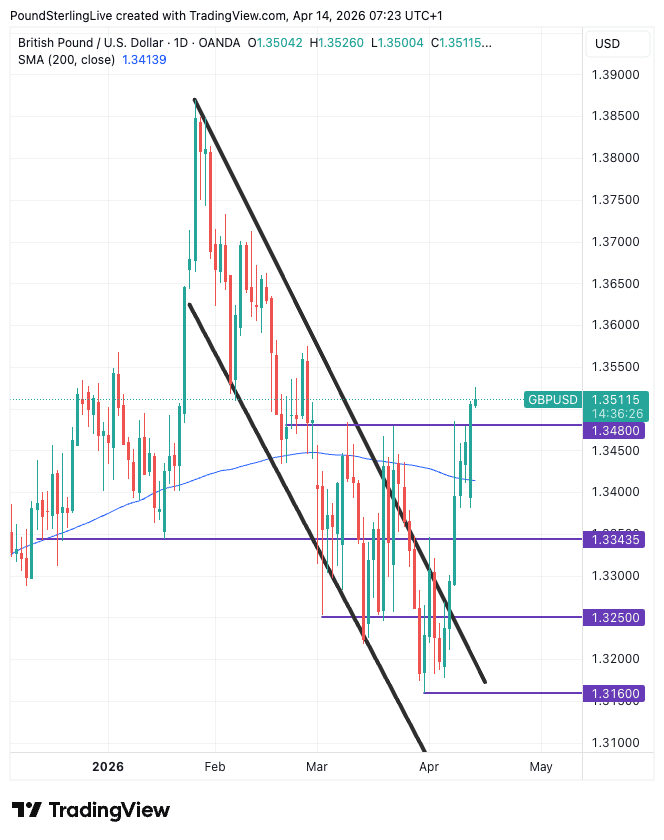
Above: GBP/USD at daily intervals.
"GBP/USD extended its recent gains," says Sarah Hammoud, an analyst at Commonwealth Bank. "Risk sentiment improved thanks to optimism that an easing conflict in the Middle East will lower oil prices and support global economic growth. Iran and the U.S. reportedly may revive talks following the start of the U.S. blockade of the Strait of Hormuz."
Markets reacted negatively to weekend news the U.S. would blockade the Strait of Hormuz, but it became clear the decision would not alter the calculus on non-existent outflows of oil and gas from the region, and that the move was a ploy to pressure Iran at the negotiating table.
GBP/EUR has also shorn its war premium, but unfortunately for euro buyers, this reset takes it lower, and the pair trades at 1.1480.
The current FX market action shows that U.S. dollar weakness is flattering the pound via the GBP/USD channel, and GBP/EUR is - as always - the better indicator of sterling-specific sentiment.
This means as long as markets feel the war in the Middle East is muddling in a messy fashion towards a conclusion, risks to global growth should be contained, which limits demand for the safe-haven dollar.
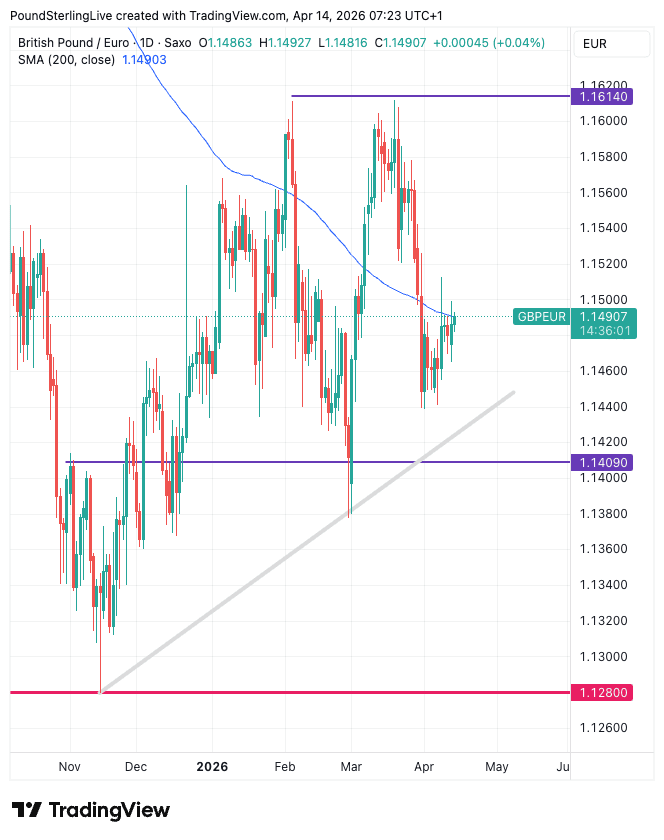
Above: GBP/EUR at daily intervals.
It also means investors can return focus to domestic issues facing the pound: namely, a difficult economic backdrop and looming local elections where the incumbent Labour Party faces a drubbing. (Learn about protecting your GBP transfer into May's elections).
"The recent resilience of GBP, supported by a sharp move higher in UK yields, is also unlikely to last. We already see scope for catch‑up GBP weakness to better reflect the negative energy price shock hitting the UK economy," says a monthly FX update from MUFG Bank Ltd.
The pound rallied against the euro in the opening two weeks of the Middle East conflict because of fears rising oil prices would boost inflation to higher levels in the UK than elsewhere, partly because Britain entered the war with a higher baseline inflation rate.
That would mean the Bank of England would need to raise interest rates, an assessment that boosted local bond yields.
But as markets see the heat come out of the Middle East, there's scope for the market to reverse previous interest rate hike bets, prompting British bond yields and the pound to retreat against the euro and other non-USD G10 currencies.
However, analysts at JP Morgan warn of another interpretation: that the UK is still particularly exposed to higher prices and a slowing economy.
"For GBP... with the severity of the energy shock worsening and pushing the UK further towards stagflation, the pound won’t be our top pick for the asset re-allocation/sell-America trade, and instead we favour EURGBP longs to position for weakening fundamentals and more reactive FX hedging from European Real Money," says a daily note from JP Morgan's London trading desk.

Concierge Money Transfers
For high-value transfers, you need high-value service: dedicated account management, on-point pricing, insight into market conditions and trends, help with structuring your payment, and execution support at key moments.
Learn More →Strategists at CIBC Capital Markets warned on Monday that the pound will likely struggle as recent developments highlight the vulnerability of Britain's strained government finances.
"Given the UK’s susceptibility to fiscal pressures and or its high beta status we can expect Sterling to remain on the defensive including versus the EUR. Given UK risk sensitivity we would expect EUR/GBP to drive higher towards the 1 April high at 0.8742, says CIBC analyst Jeremy Stretch.
EUR/GBP at 0.8742 equates to a GBP/EUR conversion of 1.1440.