
















Canadian Dollar: New Forecast Confirms Better Exchange Rates Ahead
A leading investment bank forecasts a recovery ahead for the Canadian dollar, but falling oil prices remain a constant risk to any improvement.
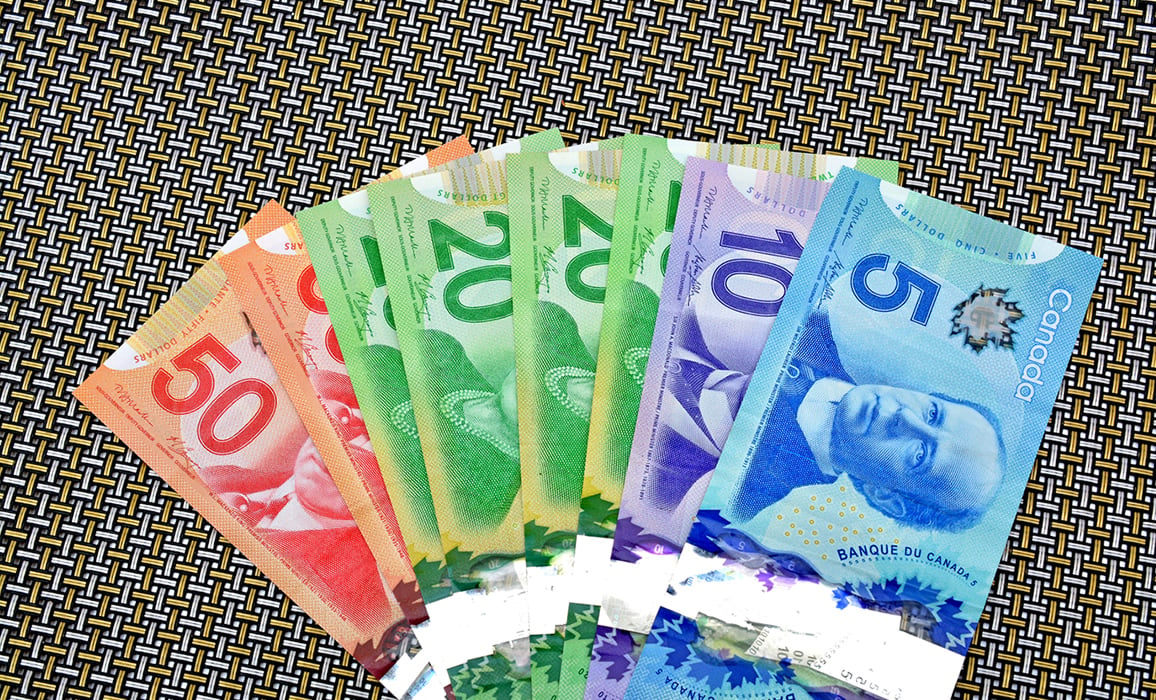
The pound sterling has advanced in impressive fashion against the Canadian dollar over the course of 2015 with a peak being achieved at 2.0934 in August.
The US dollar v Canadian dollar exchange rate (USDCAD) meanwhile saw a maximum of 1.3331 being achieved as CAD weakness has tended to be broadbased in nature.
That said, since the CAD hit its worst levels against both currencies in late August we have witnessed a gradual recovery with the Bank of Canada (BoC) paving out a route higher.
After having cut interest rates in July, the Bank of Canada left them unchanged (at 0.50%) at its meeting of 9 September and, most importantly, let on that there should be no need for further cuts.
The BoC confirmed the domestic scenario outlined in its July Monetary Policy Report – in which it had already lowered its growth and inflation forecasts.
“This is important, as in light of recent developments in China, the BoC could have denounced a further increase in downside risks to economic activity in Canada,” says Luca Mezzomo, Chief Economist at Intesa Sanpaolo.
Ultimately, the interest rate cuts implemented this year are working, and the depreciation of the exchange rate is helping in this direction.
The concerns voiced at the end of May over the appreciation of the Canadian dollar, when the USD/CAD exchange rate had climbed back to just under the 1.20 mark, have therefore dissipated.
Since then, the currency has depreciated by 11% against the US dollar, hitting a low of USD/CAD 1.33 at the end of August.
Latest Pound / Canadian Dollar Exchange Rates
  | Live: 1.8596▲ + 0.31%12 Month Best:1.8915 |
*Your Bank's Retail Rate
| 1.7964 - 1.8038 |
**Independent Specialist | 1.8336 - 1.841 Find out why this is a better rate |
* Bank rates according to latest IMTI data.
** RationalFX dealing desk quotation.
Intesa Sanpaolo point out that, Implicitly, the current levels of around USD/CAD 1.30 are probably considered by the BoC to be balanced in the present phase.
“Therefore, we confirm our expectations that the Canadian dollar will be affected by modest weakness in the short term, and will then recover gradually,” says Mezzomo.
Intesa Sanpaolo have only marginally lowered the CAD’s forecast levels on a 1m-3m horizon, to USD/CAD 1.33-1.35 from 1.30-1.34 previously, to take into account the imminent fed funds rate increase.
Canadian Dollar Higher?
Regardless of the exact timing – FOMC of 17 September, or 28 October, or 16 December – the immediate impact of the reversal on Fed rates should be favourable for the US dollar.
“Against the Canadian dollar, however, this impact could prove both modest and temporary,” says Mezzomo.
Furthermore, based on Intesa Sanpaolo’s estimates of the exchange rate’s sensitivity to interest rates and the price of oil, the expected rise in oil quotations towards the end of the year would reap stronger effects – and of opposite sign – than the Fed’s reversal.
“Specifically, a 25bp fed funds rate hike would weaken the Canadian dollar by around 1.7%, whereas an increase in the price of WTI oil from USD 45 per barrel to 50 would strengthen it around 2.2%. The joint impact would therefore result in a slight strengthening of the CAD, if anything,” says Mezzomo.
Therefore, the bank has left entirely untouched our forecasts for the evolution of the exchange rate from the end of the year onwards, with a gradual expected strengthening of the Canadian currency towards USD/CAD 1.25-1.20 on a 12m-24m horizon.
Economic growth in Canada should benefit from the three supportive factors represented by the markedly accommodative monetary policy, the depreciation of the exchange rate, and the further acceleration of the US economy.
In the July MPR, the BoC expected a return to full capacity in 1H 2017, pushed back from the closing months of 2016.
“This means that the BoC may resume hiking rates at the beginning of 2017, with expectations in this direction starting to build up towards the end of next year,” says Mezzomo.
The Big Risk: Oil Prices Could Fall Further
The problem for the Canadian dollar and others in the commodity currency sector is that commodity prices continue to struggle.
"We have gone from the commodity super cycle to the commodity super sell-off, and this pattern isn’t about to change any time soon," notes analyst David Madden at IG.
The Canadian dollar is sensitive to the oil price in particular; a key element of the Canadian economy.
Investment bank Goldman Sachs thinks that crude oil could drop further, bottoming out as low as $20 a barrel, given that surplus inventories will be much higher than initially anticipated.
The slowing Chinese economy no doubt is playing a role in this imbalance between oil supply and demand.
It is worth pointing out though that it is not just the Canadian dollar that will struggle - the severe drop in commodity prices has trickled down to the cost of living, and the UK inflation level has slipped back to zero.
The threat of deflation will keep mortgage holders happy, but its spells difficult times ahead for members of the BoE who are considering raising interest rates over coming months.
In addition, when you combine falling commodity prices with weakness in the Far East, it is difficult to foresee any interest rate hike from the Fed this week.
Watching the Federal Reserve
For global FX one event dominates the horizon: The Thursday US Federal Reserve meeting.
The market now assigns just a 30% probability to a September rate hike, while professional economists are split almost precisely 50-50.
Therefore the potential for a USD rally on the back of a rate rise has grown significantly.
Economic data has been more than supportive, but some measures of inflation expectations are now flirting with their lowest levels since the financial crisis and expected financial market volatility is now unusually high.
Neither of these are conditions that have historically supported a rising policy rate.
“We still believe the Fed is likely to raise rates before the end of the year. While the Fed is now shying away from explicit forward guidance about the timing of future policy decisions, it should at least leave the door clearly open to tightening later in the year, thus constituting a “hawkish pause” rather than a “dovish pause,” says a note on the matter from RBC Capital Markets.


